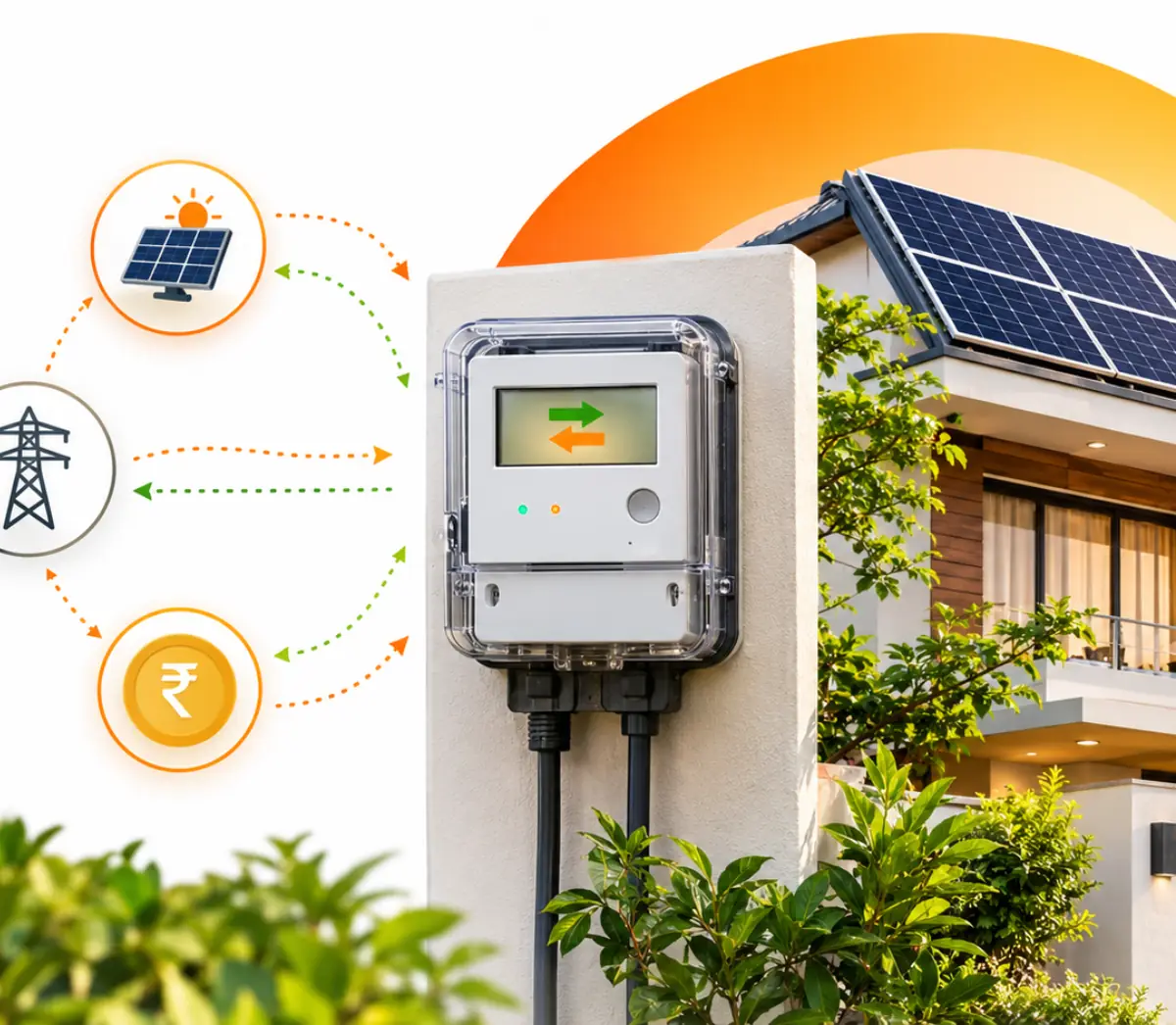
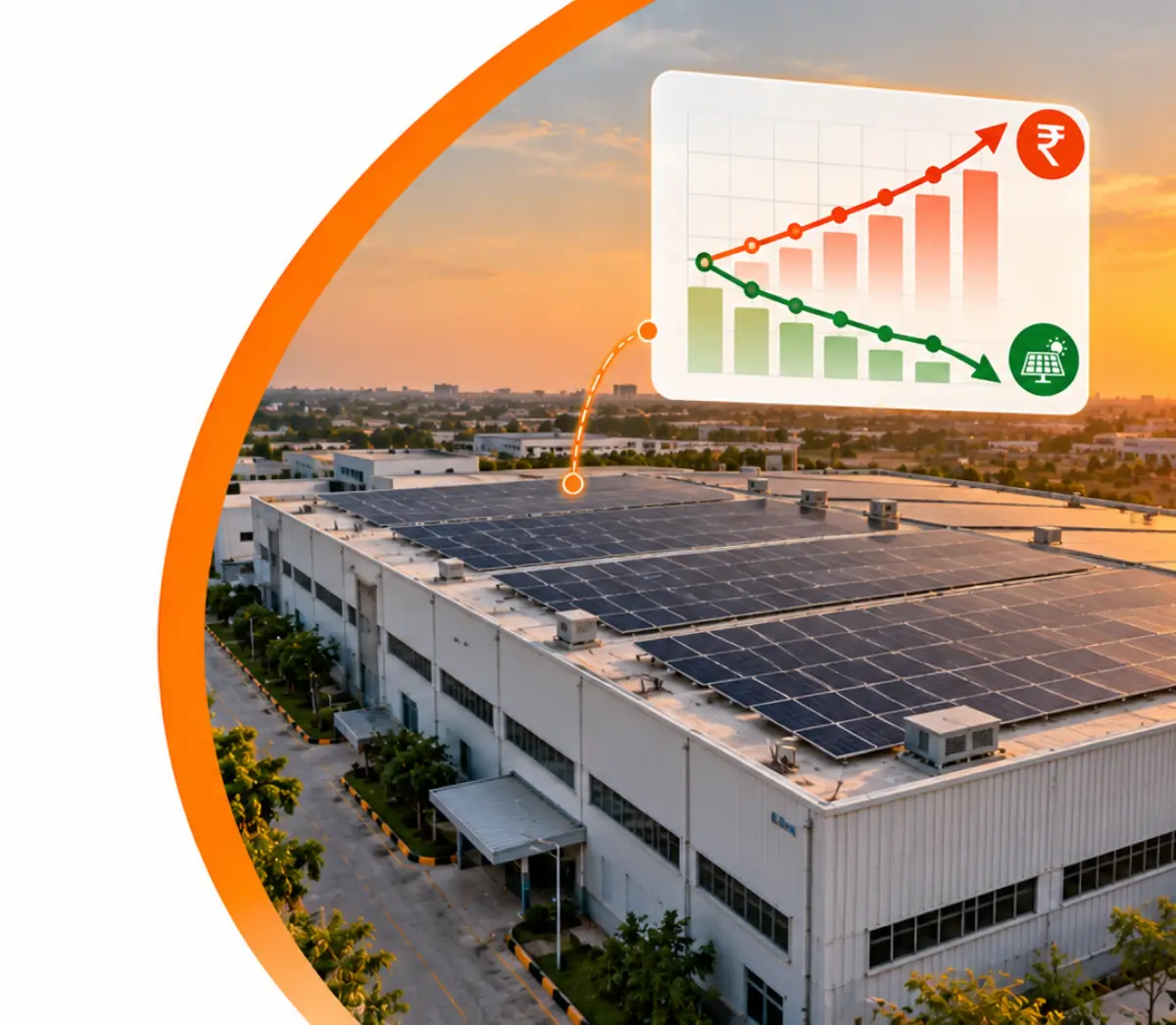


See how commercial solar can reduce grid dependence and electricity costs. Learn how commercial solar installation can deliver long-term business savings.
For most businesses, electricity used to be treated like rent.
The bill arrived. Finance paid for it. Operations moved on.
That approach is becoming harder to justify.
Electricity is a recurring operating expense attached to every unit you manufacture, every hotel room you cool, every warehouse you illuminate and every office floor you operate. When the cost or structure of grid electricity changes, the impact flows directly into operating margins.
This is one reason Indian businesses are increasingly looking at commercial solar as more than an environmental initiative.
A 2026 CEEW report found that commercial and industrial (C&I) consumers directly contracted more than 36 GW of renewable capacity by December 2025, including over 30 GW of solar through open access. Renewables supplied through DISCOMs and direct procurement together accounted for roughly 23% of C&I electricity consumption in 2025. CEEW
The shift is already happening.
The question for a business is increasingly not simply, “Should we go solar?”
It is:
“How much grid exposure can we economically reduce?”
Electricity Cost Is a Business Variable, Not Just a Utility Bill
There is an important nuance behind the phrase “rising grid tariffs.”
Electricity tariffs do not simply increase by the same percentage every year in every state. Regulators can restructure tariffs by changing energy charges, demand or fixed charges, time-of-use structures and other components.
In fact, Gujarat provides a useful current example. For FY 2026–27, GERC announced no change in scheduled tariff rates for consumers of the state-owned DISCOMs and Torrent Power in Ahmedabad, Gandhinagar and Surat. The revised tariffs became applicable from April 1, 2026. Gercin
So businesses should not make investment decisions based on a generic claim that “electricity goes up every year.”
The stronger case for solar is this:
Grid electricity is a recurring, externally determined operating cost. On-site solar allows a business to replace part of that purchased electricity with electricity generated from an asset it controls.
That changes the conversation completely.
Put the Cost Into Numbers
Consider an illustrative commercial facility consuming:
50,000 units/month
If its effective variable electricity cost is ₹10/unit, its annual energy value is:
50,000 × 12 × ₹10 = ₹60 lakh
Now see what happens if the effective cost of those units changes.
| Effective Electricity Cost | Annual Value of 6 Lakh Units |
|---|---|
| ₹8/unit | ₹48 lakh |
| ₹9/unit | ₹54 lakh |
| ₹10/unit | ₹60 lakh |
| ₹11/unit | ₹66 lakh |
| ₹12/unit | ₹72 lakh |
A ₹2/unit difference across 6 lakh annual units represents:
₹12 lakh per year.
That is why electricity procurement deserves management attention.
What a ₹1–₹2/unit Difference Means at Commercial Scale
Illustrative business consuming 6 lakh units annually.
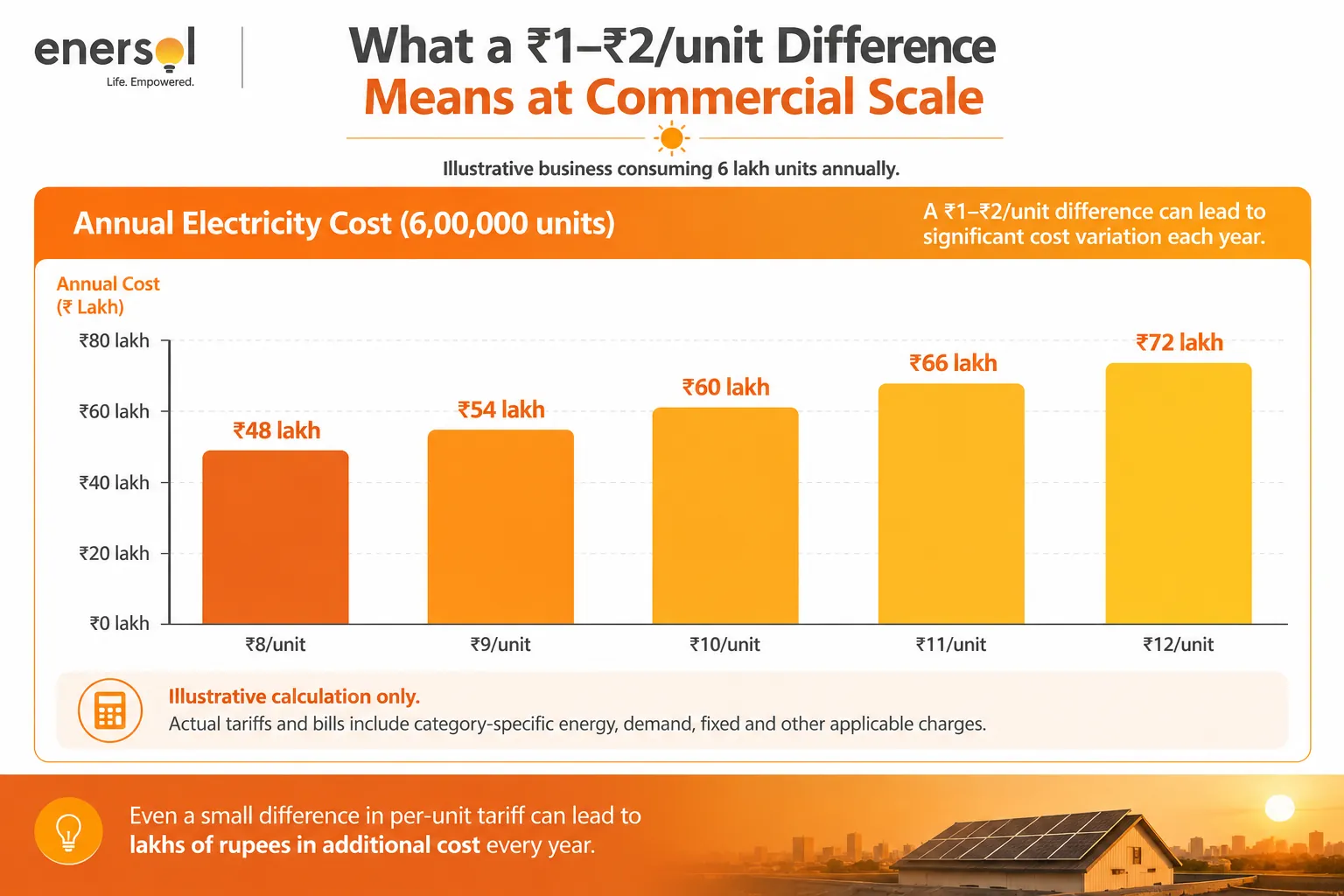
Illustrative calculation only. Actual tariffs and bills include category-specific energy, demand, fixed and other applicable charges.
This is the scale at which a commercial solar panel installation should be evaluated.
Not simply by counting panels.
By measuring how much purchased electricity it can economically replace.
Commercial Solar Works Particularly Well With Daytime Loads
Consider two businesses that each consume 1,000 units a day.
Business A operates primarily between 9 AM and 6 PM.
Business B uses most of its electricity after sunset.
Their annual consumption may look similar, but their rooftop solar economics can be very different.
Why?
Solar generation naturally occurs during the day.
A commercial building operating air conditioning, machinery, refrigeration, pumps, computers or other loads during solar hours may be able to consume a significant portion of generation directly.
That means solar electricity is replacing grid electricity at the time the business needs power.
This is one of the reasons factories, hospitals, hotels, offices, warehouses, malls and educational campuses can be attractive applications for commercial rooftop solar.
Turn a Rising Electricity Bill Into an Operating-Cost Strategy
Get a bill-and-load-profile based commercial solar assessment from Enersol, with the numbers behind every ROI figure.
Don't Ask Only, “How Many kW Can Fit?”
A roof might physically accommodate 500 kW.
That doesn't automatically mean the business should install 500 kW.
The right starting point is the electricity data.
Suppose a business has:
Daytime average load: 300 kW
An installer proposes:
500 kW solar
Before approving it, management should ask:
- What is our 15-minute or hourly load profile?
- How much solar generation will be self-consumed?
- What happens to surplus generation?
- What metering arrangement applies?
- Are weekends different?
- Does production stop seasonally?
- What is our sanctioned/contract demand?
- What annual generation is expected?
The best commercial solar companies should be able to answer those questions before giving you an ROI figure.
A proposal based only on roof area is incomplete.
A Concrete Commercial Solar Example
Consider an illustrative 250 kW commercial rooftop system.
Assume annual generation of:
375,000 units
This uses a simplified assumption of 1,500 units generated annually per installed kW. Actual generation will depend on location, irradiation, shading, system losses, orientation, equipment and operating conditions.
If those solar units replace grid electricity worth ₹9/unit:
375,000 × ₹9 = ₹33.75 lakh/year
At ₹10/unit:
₹37.50 lakh/year
At ₹11/unit:
₹41.25 lakh/year
| Avoided Grid Energy Value | Illustrative Annual Solar Value |
|---|---|
| ₹8/unit | ₹30.00 lakh |
| ₹9/unit | ₹33.75 lakh |
| ₹10/unit | ₹37.50 lakh |
| ₹11/unit | ₹41.25 lakh |
| ₹12/unit | ₹45.00 lakh |
That does not mean the business's electricity bill will fall by exactly these amounts.
Actual savings depend on self-consumption, tariff structure, export settlement, demand charges, downtime and other applicable billing components.
But this is how a useful commercial solar proposal should begin:
units × value of displaced electricity = potential energy-cost impact
Not with vague statements such as “save up to 90%.”
Those figures should not be copied into every proposal.
A two-year payback in one tariff category does not mean your building will achieve the same result.
Your ROI should be calculated from your electricity bills and your proposed system.
Here's a Better ROI Test
Before accepting a commercial solar ROI claim, request these numbers:
1. Proposed solar capacity: ___ kW
2. Expected annual generation: ___ kWh
3. Expected self-consumption: %
4. Applicable electricity value avoided: ₹/unit
5. Expected annual monetary savings: ₹___
6. Total project investment: ₹___
7. O&M assumptions: ₹___
8. Degradation assumption: %
9. Simple payback: ___ years
10. 10-year cumulative savings: ₹
If an installer says:
“ROI: 25%”
but cannot show the numbers behind it, the percentage has limited value.
Rooftop Solar Is Already Scaling Quickly
India installed 7.1 GW of rooftop solar during 2025, according to Mercom India Research, up 123% from 3.2 GW in 2024. Industrial projects accounted for more than 18% of capacity added during the year and commercial installations for over 5%. Gujarat was also among the leading states, accounting for nearly 16% of rooftop additions. Mercomindia.com
That matters because businesses are no longer evaluating experimental technology.
They are evaluating an increasingly mainstream energy-procurement option.
CEEW's 2026 research goes further: India's C&I segment represents nearly half of national electricity demand, and businesses are increasingly using renewable procurement to hedge against grid-tariff exposure, improve long-term energy planning and respond to decarbonisation pressures.
But Solar Does Not Eliminate Every Electricity Charge
This point is critical.
Installing solar does not automatically eliminate:
- fixed charges;
- demand charges;
- minimum charges;
- taxes/duties where applicable;
- grid electricity consumed outside solar hours; or
- other tariff-specific components.
A business should therefore avoid the simplistic calculation:
Current annual electricity bill − solar generation value = future bill
Commercial electricity bills are more complicated.
Your solar partner should analyse the actual tariff structure and determine which components can realistically be reduced.
This is another useful way to separate an experienced C&I solar company from a panel seller.
Where Commercial Solar Battery Storage Fits
Commercial solar battery storage adds another dimension.
A rooftop solar system generates electricity when sunlight is available. A battery can store electricity and make some of that energy available later.
But storage should not be added merely because “battery is the future.”
It needs a defined job.
Possible applications include:
- shifting solar energy to later hours;
- backup for critical loads;
- managing certain peak-demand periods;
- improving renewable-energy utilisation; or
- supporting operational resilience.
CEEW's May 2026 corporate clean-energy report identified falling storage costs as one of the structural changes reshaping C&I renewable procurement, making dispatchable renewable power increasingly competitive. CEEW
Gujarat is also actively developing its regulatory framework: GERC published draft Grid Interactive Battery Energy Storage System Regulations, 2026 in May. Gercin
But the economics must still be calculated.
Ask:
What specific cost or operational problem will this battery solve?
Then size storage against that requirement.
What About Gujarat Businesses?
For Enersol's commercial and industrial audience, Gujarat deserves special attention.
GERC's FY 2026–27 order maintained scheduled tariff rates for state-owned DISCOM and relevant Torrent Power consumers rather than introducing a blanket tariff increase.
At the same time, tariff design continues to evolve.
For example, GERC set an optional Green Power Tariff of ₹0.75/kWh above the normal applicable tariff for consumers opting to meet their requirements through green energy under the relevant framework. Gercin
The lesson for businesses is not “grid prices will definitely rise next year.”
It is:
Your energy cost structure is controlled by regulation, procurement costs and tariff design. Solar gives you a way to bring part of that energy cost under your own asset base.
That's a much stronger investment argument.
Why Enersol's Approach Matters
A commercial solar project should not begin with:
“How many panels do you want?”
It should begin with the business's electricity bill, load profile and site.
For Enersol, that means evaluating the available rooftop or project area, daytime demand, system capacity, expected generation, engineering requirements and the financial case before treating solar as an investment.
For C&I customers, this distinction is particularly important.
A 50 kW system installed on a small commercial property and a multi-hundred-kilowatt system powering a manufacturing operation may use the same basic solar technology but they are completely different energy projects.
The goal is not simply to install solar.
It is to design solar around the economics of the business.
The Five Numbers Every CFO Should Ask For
Before approving a commercial solar panel installation, put these five figures on one page:
| Metric | Your Business |
|---|---|
| Annual electricity consumption | ___ kWh |
| Annual electricity spend | ₹___ |
| Proposed solar generation | ___ kWh |
| Estimated annual solar savings | ₹___ |
| Simple payback | ___ years |
Then add a sixth:
10-year projected net savings: ₹___
Now management can compare solar with other capital investments.
That is much more useful than saying:
“Solar panels have a 25-year life.”
Final Thoughts
Commercial solar is increasingly becoming a cost-management decision rather than simply a sustainability decision.
But the reason is more sophisticated than “electricity tariffs always rise.”
Tariff structures change. Energy charges can rise or fall. Fixed charges can change. Regulations evolve. Business consumption changes.
What remains constant is that grid electricity is a recurring operating expense whose future price a business does not fully control.
A well-designed commercial solar system converts part of that recurring purchase into electricity generated from a long-term business asset.
For some companies, rooftop solar will be enough.
For others, the right answer may combine rooftop generation, open access and eventually commercial solar battery storage.
The starting point should always be the same:
Take your last 12 months of electricity bills. Map when you consume power. Calculate how many grid units solar can realistically replace. Then put a rupee value on those units.
When the numbers work, commercial solar stops looking like an environmental expense.
It starts looking like what it really is: an operating-cost strategy.