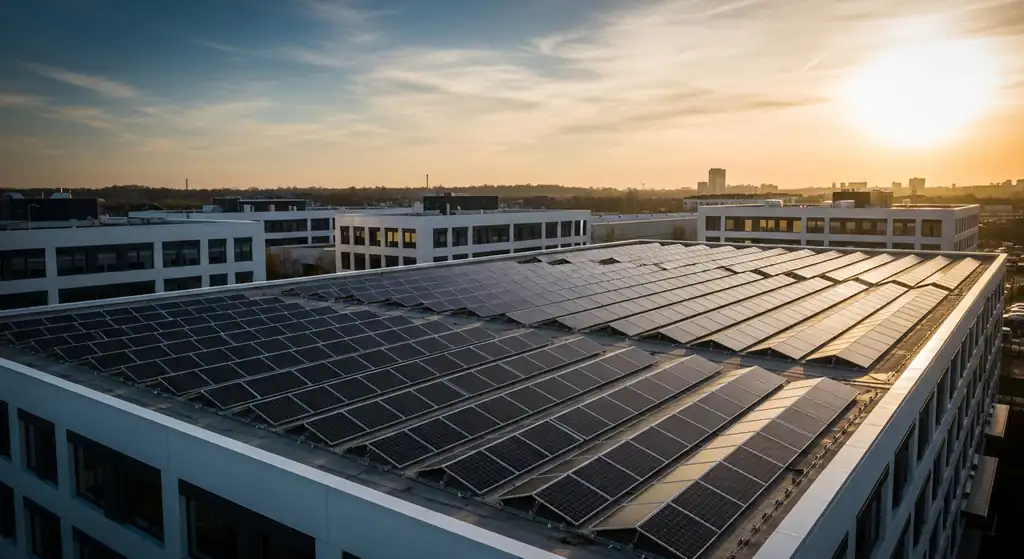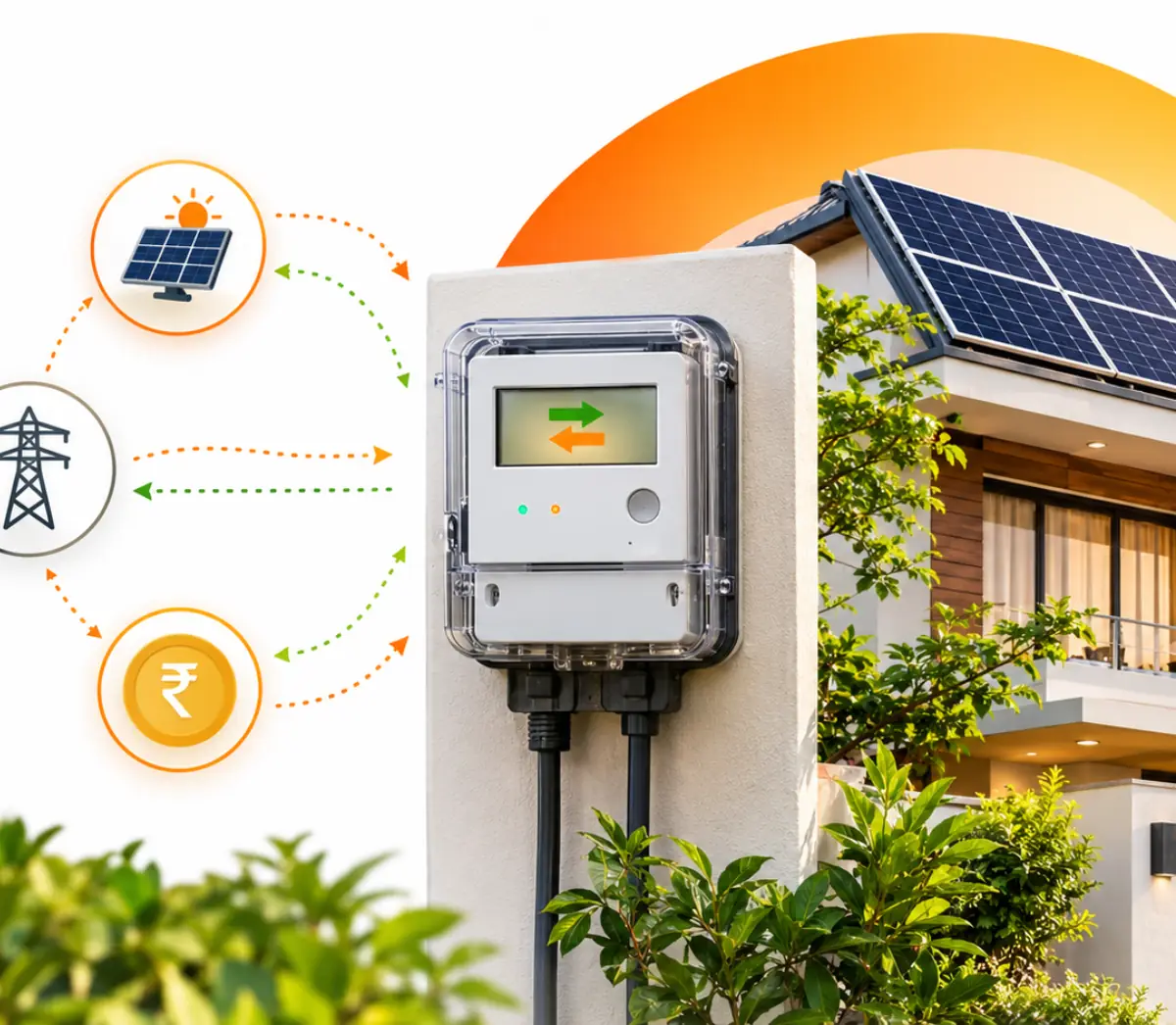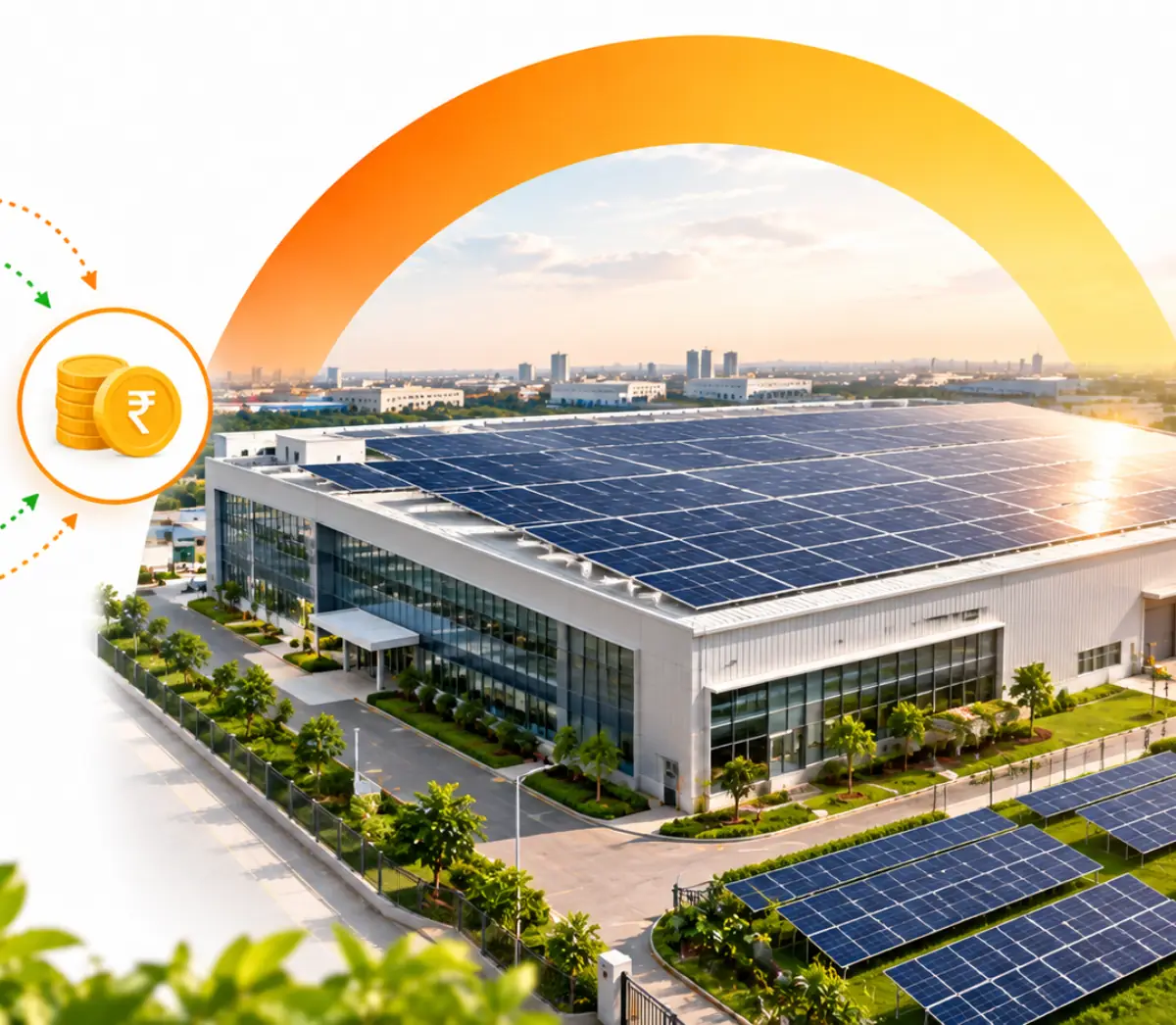

Discover how industrial and commercial solar can deliver 20%+ IRR for businesses. See how rooftop solar cuts electricity costs and turns your factory roof into a savings asset.
When businesses think about investments, they usually consider:
- Expanding production capacity
- Buying new machinery
- Opening new facilities
- Investing in technology
Rarely does the rooftop make the list.
Yet for thousands of businesses across India, the rooftop has quietly become one of the most profitable assets on the balance sheet.
Why?
Because unlike many investments that carry market uncertainty, rooftop solar generates value every single day through reduced electricity costs.
For many industrial and commercial facilities, solar energy for businesses is no longer just a sustainability initiative.
It has become a financial decision capable of delivering attractive returns while reducing operational costs.
In fact, many well-designed industrial solar projects can deliver an effective Internal Rate of Return (IRR) exceeding 20%, depending on electricity tariffs, system utilization, and financing structure.
That is why businesses across manufacturing, warehousing, logistics, pharmaceuticals, engineering, textiles, and commercial real estate are increasingly adopting solar.
Why Businesses Are Looking Beyond Traditional Investments
Business owners understand one simple principle:
Every rupee invested should create long-term value.
The challenge is that many investments come with market volatility, economic uncertainty, long payback periods, or risks that are difficult to control.
Electricity is different.
Every business already depends on it to operate. And every month, that expense returns.
When you install solar, you're not creating a new source of spending. You're reducing a cost your business already incurs every single day.
That's what makes business solar different from most investments.
Instead of waiting for demand to generate returns, your existing electricity consumption starts creating savings from the energy your own system produces.
What Does 20%+ IRR Really Mean?
IRR (Internal Rate of Return) measures the profitability of an investment over time.
Without diving into financial formulas, think of it this way:
If an asset consistently reduces your operating expenses year after year while requiring minimal maintenance, it generates financial returns.
Many commercial and industrial solar projects achieve attractive returns because:
- Electricity tariffs continue to rise
- Solar generation costs remain low
- System life exceeds 25 years
- Maintenance requirements are minimal
For businesses paying ₹8–₹12 per unit of electricity, the economics become especially compelling.
Once a solar system is installed, the Levelized Cost of Electricity (LCOE) the average cost of generating one unit of electricity over the system's lifetime is often significantly lower than grid tariffs. While the exact LCOE depends on factors such as system size, location, financing, and energy generation, it generally remains stable for decades, unlike grid electricity prices that tend to increase over time.
This combination of predictable energy costs and long-term savings is one of the key reasons solar delivers strong financial returns for commercial and industrial businesses.
Why Electricity Costs Matter More Than Ever
For industrial and commercial consumers, electricity is often one of the largest operating expenses.
Over the last decade:
- Grid electricity tariffs have generally increased
- Demand charges continue to impact costs
- Energy budgets remain difficult to predict
Most businesses have little control over these increases.
Solar changes that equation.
Instead of purchasing every unit from the grid, businesses generate a significant portion of their own electricity.
The result is greater control over long-term energy costs.
Turn Your Rooftop Into a 20%+ IRR Asset
Stop leaving savings on the roof. Get a free professional assessment of your business's solar potential and projected returns with Enersol.
How Solar Creates Returns for Businesses
A rooftop solar system generates electricity every day.
That electricity offsets power purchased from the utility.
The savings accumulate month after month.
Example
If a facility generates:
100,000 units annually
And electricity costs:
₹9 per unit
Annual savings may approach:
₹9 lakh per year
Multiply that over 25 years and the numbers become significant.
This is why many CFOs and business owners increasingly view solar as an infrastructure investment rather than an environmental expense.
Industrial Solar vs Traditional Investments
| Investment Type | Potential Return | Risk Level |
|---|---|---|
| Fixed Deposit | Moderate | Low |
| Equity Markets | Variable | Medium to High |
| Commercial Real Estate | Market Dependent | Medium |
| Industrial Solar | Energy Savings Driven | Relatively Predictable |
Unlike many investments, solar generates returns through avoided expenses.
Every unit generated is a unit not purchased from the grid.
That predictability is valuable for businesses.
Real Example: Factory Rooftop Economics
Consider a manufacturing unit with:
Monthly Electricity Cost
₹8 lakh
Annual Electricity Cost
₹96 lakh
The company installs a rooftop solar system sized appropriately for its consumption profile.
Potential Outcome
- Significant reduction in daytime electricity purchases
- Improved cost predictability
- Lower operational expenses
- Long-term savings extending beyond the payback period
Over the lifespan of the system, savings can run into crores.
This is why industrial solar adoption continues to accelerate across India.
Industries Benefiting from Solar
Solar works particularly well for businesses with:
Manufacturing Facilities
- Textiles
- Engineering
- Automotive
- Chemicals
- Pharmaceuticals
Warehouses
Large rooftops make warehouses excellent solar candidates.
Commercial Buildings
- Office complexes
- IT parks
- Commercial centers
Logistics and Distribution Centers
High daytime consumption aligns well with solar generation.
Key Factors That Impact Solar Returns
Not all projects generate identical returns.
Several factors influence performance.
Electricity Tariff
Higher tariffs generally improve project economics.
Roof Availability
More usable roof space enables larger installations.
Daytime Consumption
Businesses consuming power during daylight hours often maximize solar utilization.
System Design Quality
Poor design can reduce generation and financial returns.
Equipment Selection
High-quality panels and inverters improve long-term performance.
Choosing the Right Solar EPC Partner
A solar system is expected to operate for 25 years or more.
Choosing the right partner matters.
When evaluating solar EPC companies in Ahmedabad or elsewhere, ask:
What is the projected annual generation?
Focus on output, not just capacity.
What equipment is being used?
Request:
- Panel datasheets
- Inverter specifications
- Warranty information
Who provides post-installation support?
Maintenance and monitoring are critical for long-term performance.
Do you have industrial project experience?
Industrial solar requires different expertise than residential installations.
An experienced solar company in Ahmedabad should be able to provide references, case studies, and realistic generation estimates.
Is Your Business a Good Candidate for Solar?
Most businesses are good candidates if they have:
✓ High electricity bills
✓ Available rooftop space
✓ Daytime operations
✓ Long-term occupancy plans
✓ Desire to reduce operating expenses
A professional site assessment can determine the exact opportunity.
The Bigger Picture
The conversation around solar has evolved.
Businesses are no longer adopting solar solely to reduce carbon emissions.
They are adopting solar because the economics make sense.
The rooftop is no longer just a structural component of the building.
It is an energy-generating asset.
And unlike many investments, it starts working from the moment sunlight hits it.
Final Thoughts
For businesses evaluating growth opportunities, reducing operating costs is often just as valuable as increasing revenue.
Solar helps achieve both.
It lowers electricity expenses while improving long-term financial performance.
That is why solar energy for businesses continues to gain momentum across India.
Whether you are evaluating industrial solar panels in Ahmedabad, comparing solar EPC companies in Ahmedabad, or exploring business solar panels for a factory, warehouse, or commercial building, one thing is becoming increasingly clear:
The roof may be one of the most underutilized assets your business owns.
And every day it remains unused, potential savings are left behind.
References
- Ministry of New and Renewable Energy (MNRE): https://mnre.gov.in
- National Institute of Solar Energy (NISE): https://nise.res.in
- International Renewable Energy Agency (IRENA): https://www.irena.org
- Solar Energy Corporation of India (SECI): https://www.seci.co.in