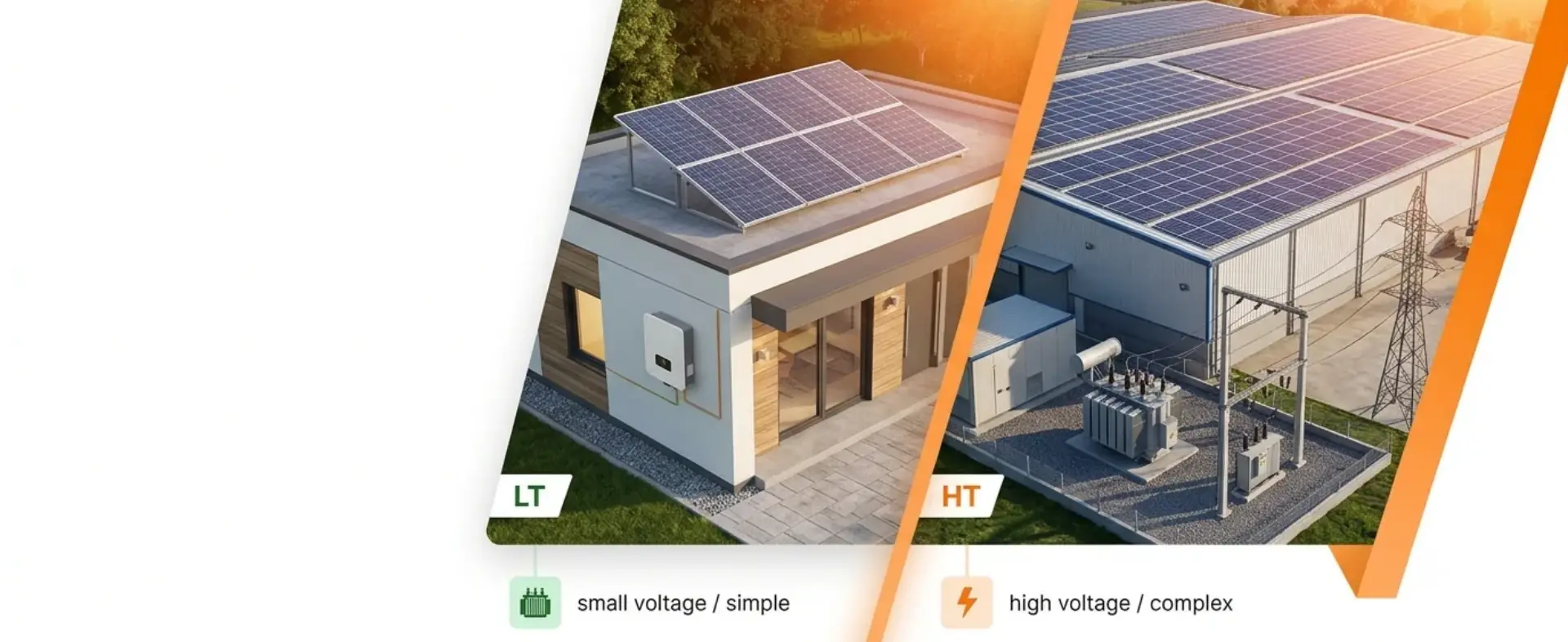
Learn why HT consumers need a different industrial solar design, considering load profiles, demand, transformers, protection and factory power needs.
A factory consumes 20 lakh units of electricity a year.
The management decides to install industrial solar. The roof has enough space, the annual consumption is high, and the financial case looks attractive.
So the first calculation seems simple:
Annual units → required solar capacity → number of panels → installation.
That approach may work as a rough starting point.
For an HT industrial consumer, however, it is nowhere near enough to finalise the system.
An industrial facility taking electricity at high tension operates in a very different electrical and commercial environment from a smaller LT rooftop consumer. The difference is not simply that an HT system is “bigger.”
HT consumers can have substantial maximum demand, contract demand, transformers, protection systems, complex internal distribution, multiple production loads and time-dependent consumption patterns. Their electricity economics can also depend on when power is consumed, not merely how many units appear on the monthly bill.
That changes how industrial solar should be designed.
The real objective isn't:
How many solar panels can we install?
It is:
How should solar integrate with this factory's electrical system, operating load and tariff structure?
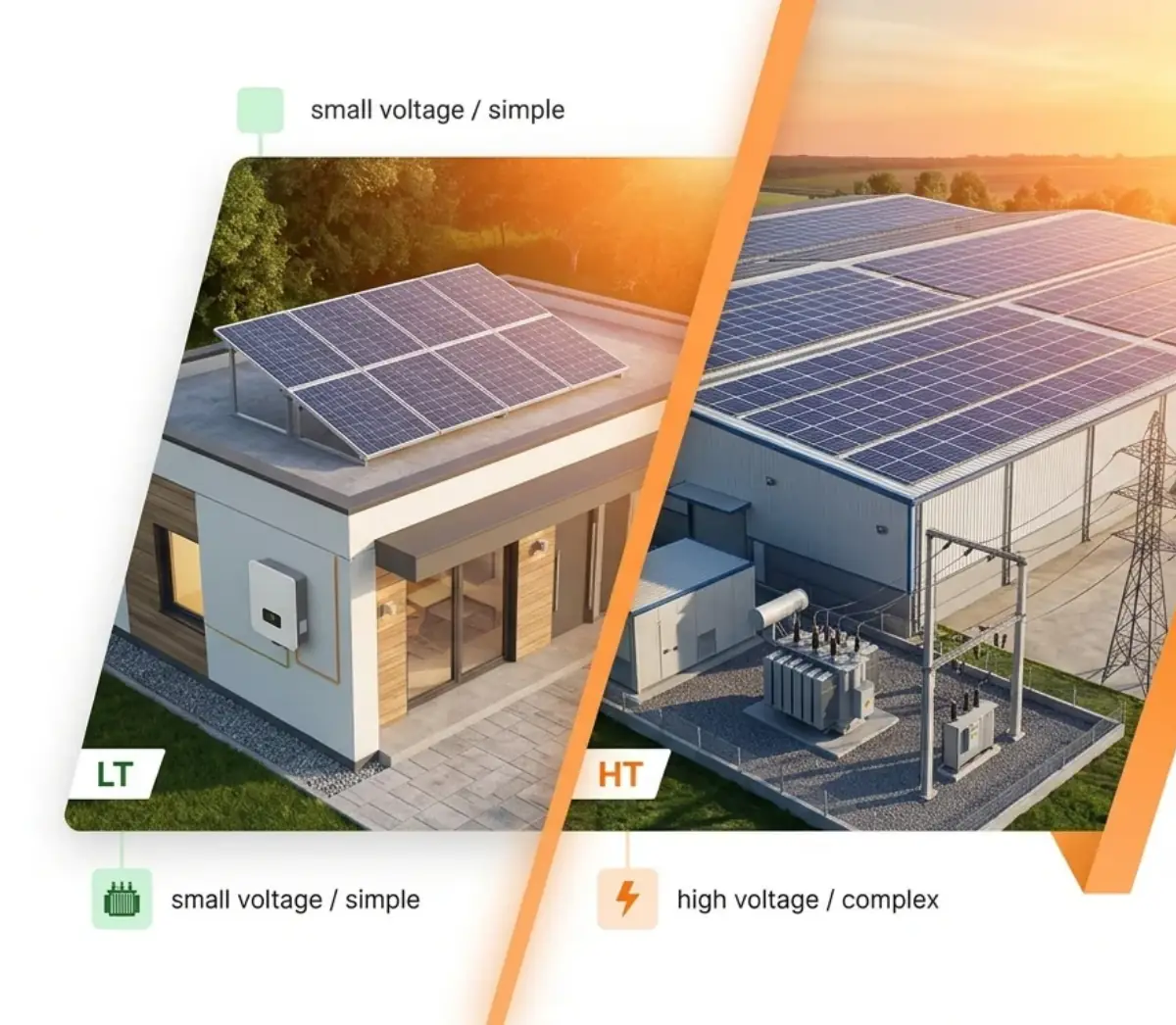
LT vs HT: Why the Difference Matters
LT means Low Tension, while HT means High Tension.
A smaller LT commercial or industrial installation may have relatively straightforward consumption and electrical infrastructure.
An HT industrial facility can look very different.
Think of a large manufacturing plant containing:
- production machinery;
- motors;
- compressors;
- furnaces or process equipment;
- chillers;
- HVAC;
- multiple transformers;
- large motor-starting loads;
- power-factor correction;
- DG backup; and
- multiple internal distribution panels.
The factory may operate one, two or three shifts.
Its load may change dramatically from one production line to another.
So a 1 MW industrial solar installation at such a facility cannot simply be treated as a scaled-up version of a 100 kW LT rooftop plant.
Start With the Load Profile, Not the Electricity Bill
Suppose two factories each consume:
20 lakh units/year
At first glance, they appear to need a similar solar system.
Now look at how they operate.
Factory A
Operating hours: 8 AM–6 PM
Most machinery runs during the day.
Factory B
Operating hours: 24×7
Large loads continue through the evening and night.
Annual consumption is identical.
But the solar opportunity isn't.
Factory A may be able to consume a large portion of solar generation directly.
Factory B may still have excellent daytime solar utilisation, but solar alone cannot address much of its night-time requirement.
This is why an HT project should ideally be modelled using:
15-minute or hourly load data
rather than only monthly electricity bills.
You need to know:
When does the factory consume power?
Not just:
How much power does it consume?
Consider a 24-Hour Factory
Imagine an HT industrial facility with the following simplified load:
| Time | Factory Load |
|---|---|
| 6 AM | 600 kW |
| 9 AM | 900 kW |
| 12 PM | 1,200 kW |
| 3 PM | 1,100 kW |
| 6 PM | 900 kW |
| 9 PM | 750 kW |
| Midnight | 650 kW |
Now suppose its industrial solar system produces:
| Time | Solar Output |
|---|---|
| 6 AM | 0 kW |
| 9 AM | 300 kW |
| 12 PM | 750 kW |
| 3 PM | 600 kW |
| 6 PM | 50 kW |
| 9 PM | 0 kW |
| Midnight | 0 kW |
At noon:
Factory demand = 1,200 kW
Solar generation = 750 kW
Approximate grid requirement = 450 kW
At 9 PM:
Factory demand = 750 kW
Solar generation = 0 kW
Grid requirement = 750 kW
Solar hasn't reduced the factory's electricity requirement.
It has reduced how much of that requirement needs to come from the grid during solar-generation hours.
That distinction is fundamental to HT solar design.
Design Solar Around Your Factory, Not Just Your Roof
Get an engineering-led HT industrial solar assessment covering load curve, demand, transformers, protection and DG integration from Enersol.
Maximum Demand Adds Another Dimension
An HT consumer's electricity economics can involve more than energy consumption.
GERC's FY 2026–27 tariff framework, for example, defines maximum demand based on the average kW/kVA supplied over the applicable demand interval and defines contract demand as the maximum kW/kVA for which supply facilities are provided. Gercin
That means a factory should not evaluate solar only through:
Annual solar generation × ₹/unit
It should also understand what happens to its grid-demand profile.
Consider an illustrative facility.
Without Solar
Daytime factory demand:
1,500 kW
Grid requirement:
1,500 kW
With Solar
Factory demand:
1,500 kW
Solar generation:
700 kW
Grid requirement:
800 kW
During that interval, solar has significantly reduced grid draw.
But now imagine the factory reaches its monthly maximum demand at:
7:30 PM
Factory demand:
1,600 kW
Solar generation:
0 kW
Grid requirement:
1,600 kW
The solar system may save a substantial number of units during the month while having little or no effect on the demand-setting event.
This is exactly why an HT solar proposal should not automatically promise:
“Solar will reduce both your energy and demand charges.”
The load data has to prove it.
Time-of-Use Tariffs Make Timing Even More Important
For HT consumers, the value of electricity can also vary according to time.
This is particularly relevant in Gujarat in 2026.
GERC's FY 2026–27 DGVCL tariff order discusses Time-of-Day charges for consumers with maximum demand above 10 kW and identifies the role of peak periods in encouraging consumers to shift consumption toward periods that better align with available generation. Gercin
Torrent Power Ahmedabad's FY 2026–27 tariff order likewise incorporates revised peak periods and a daytime consumption rebate for applicable HT categories. It records peak periods of 6 AM–8 AM and 5 PM–11 PM, while shifting the earlier night-time rebate toward daytime/solar-hour consumption. Gercin
That creates an important engineering and financial question:
At what times is the factory buying its most valuable grid electricity, and how much of that consumption can solar actually displace?
A unit generated at noon and a unit required at 8 PM may not have identical economic value.
10 Lakh Solar Units Can Have Different Value at Two Factories
Consider two HT factories.
Both install systems generating:
10 lakh units/year
Factory A
Uses almost all generation directly during operating hours.
Factory B
Has lower daytime load and significant consumption outside solar hours.
Even if annual generation is identical, the economic outcome can differ because of:
- self-consumption;
- export treatment;
- time-of-use tariffs;
- banking or settlement rules where applicable;
- demand profile; and
- tariff structure.
So the KPI for solar for industries should not simply be:
Annual Generation = 10,00,000 units
It should include:
How many of those units create useful financial value for this particular factory?
HT Solar Must Integrate With Existing Electrical Infrastructure
For a small rooftop system, the electrical architecture may be relatively straightforward.
A large industrial facility can contain:
11 kV/22 kV or other applicable incoming supply
HT switchgear
transformers
LT panels
multiple distribution boards
DG sets
protection relays
APFC systems
and sometimes multiple buildings or load centres.
The solar plant needs to be designed around that architecture.
Suppose a factory has three transformers:
Transformer A → Production Line 1
Transformer B → Production Line 2
Transformer C → Utilities + HVAC
Where should solar be integrated?
At one LT bus?
Across multiple buses?
At HT level?
The answer depends on system capacity, load distribution, existing equipment ratings, protection philosophy and site configuration.
There is no universal answer.
That's why large solar panels for industrial use cannot be designed properly from a Google Maps roof measurement and one electricity bill.
Transformer Loading Needs to Be Understood
Consider a factory with a:
2,000 kVA transformer
and a large proposed rooftop solar system.
An inexperienced approach might simply connect solar to the nearest available panel.
But engineers need to understand the direction and magnitude of power flows under different operating conditions.
For example:
Factory Running Normally
Factory load: 1,500 kW
Solar: 700 kW
Grid contribution: 800 kW
Straightforward.
Now suppose production stops temporarily:
Factory load: 200 kW
Solar: 700 kW
There is now:
500 kW of surplus generation
Where does it go?
Whether export is permitted and how the system should respond depends on the project's connection and regulatory arrangement.
The electrical design therefore needs to consider not only maximum factory load but also:
minimum daytime load.
That is a major sizing parameter for behind-the-meter industrial solar.
Minimum Load Can Be More Important Than Maximum Load
Imagine an HT factory with:
Peak demand = 2 MW
Management concludes:
“Let's install 2 MW solar.”
But during weekends and production shutdowns, the factory load falls to:
300 kW
On a sunny Sunday, the solar plant could potentially generate far more electricity than the facility is consuming.
If export is limited or economically unattractive, this can result in curtailment.
Now the 2 MW design may not be optimal without:
- export capability;
- zero-export control;
- load management;
- storage; or
- another appropriate energy arrangement.
This is why industrial system sizing should consider:
maximum load
and
minimum daytime load.
Annual consumption alone hides both.
Protection Design Becomes More Important as Capacity Grows
A large industrial solar plant changes the electrical network inside the factory.
Engineers may need to evaluate:
- short-circuit levels;
- relay coordination;
- anti-islanding protection;
- over/under-voltage protection;
- over/under-frequency protection;
- breaker ratings;
- transformer capacity;
- cable sizing;
- earthing;
- surge protection; and
- grid-synchronisation requirements.
For an HT-connected facility, solar should behave correctly not only during normal generation but also during:
grid faults
power failures
DG operation
maintenance
and
system switching.
This is why the inverter is not simply another machine connected to the factory.
It becomes part of the electrical power system.
DG + Solar Requires Special Attention
Many factories have diesel generators for backup.
Now consider what happens during a grid outage.
The grid disappears.
DG starts.
What happens to the solar plant?
Can solar operate with the DG?
Should it disconnect?
If coordinated operation is intended, how will generation and DG loading be controlled?
Suppose:
DG capacity = 1,000 kVA
Factory emergency load = 500 kW
Solar generation = 700 kW
Without the correct control philosophy, the operating condition can become problematic.
The solution depends on the system architecture and equipment.
The important point for factory owners is:
“We already have DG backup” is not the end of the solar discussion.
It is the beginning of another engineering discussion.
Power Quality Matters in an Industrial Environment
Industrial facilities can contain:
- variable-frequency drives;
- welding equipment;
- large motors;
- furnaces;
- rectifiers;
- compressors; and
- other nonlinear or rapidly changing loads.
These can influence harmonics, voltage behaviour and power quality.
Solar inverters also interact with the electrical system.
A large industrial solar installation therefore deserves proper electrical studies where required rather than assuming that a technically compliant inverter will automatically solve every site-level interaction.
This becomes increasingly important as solar penetration rises relative to the facility load.
Solar Sizing Should Follow the Factory's Production Cycle
Consider a textile unit.
Production operates:
24×7 for eight months
but slows substantially during the remaining four months.
Now consider an engineering plant operating:
Monday–Saturday
with almost no Sunday load.
And a food-processing factory with a:
four-month seasonal production peak.
All three could consume the same annual number of units.
Their optimum solar designs could still differ.
For an HT consumer, ask for at least:
12 months of electricity bills
and, where available:
interval load data across representative working and non-working days.
Then overlay expected solar generation.
That is much stronger than sizing from:
Annual units ÷ assumed generation/kW.
Illustrative: Same 1 MW Solar, Different Factory
Consider a 1 MW solar plant expected to generate an illustrative:
15 lakh units/year
Now compare two factories.
Factory A
Directly consumes 95% of solar generation.
Useful direct solar energy:
14.25 lakh units
Factory B
Can directly use only 65%.
Useful direct solar energy:
9.75 lakh units
Difference:
4.5 lakh units/year
At an illustrative electricity value of ₹8/unit:
₹36 lakh/year
Same 1 MW system.
Same solar generation.
Potentially very different direct-consumption value.
The treatment and value of any surplus would depend on the applicable arrangement, so this example intentionally focuses only on direct utilisation.
This is why industrial solar should be designed against the load curve.
Rooftop Solar May Only Be the First Layer for HT Consumers
Large HT consumers often have another challenge:
Their electricity requirement is much larger than their available roof.
Suppose a factory consumes:
1.5 crore units/year
The technically suitable rooftop can support a solar system producing:
25 lakh units/year
Even a perfectly designed rooftop plant addresses only part of the requirement.
That doesn't make rooftop solar a poor investment.
It means the factory's energy strategy may need multiple layers:
Rooftop industrial solar
Captive / group-captive / open-access renewable power
Grid
Storage where economically justified
Mercom reported in July 2026 that open access is expected to remain an important route for large industrial consumers specifically because rooftop solar is constrained by available space. Mercomindia.com
Earlier in 2026, industry participants similarly described rooftop solar as the logical first step before evaluating open access for larger C&I requirements. Mercomindia.com
Industrial Solar Is Growing But Residential Design Logic Shouldn't Follow It Into Factories
India added 6.6 GW of rooftop solar in the first half of 2026, up 131% year over year. Industrial projects accounted for 10% of Q2 additions, while Gujarat was one of the country's leading rooftop markets. Mercomindia.com
This rapid growth is encouraging.
But residential and industrial rooftop projects solve very different problems.
A residential system may primarily be designed around:
household consumption + available roof + applicable net-metering arrangement.
A large HT industrial system can require analysis of:
energy consumption + maximum demand + contract demand + load curve + tariff timing + transformer architecture + protection + DG integration + export conditions + future production.
That is a fundamentally different design exercise.
Where Do Industrial Solar Batteries Fit?
For some HT consumers, industrial solar batteries can add another layer of control.
Suppose a factory produces surplus solar around:
1 PM–3 PM
but experiences a high grid-demand period around:
6 PM–8 PM.
Storage could potentially shift some energy from the first period into the second.
For example:
Surplus solar available:
500 kW for 2 hours
Energy:
1,000 kWh
A suitably designed battery could store part of that energy for later use, subject to efficiency, usable state of charge and system constraints.
But battery sizing must answer two different questions:
How much power is required? — kW/MW
For how long? — kWh/MWh
A battery should not be added simply because the factory is an HT consumer.
Mercom reported in May 2026 that C&I energy procurement is increasingly moving beyond rooftop solar alone toward combinations of renewable energy and battery storage as businesses seek better alignment between clean generation and their actual operating requirements. Mercomindia.com
Storage should solve a measurable problem.
Future Production Expansion Should Be Designed In
Suppose a factory currently operates with:
Maximum demand: 1,500 kVA
Management plans to add a production line next year.
Expected demand:
2,200 kVA
If the solar plant is designed only around today's operating profile, the facility may need major modifications later.
Future planning can affect:
- inverter architecture;
- transformer loading;
- connection point;
- switchgear;
- cable routes;
- rooftop allocation;
- monitoring; and
- potential storage integration.
For a 25-year energy asset, asking about the factory's next five years of production is entirely reasonable.
An HT Solar Proposal Should Show More Than Payback
A serious industrial proposal should ideally include:
| Metric | Project Data |
|---|---|
| Annual electricity consumption | ___ kWh |
| Maximum demand | ___ kW/kVA |
| Contract demand | ___ kW/kVA |
| Minimum daytime load | ___ kW |
| Proposed solar capacity | ___ kW |
| Expected annual generation | ___ kWh |
| Expected direct consumption | ___% |
| Expected surplus/export | ___ kWh |
| Existing transformer capacity | ___ kVA |
| Connection level | ___ kV |
| Annual grid energy displaced | ___ kWh |
| Estimated annual savings | ₹___ |
Then include an hourly or interval-based graph showing:
Factory Load vs Solar Generation vs Grid Import
That single chart can expose design problems that an attractive “3-year payback” headline hides.
Five Questions HT Consumers Should Ask Their Solar EPC Company
1. Have you analysed our interval load data?
If the design uses only monthly bills, ask why.
2. Where exactly will solar connect to our electrical network?
The proposal should identify the connection architecture not just the roof layout.
3. What happens when production load falls below solar generation?
Ask about export, curtailment and control strategy.
4. How does the solar system interact with transformers, protection and DG backup?
These should be engineered, not assumed.
5. What percentage of solar generation will we actually use economically?
Annual generation alone isn't enough.
These questions help distinguish an industrial solar engineering proposal from a scaled-up rooftop quotation.
The Enersol Approach: Design Around the Factory, Not Just the Roof
For Enersol, an HT industrial project should begin with three datasets:
The electricity data.
The electrical system.
The production pattern.
The electricity data tells us consumption, maximum demand and tariff exposure.
The electrical study shows transformers, switchgear, connection points, protection and existing infrastructure.
The production profile tells us when electricity is actually required.
Then comes the roof and solar-resource assessment.
Only after these pieces are brought together should the final solar panels for industrial use be sized and the electrical architecture locked.
For some factories, rooftop solar may address a substantial share of daytime energy.
For larger HT consumers, rooftop solar may become the first layer of a wider strategy involving captive/open-access renewable energy and potentially industrial solar batteries.
The goal isn't simply to install the maximum possible MW.
It is to make every installed MW work intelligently with the factory.
Final Thoughts
HT industrial consumers should not buy solar as though they are buying a larger version of an LT rooftop system.
The difference goes far beyond capacity.
HT facilities can have:
- complex load curves;
- maximum and contract demand;
- time-dependent tariffs;
- multiple transformers;
- large motors and process loads;
- DG systems;
- protection requirements;
- 24-hour production.
That changes both the engineering and the economics.
India's industrial rooftop solar market is growing quickly, with industrial installations representing 10% of Q2 2026 rooftop additions. Mercomindia.com At the same time, C&I consumers are increasingly combining rooftop solar with open access and storage as their energy strategies become more sophisticated. Mercomindia.com
For a factory owner, the actionable takeaway is simple:
Before approving an industrial solar installation, ask for more than a capacity recommendation.
Ask for:
your load curve,
the solar-generation curve,
the proposed electrical connection architecture,
and
the resulting grid-import profile.
If those four pieces are missing, you may know how many panels you're buying.
But you still don't know whether the solar system has been designed for your factory.