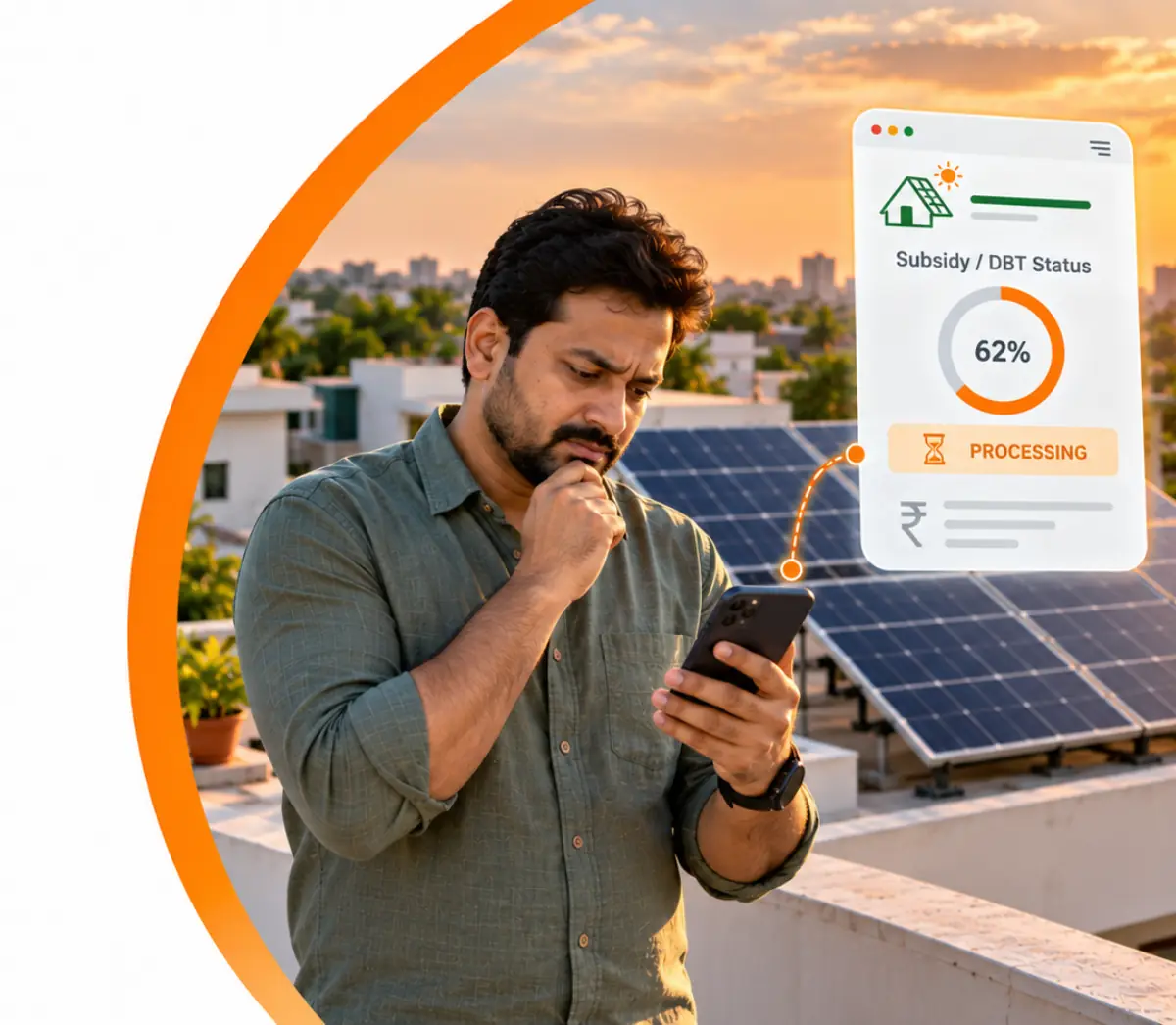
PM Surya Ghar subsidy delayed after rooftop solar installation? Learn how to check your subsidy status, identify pending steps and resolve common issues.
Your rooftop solar system has been installed. The meter is commissioned. The panels are generating electricity.
But the subsidy you expected under PM Surya Ghar: Muft Bijli Yojana has still not reached your bank account.
Naturally, the first thought is: Where is my subsidy stuck?
A delay does not necessarily mean your subsidy has been rejected. The process involves several checkpoints from installation details and DISCOM verification to bank information and the National Portal. If one step is incomplete or contains a mismatch, the application may not move forward as expected.
The useful approach is therefore not to repeatedly ask your installer, “When will the money come?”
Instead, identify which stage is pending and who is responsible for clearing it.
First, Know How Much Subsidy You Are Actually Eligible For
Under PM Surya Ghar, Central Financial Assistance (CFA) for the general residential category is currently structured as:
| Rooftop Solar Capacity | Central Subsidy |
|---|---|
| 1 kW | ₹30,000 |
| 2 kW | ₹60,000 |
| 3 kW | ₹78,000 |
| Above 3 kW | ₹78,000 maximum |
The CFA is ₹30,000 per kWp for the first 2 kWp and ₹18,000 for the next 1 kWp. No additional CFA is provided for capacity beyond 3 kWp under the standard residential category. Special-category states/UTs have different rates. Press Information Bureau
This distinction matters.
If you install a 5 kW residential rooftop solar system, you should not assume the central subsidy increases proportionately to 5 kW.
Under the standard category, the CFA remains capped at ₹78,000.
Before treating a payment as “short,” first confirm the amount you were actually eligible to receive.
The Subsidy Process Doesn't End When Panels Are Installed
One of the biggest misconceptions is that installation automatically triggers payment.
It doesn't.
PM Surya Ghar is a structured process involving the consumer, registered vendor, DISCOM and National Portal. MNRE states that residential consumers with a grid-connected electricity connection can apply through the National Portal. Successful installation and verification by the State DISCOM form part of the process. Press Information Bureau
Think of your subsidy journey as a chain:
Application → Installation → System details → DISCOM inspection/verification → Commissioning → Subsidy/CFA processing → Bank credit
If the application stops at one checkpoint, the next stage cannot simply bypass it.
That gives you the first actionable rule:
Don't ask only how long the subsidy is taking. Ask which stage is currently pending.
“Subsidy in 15 Days” Needs Context
Homeowners may have seen the widely reported claim that PM Surya Ghar subsidies are credited within 15 days.
A government release in March 2025 stated that the scheme's automated application, vendor-selection and subsidy-redemption process enabled subsidies to be credited to applicants' bank accounts within 15 days. Press Information Bureau
But that should not be interpreted as:
Installation today → money guaranteed in your bank exactly 15 days later.
The relevant processing stages first need to be successfully completed.
If DISCOM verification is pending, bank details do not match, commissioning information is incomplete or the portal requires action, simply counting 15 days from panel installation will give you the wrong expectation.
Subsidy Delayed After Installation?
Speak to Enersol about subsidy and net-metering support for your residential rooftop solar project.
Where Can Your Application Actually Get Delayed?
Instead of treating every delay as the same problem, divide it into four categories.
| What You See | Possible Area to Check | Who May Need to Act |
|---|---|---|
| Installation not updated | Project/vendor records | Installer/vendor |
| Inspection pending | DISCOM verification | DISCOM/vendor |
| Commissioning stage incomplete | Meter/system process | DISCOM/vendor |
| CFA/payment not progressing after prior stages | Portal/bank/application data | Portal support/consumer |
This table isn't a substitute for your portal status. It is a troubleshooting framework.
Your actual application status should determine what you do next.
1. Check the National Portal Before Calling Anyone
Start with your application.
Use the official PM Surya Ghar portal and review the current status rather than relying only on WhatsApp updates from the installer.
Record:
- application/reference number;
- registered mobile number;
- current portal status;
- installation completion date;
- inspection/commissioning status;
- subsidy/CFA status; and
- any error or action-required message.
Take screenshots.
Why?
Because “My subsidy hasn't come” is difficult for a support team to investigate.
“Application XXXXX shows DISCOM verification pending since 12 August” is actionable.
2. Check Whether DISCOM Verification Is Pending
The State DISCOM plays an important role in the rooftop solar process.
If installation is complete but inspection, commissioning or another DISCOM-side step is pending, the subsidy process may not yet be ready to progress.
The National Portal maintains official contact details and portal information for DISCOMs across states. Solar Rooftop
For Gujarat consumers, for example, the National Portal lists subsidy-related links and contacts for DGVCL, MGVCL, PGVCL, UGVCL and Torrent Power in Ahmedabad and Surat. Solar Rooftop
So if your portal clearly shows a DISCOM-related pending stage, contacting the relevant DISCOM with your application number is more useful than repeatedly escalating to unrelated departments.
3. Verify Your Bank Details Carefully
If technical and DISCOM stages are complete but payment has not arrived, review the financial information associated with your application.
Check details such as:
Account holder name
Account number
IFSC
Bank/account status
Any portal verification requirement
The key issue is consistency.
A minor mismatch in information can create unnecessary back-and-forth in a process involving digital verification and payment.
Don't send bank details casually over messages to unknown numbers claiming they can “release” your subsidy. Work through the official portal, authorised process and your legitimate vendor/support contacts.
4. Check What Your Solar Installer Has Completed
A good installer should not disappear once the panels are mounted.
Ask for specific answers:
Has installation completion been updated?
Have the required system details been submitted?
Is the DISCOM inspection complete?
Is commissioning complete?
Is any document or action pending from me?
Avoid this conversation:
Homeowner: “Subsidy kab aayegi?”
Installer: “Process mein hai.”
Replace it with:
“My portal currently shows ______. What exact action remains, and who needs to complete it?”
That one question can save days of unproductive follow-ups.
5. If Everything Is Complete, Raise a Formal Grievance
If your portal shows the relevant preceding steps as completed but the subsidy remains unresolved beyond the expected processing period, move from informal follow-up to documented escalation.
The National Rooftop Solar portal provides a formal grievance mechanism.
Its official grievance page currently lists:
Rooftop Solar scheme/subsidy queries:
rts-support[at]gov[dot]in
Portal/technical problems:
itsupport-mnre[at]nic[dot]in Solar Rooftop
You can access the official Rooftop Solar grievance page.
When escalating, include enough information to make the case traceable:
Application/reference number
Consumer number, where relevant
Registered mobile details
DISCOM
Installation/commissioning date
Current portal status
Screenshot of the pending stage
Brief explanation of the issue
Don't send a five-paragraph complaint before giving the support team the application number.
Make the problem easy to locate.
A Simple Escalation Timeline
There is no reason to escalate every application immediately after installation.
Use the process stage instead.
Stage 1 — Installation Complete
Check whether the installation/system information has been correctly updated.
Stage 2 — DISCOM Action Pending
Follow up with the installer and relevant DISCOM.
Stage 3 — Verification/Commissioning Complete
Check whether the portal reflects completion correctly and whether any consumer action remains.
Stage 4 — CFA/Payment Pending
Verify bank/application information.
Stage 5 — Unresolved Despite Completed Requirements
Use the official grievance/support route with documented evidence.
The principle is simple:
Escalate the bottleneck—not everyone involved in the project.
Why These Delays Matter More Now
PM Surya Ghar has scaled extraordinarily quickly.
As of August 12, 2026, the government reported that 51.58 lakh households were benefiting from rooftop solar installations under the scheme. Approximately ₹28,024 crore in subsidy had been transferred to beneficiaries, while cumulative rooftop capacity commissioned under the programme had reached 14.8 GW. Press Information Bureau
That gives homeowners useful context.
This isn't a small pilot programme where only a few thousand applications are being handled.
Millions of households are moving through an ecosystem involving installers, DISCOMs, banking information and government digital systems.
That makes accurate documentation and status tracking particularly important.
A ₹78,000 Delay Can Change Your Solar Cash Flow
Consider a household installing a 3 kW system and qualifying for the standard maximum CFA of ₹78,000.
Assume, purely for illustration:
Gross system investment: ₹2,00,000
Eligible CFA: ₹78,000
Effective investment after CFA: ₹1,22,000
The subsidy represents:
39% of the illustrative ₹2 lakh gross project cost.
That is not a minor amount.
Why Tracking a ₹78,000 Subsidy Matters
Illustrative ₹2,00,000 residential rooftop solar project eligible for ₹78,000 CFA.
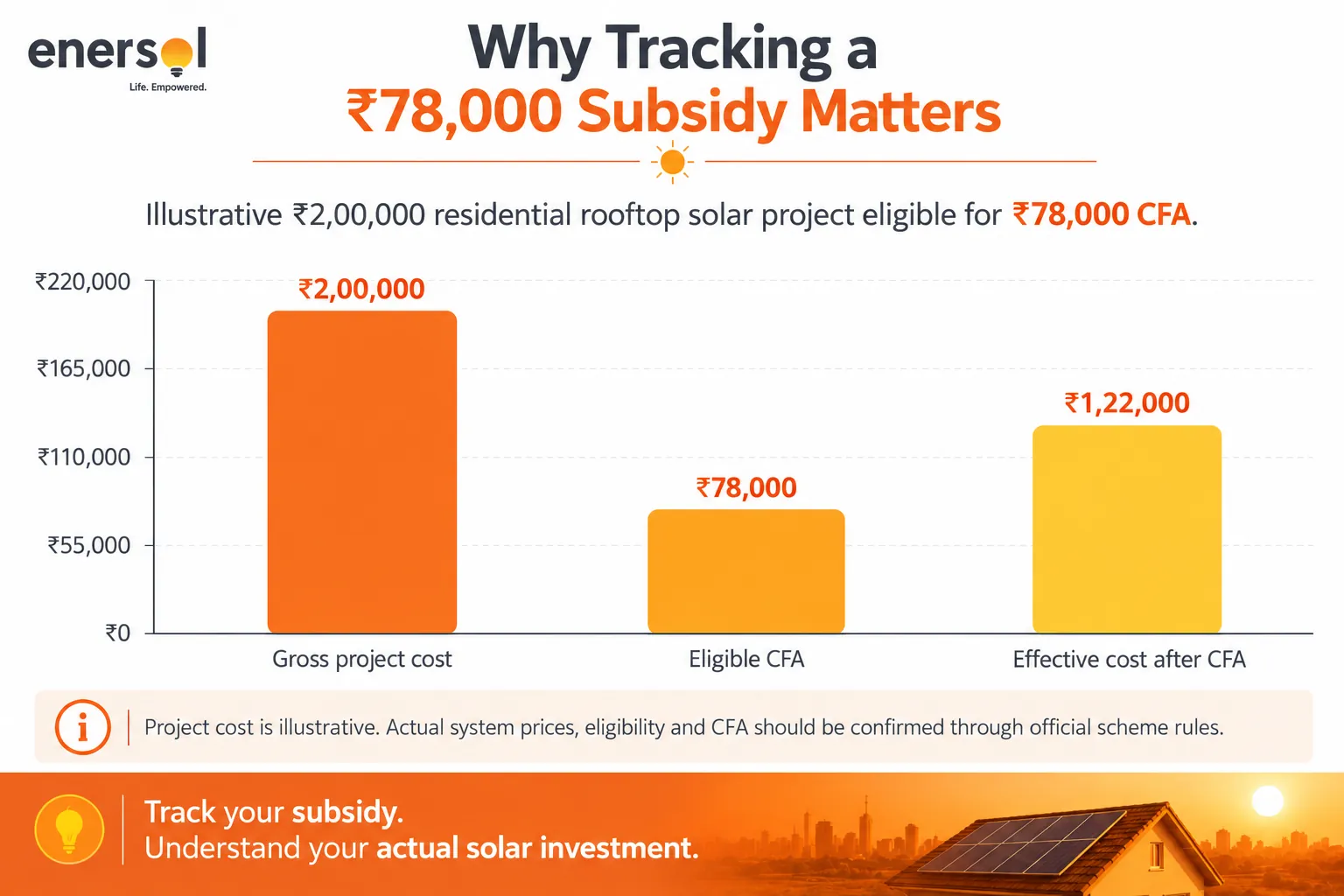
Project cost is illustrative. Actual system prices, eligibility and CFA should be confirmed through official scheme rules.
A delayed subsidy therefore affects household cash flow even though it does not necessarily change the underlying economics of the operating solar system.
That is why subsidy tracking should be treated as part of project completion—not as an afterthought.
Where Enersol Fits In
For homeowners, the easiest subsidy problem is the one prevented before installation.
That means choosing a solar partner that understands not only panels and inverters but also the administrative journey surrounding a residential rooftop project.
Enersol's residential approach includes support for site assessment, system design, installation, commissioning and the applicable subsidy/net-metering process.
The important distinction is that an installer cannot personally control every government or DISCOM processing timeline.
No responsible solar company should promise that it can override the official system.
What a professional partner can do is help ensure that the installation-side documentation is correct, explain the next step, identify where the application is pending and guide the homeowner toward the appropriate official channel when escalation is required.
That is much more valuable than simply promising:
“Don't worry, subsidy aa jayegi.”
Before You Escalate: Use This 7-Point Check
Keep this checklist with your solar documents:
1. Application number: ______
2. Installation status: ______
3. DISCOM inspection status: ______
4. Commissioning status: ______
5. CFA/subsidy status: ______
6. Bank details verified: Yes / No
7. Current pending authority/action: ______
If you can fill in all seven, you already understand your problem far better than someone who only knows that “the subsidy is delayed.”
Final Thoughts
A delayed PM Surya Ghar subsidy can be frustrating, especially when ₹30,000, ₹60,000 or ₹78,000 forms an important part of your rooftop solar budget.
But don't treat every delay as a payment failure.
First determine whether the application is waiting for installation information, DISCOM verification, commissioning, bank validation or final subsidy processing.
Then contact the party responsible for that specific stage.
If the required stages are complete and the issue remains unresolved, use the government's formal grievance route and provide your application details and supporting screenshots.
PM Surya Ghar has already moved tens of thousands of crores of subsidy to Indian households. Press Information Bureau The system is operating at enormous scale.
For an individual homeowner, the most useful strategy is much simpler:
Track the status. Identify the bottleneck. Document it. Escalate through the right channel.
That turns into “Where is my subsidy?” into a question someone can actually answer.