

Learn how to choose a reliable solar installer, compare rooftop solar quotes, check system quality, warranties and avoid cheap, low-quality installations.
A homeowner receives two quotations for a 5 kW rooftop solar system.
Installer A: ₹2.60 lakh
Installer B: ₹2.90 lakh
At first glance, saving ₹30,000 looks like the obvious decision.
But what exactly is ₹30,000 buying or removing?
Perhaps one proposal includes a properly engineered mounting structure, documented generation estimate, quality protection devices, correct cable sizing, waterproofing attention and after-sales support. The other may simply list “5 kW solar system” with a panel and inverter brand.
Both are technically 5 kW systems.
They may not deliver the same value over the next 20–25 years.
Choosing a reliable solar installer therefore requires more than finding the lowest price per kW. You are selecting the company responsible for designing, installing and supporting an electrical generation system on your roof for decades.
Here is what homeowners should actually compare.
Start With the System Design, Not the Panel Brand
A quotation containing a premium solar panel does not automatically mean the complete installation is premium.
Solar performance depends on the entire system:
- module selection;
- inverter sizing;
- mounting structure;
- panel orientation and layout;
- DC and AC cabling;
- earthing;
- electrical protection;
- shading;
- waterproofing;
- workmanship; and
- commissioning.
This is why a professional rooftop solar installation should start with a site assessment.
At Enersol, for example, the residential process begins with a site assessment and energy audit, followed by customised system design, approvals, installation and commissioning rather than treating every roof as a standard package.
The question to ask an installer is not simply:
“Which panel are you using?”
Ask:
“Why have you designed this system this way for my roof?”
The quality of that answer tells you much more.
1. Ask for Expected Annual Generation in Units
This is one of the easiest ways to make quotations more meaningful.
Suppose two installers offer you 5 kW.
Proposal A
5 kW system
Expected annual generation: 7,500 units
Proposal B
5 kW system
No generation estimate provided
How do you compare them?
You can't do it properly.
Installed capacity tells you the system's rated size. It does not tell you what the installer expects it to produce on your roof.
A generation estimate should consider site-specific factors such as orientation, shading and layout.
Once you have an annual-generation estimate, you can translate differences into money.
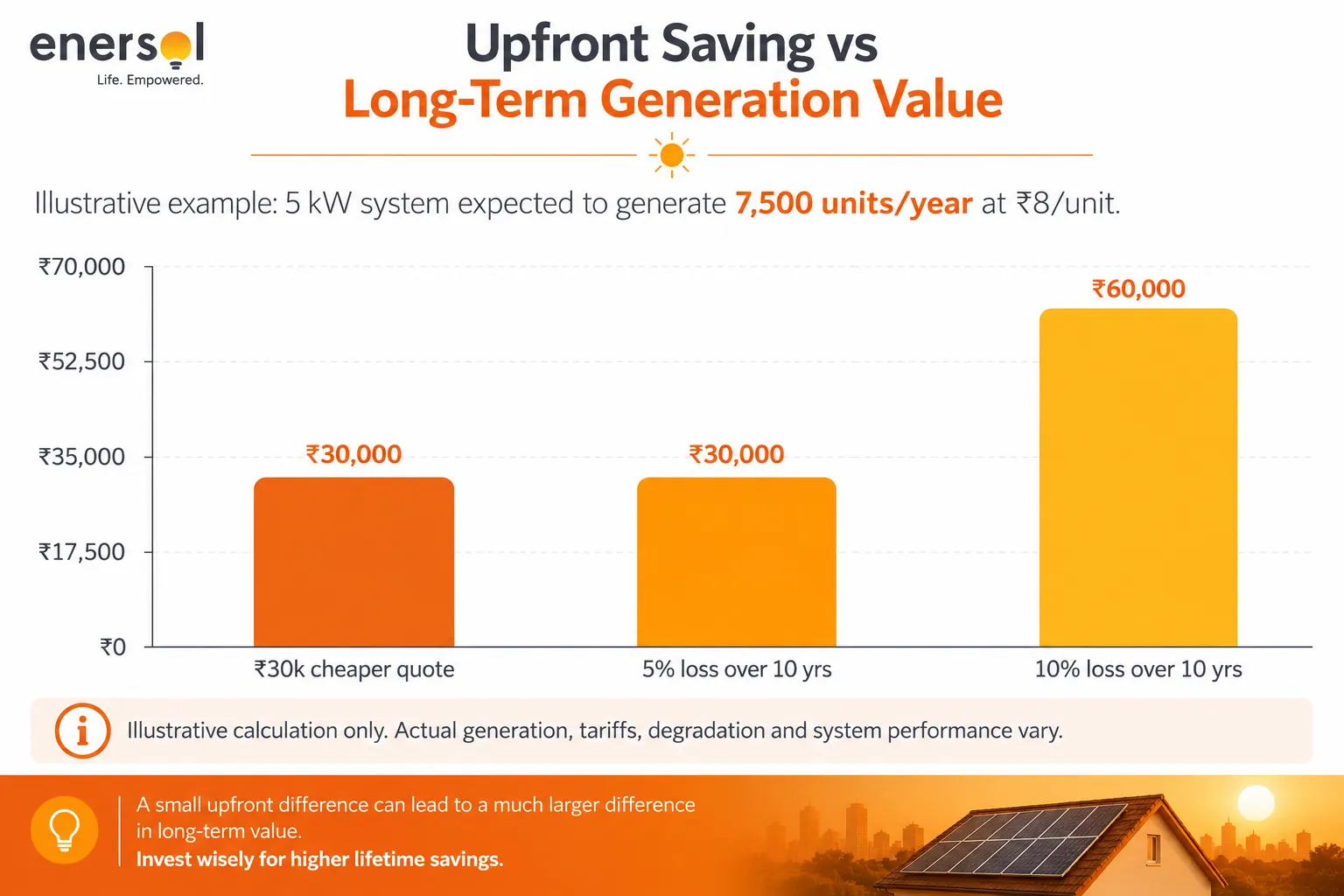
Assume your electricity is worth an illustrative ₹8/unit.
If expected generation is 7,500 units:
7,500 × ₹8 = ₹60,000/year
Now suppose poorer design or execution resulted in 10% lower annual generation:
750 units × ₹8 = ₹6,000/year
Over 10 years, without considering tariff escalation or degradation:
₹60,000
That puts a ₹20,000–₹30,000 quotation difference into perspective.
Upfront Saving vs Long-Term Generation Value
Illustrative example: 5 kW system expected to generate 7,500 units/year at ₹8/unit.
This does not mean an expensive installer is automatically better.
It means price without engineering context is an incomplete comparison.
2. Compare the Mounting Structure Properly
Solar panels may carry long performance warranties, but those modules depend on the structure beneath them.
Ask what the mounting structure is made from.
Then go further:
What material specification is being used?
How has wind loading been considered?
How will loads be distributed across the roof?
How are fasteners and connections specified?
Will drainage remain unobstructed?
A vague phrase such as “heavy-duty structure” is not an engineering specification.
This matters because a rooftop system has to withstand years of wind, rain, temperature changes and maintenance activity not just look straight on installation day.
Comparing Rooftop Solar Quotes?
Talk to Enersol for a site-specific design, a documented generation estimate and clear warranty and support terms.
3. Look at What You Can't See From the Street
Many shortcuts in cheap solar installations aren't obvious in photographs.
Look beneath the panels.
Electrical quality matters.
Check whether the proposal clearly identifies:
- DC cables and connectors
- AC/DC protection
- Earthing
- Surge protection
- Isolators
- Cable routing and management
Loose connections and inappropriate components can create resistance, heating, downtime and safety issues.
Consider the electrical relationship:
Heat generated at a resistive connection = Current² × Resistance
For an illustrative high-resistance connection of 0.1 Ω:
| Current | Heat |
|---|---|
| 5 A | 2.5 W |
| 10 A | 10 W |
| 15 A | 22.5 W |
| 20 A | 40 W |
Double the current and resistive heating becomes four times higher when resistance remains constant.
That's why workmanship hidden behind the panels deserves as much attention as the module logo printed on top.
4. Check Whether the Installer Is Eligible for the Applicable Government Process
For homeowners seeking government support, vendor eligibility matters.
MNRE states that residential consumers using the relevant rooftop programme route receive CFA after successful installation by empanelled vendors and verification by the State DISCOM. Ministry of New and Renewable Energy
So don't rely on someone saying:
“We handle subsidy.”
Verify their status through the applicable official process.
Enersol states that it is MNRE-empanelled, ISO 9001:2015 certified and GEDA registered, and its residential offering includes assistance with subsidy and net-metering procedures. Enersol
For homeowners in Gujarat, local experience can also matter because DISCOM procedures, documentation and net-metering requirements form part of getting a grid-connected project commissioned successfully.
5. Don't Compare “Warranty” as One Number
A salesperson may say:
“25-year warranty.”
Ask: 25 years on what?
A rooftop system can have several separate warranty/support elements:
Panel product warranty
Panel performance warranty
Inverter warranty
Mounting/component warranties
Installation/workmanship terms
Service and maintenance support
They are not interchangeable.
Ask for warranty documentation and understand who actually honours each warranty, the installer or manufacturer.
A 25-year module-performance warranty is far less reassuring if the company that installed the system becomes unreachable when an inverter or electrical issue appears in year four.
6. Ask What Happens After Installation
Solar is relatively low-maintenance, but it isn't a “install today, forget forever” asset.
Panels can become dirty.
Trees grow.
Connections can need inspection.
Inverters can report faults.
Monitoring can reveal abnormal generation.
A strong solar partner should be able to explain the process after commissioning.
Enersol, for example, says its model includes dedicated operations and maintenance support through Enersol Care+, alongside monitoring and long-term after-sales service. Its published process covers the project from consultation and design through commissioning rather than ending at panel installation.
Ask every installer:
Who do I call after installation?
Then ask:
What happens if a generation falls unexpectedly?
If there is no clear answer before payment, support may not become clearer five years later.
7. Look for Evidence of Actual Execution
Marketing brochures are easy to create.
Completed solar projects are harder to fake.
Ask to see:
completed residential projects;
projects similar to your roof type;
installation photographs;
customer references or verified reviews; and
examples of long-term projects still operating.
Enersol reports operating since 2012, with 500+ projects and more than 150 MW of installed capacity, covering residential, commercial, industrial and ground-mounted installations. Its published portfolio also provides examples across project categories. Enersol
Track record does not eliminate the need to inspect your individual proposal.
But it gives you something concrete to verify.
8. Cheap Solar Can Become Expensive Without Completely Failing
This is an important point.
A low-quality system does not necessarily collapse or stop generating electricity.
It may simply underperform.
Suppose:
Expected generation: 7,500 units/year
Actual generation: 6,750 units/year
Difference:
750 units/year
At ₹8/unit:
₹6,000/year
Over ten years:
₹60,000
The system is still generating electricity every day.
Nothing looks catastrophically wrong.
Yet the homeowner has lost significant energy value.
This is why the lowest solar installation cost should never be considered independently of expected generation, equipment, engineering and support.
9. Use This 10-Point Checklist Before Paying an Advance
For each quotation, ask the installer to provide:
| What to Check | What You Want to See |
|---|---|
| System capacity | kW clearly specified |
| Annual generation | Estimated kWh/year |
| Solar modules | Make, model and rating |
| Inverter | Make, model and capacity |
| Structure | Material and design specification |
| Electrical system | Cable and protection details |
| Shading | Site-specific assessment |
| Warranty | Separate component terms |
| Government process | Applicable vendor eligibility/support |
| After-sales | Named service process |
If Installer A is ₹25,000 cheaper but cannot provide half this information, you are no longer comparing two equivalent systems.
You're comparing two different levels of engineering and accountability.
What Should a Good Residential Solar Proposal Actually Tell You?
For a homeowner, a useful proposal should connect three things:
Your electricity consumption → Your rooftop → Your expected generation
For example:
Annual household consumption: 7,200 units
Proposed capacity: 5 kW
Illustrative expected generation: 7,500 units/year
Now you can ask meaningful questions.
Does the generation estimate account for shading?
Will future electricity consumption increase?
How much usable roof space remains?
How will net metering affect the final bill?
Could the system be expanded later?
That's a real solar conversation.
“5 kW premium system at best price” isn't.
Where Enersol Fits Into This Approach
The purpose of choosing Enersol should not simply be that it sells solar panels.
The stronger reason is the end-to-end engineering approach.
Enersol's published residential process covers site assessment and energy audit, customised design, approvals, professional installation, commissioning, net-metering/subsidy assistance and ongoing maintenance. The company says it uses ALMM-listed panels and trusted inverters and designs residential systems around the individual home's roof and electricity consumption. Enersol
Its broader track record since 2012, 500+ projects and 150+ MW installed also gives prospective customers completed work they can evaluate rather than relying solely on sales claims. Enersol
That is ultimately what homeowners should expect from any reliable installer:
Not just equipment. Accountability for the complete system.
Final Thoughts
When comparing rooftop solar quotations, don't ask only:
“How much does 5 kW cost?”
Ask:
“What exactly am I getting for that price, and how has it been engineered to perform on my roof?”
A reliable solar installer should be willing to explain the system capacity, expected annual generation, layout, shading assumptions, structure, inverter, electrical protection, warranties, government approvals and after-sales support.
Then put the quotations next to each other.
The cheapest proposal may still turn out to be the right one.
But choose it because the engineering and value stand up to comparison not simply because the number at the bottom of the quotation is smaller.
A rooftop solar system can operate for decades.
Spend more time comparing what will remain on your roof for 25 years than what you'll save on installation day.
For Enersol's residential approach and site-survey process, see Enersol Residential Solar.