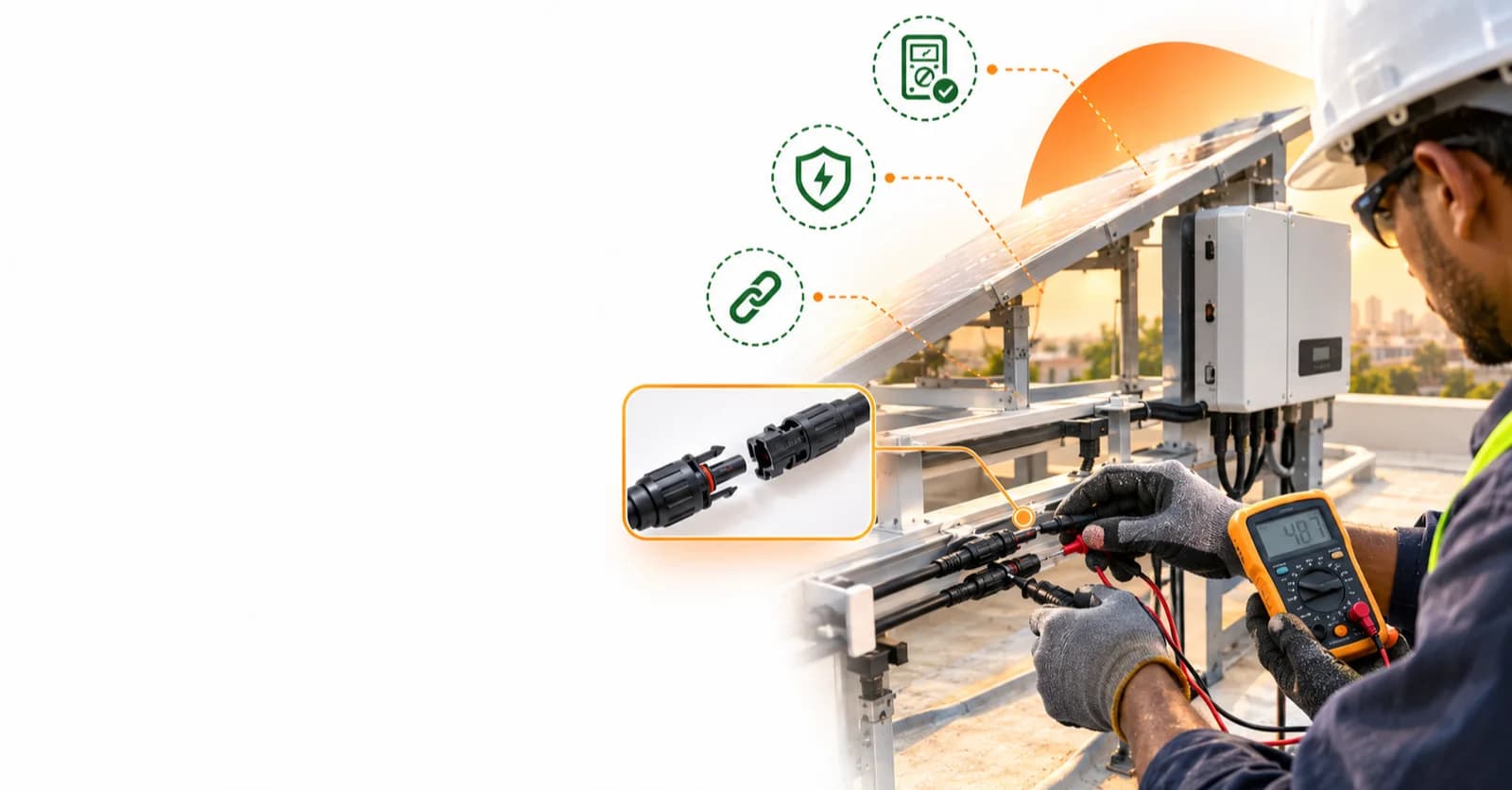
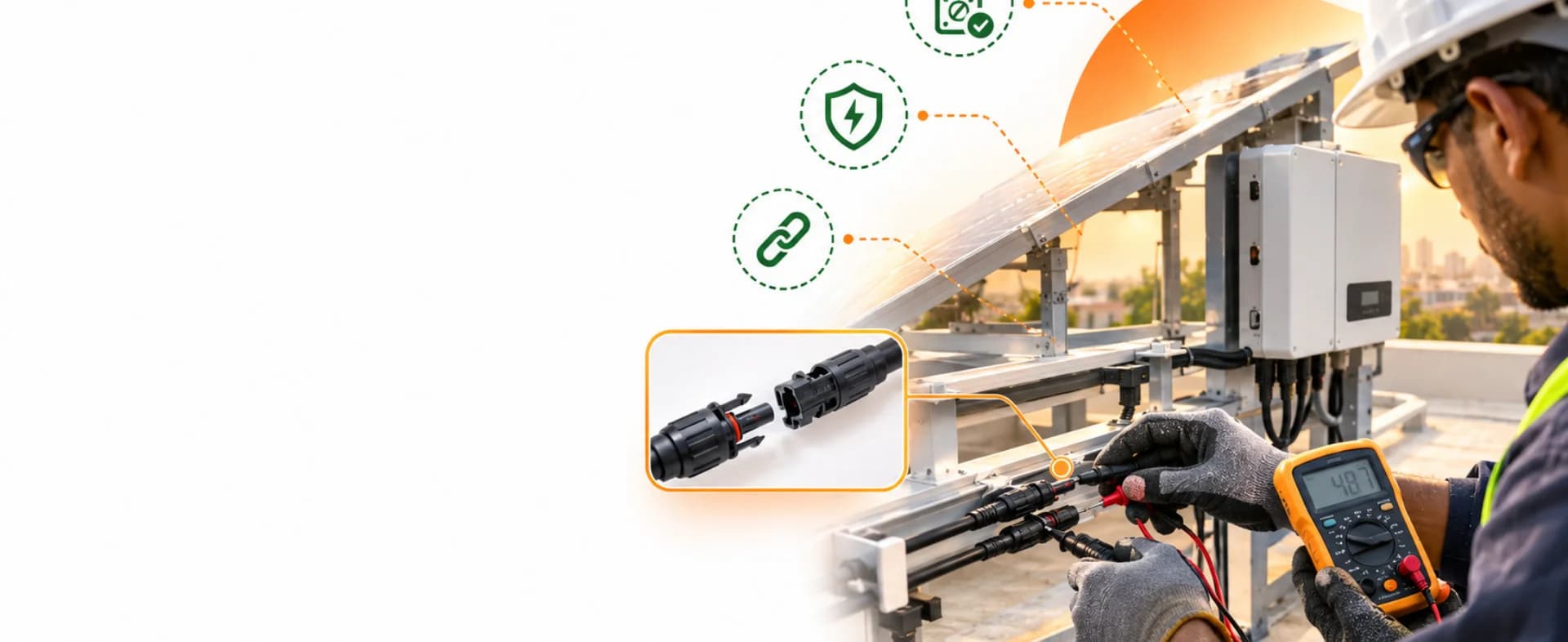
Learn why solar wiring and electrical safety are essential for every solar power inverter for home and household solar inverter installation.
Quick Summary
A home solar system may have premium panels and a high-quality solar power inverter for home, but its performance still depends on dozens of electrical connections working correctly.
A loose or high-resistance connection doesn't simply “lose electricity.” Electrical resistance generates heat.
A basic relationship explains why:
Power converted to heat = Current² × Resistance
For example, if a connection carrying 15 amps develops resistance of 0.1 ohm, the heat generated at that point would theoretically be:
15² × 0.1 = 22.5 watts
At 20 amps, the same resistance would produce:
20² × 0.1 = 40 watts
That heat is concentrated at a small electrical connection not spread across the whole solar system.
This is why solar wiring and electrical safety deserve the same attention as panels and inverters. Correct cable sizing, compatible connectors, proper termination, protection devices, earthing, cable management and commissioning tests all contribute to safe, reliable long-term performance.
Your Solar Panels Generate Power. The Wiring Has to Carry Every Unit.
When homeowners buy solar, the visible components usually get the most attention.
Which panels?
Which inverter?
How much generation?
What warranty?
What will the system cost?
But consider the path electricity takes:
Solar Panels → DC Cables → Connectors → Protection → Solar Inverter → AC Protection → Home Electrical System
Every unit generated by the array has to travel through this electrical network.
Your household solar inverter may perform perfectly, but if a critical connection before or after it is poorly installed, the overall system can still experience problems.
The hidden electrical work therefore deserves much more attention than it usually receives.
Why Can a Loose Connection Become Hot?
This is where homeowners can understand the problem with actual numbers.
Every electrical connection has some resistance.
A correctly made connection is designed to keep that resistance very low.
A loose, contaminated, damaged or poorly terminated connection can develop higher resistance.
The relationship between electrical current, resistance and heating can be represented by:
P = I²R
Where:
P = power converted into heat I = current R = resistance
The important part is I².
Heat increases with the square of current.
Is Your Home Ready for Solar?
Reduce your monthly electricity bills and build long-term energy independence with Enersol's rooftop solar solutions.
Put Electrical Heating Into Numbers
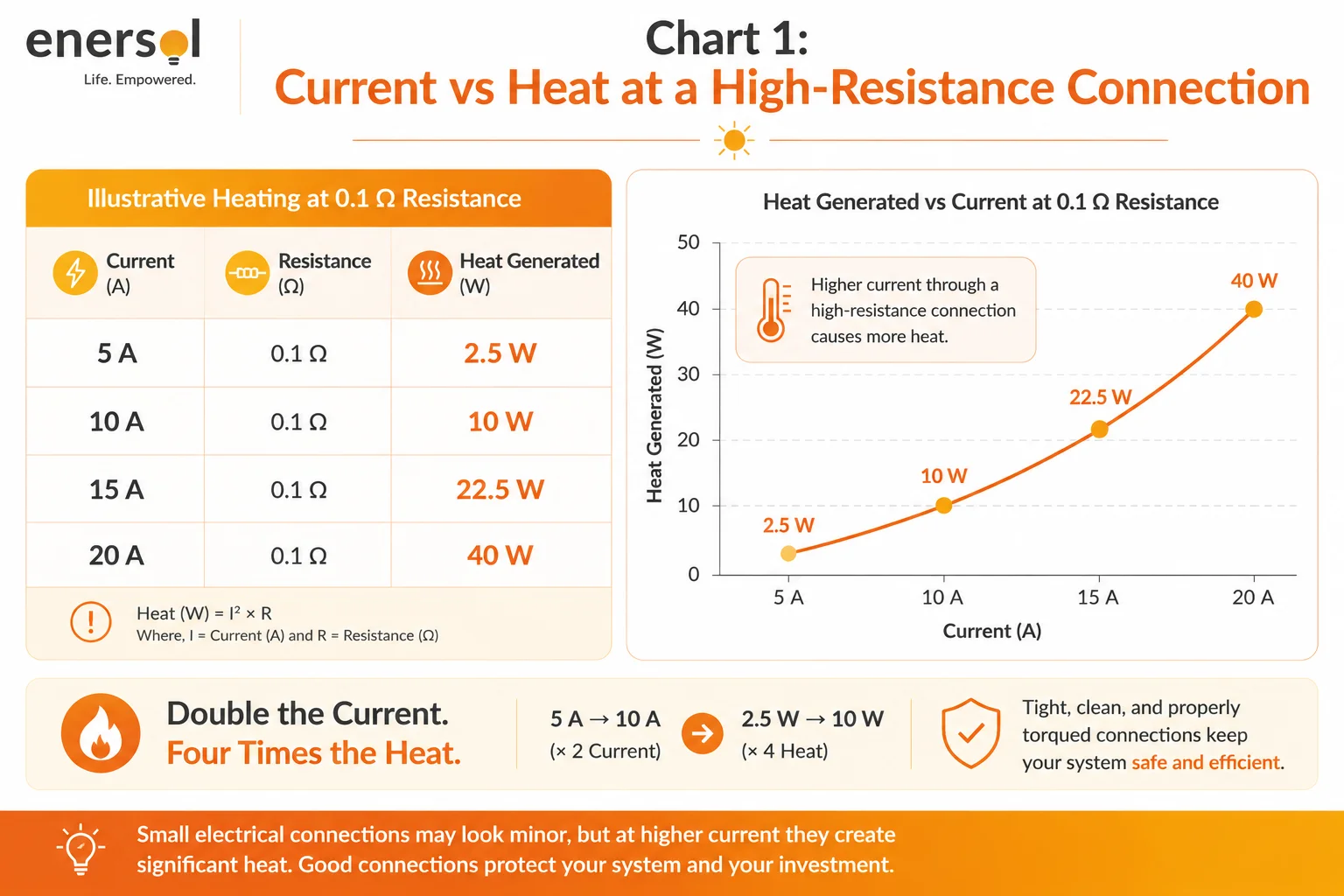
Consider a simplified example where an abnormal connection has 0.1 Ω resistance.
| Current Through Connection | Illustrative Heat at Connection |
|---|---|
| 5 A | 2.5 W |
| 10 A | 10 W |
| 15 A | 22.5 W |
| 20 A | 40 W |
This is a theoretical illustration, not a prediction of what will happen in a particular solar system.
But it demonstrates something important.
When current increases from 10 A to 20 A, it doubles.
The heat generated at the same resistance increases from 10 W to 40 W four times as much.
That's why connection quality matters.
Chart 1: Current vs Heat at a High-Resistance Connection
This is an excellent graph for the blog.
Illustrative Heating at 0.1 Ω Resistance
5 A → 2.5 W
10 A → 10 W
15 A → 22.5 W
20 A → 40 W
Graphic takeaway:
“Double the Current. Four Times the Heat.”
This gives homeowners a concrete understanding of why a small electrical connection should never be treated as a minor installation detail.
Loose Wiring Doesn't Always Fail Immediately
One reason wiring problems are difficult for homeowners to recognize is that the solar system may continue operating.
A connection doesn't necessarily go from perfect to failed overnight.
Problems may develop gradually because of factors such as:
- Poor cable termination
- Improper connector assembly
- Incorrect installation
- Moisture ingress
- Corrosion
- Thermal cycling
- Mechanical stress
- Inappropriate cable routing
Possible symptoms include:
- Unexpected reduction in generation
- Frequent inverter warnings
- Intermittent shutdowns
- Visible connector or cable damage
- Unusual heating
- Discoloration near electrical connections
These symptoms should be investigated professionally.
Homeowners should not open live solar electrical equipment or attempt to tighten DC connections themselves.
What Can a Small Electrical Loss Mean Financially?
Now consider system performance.
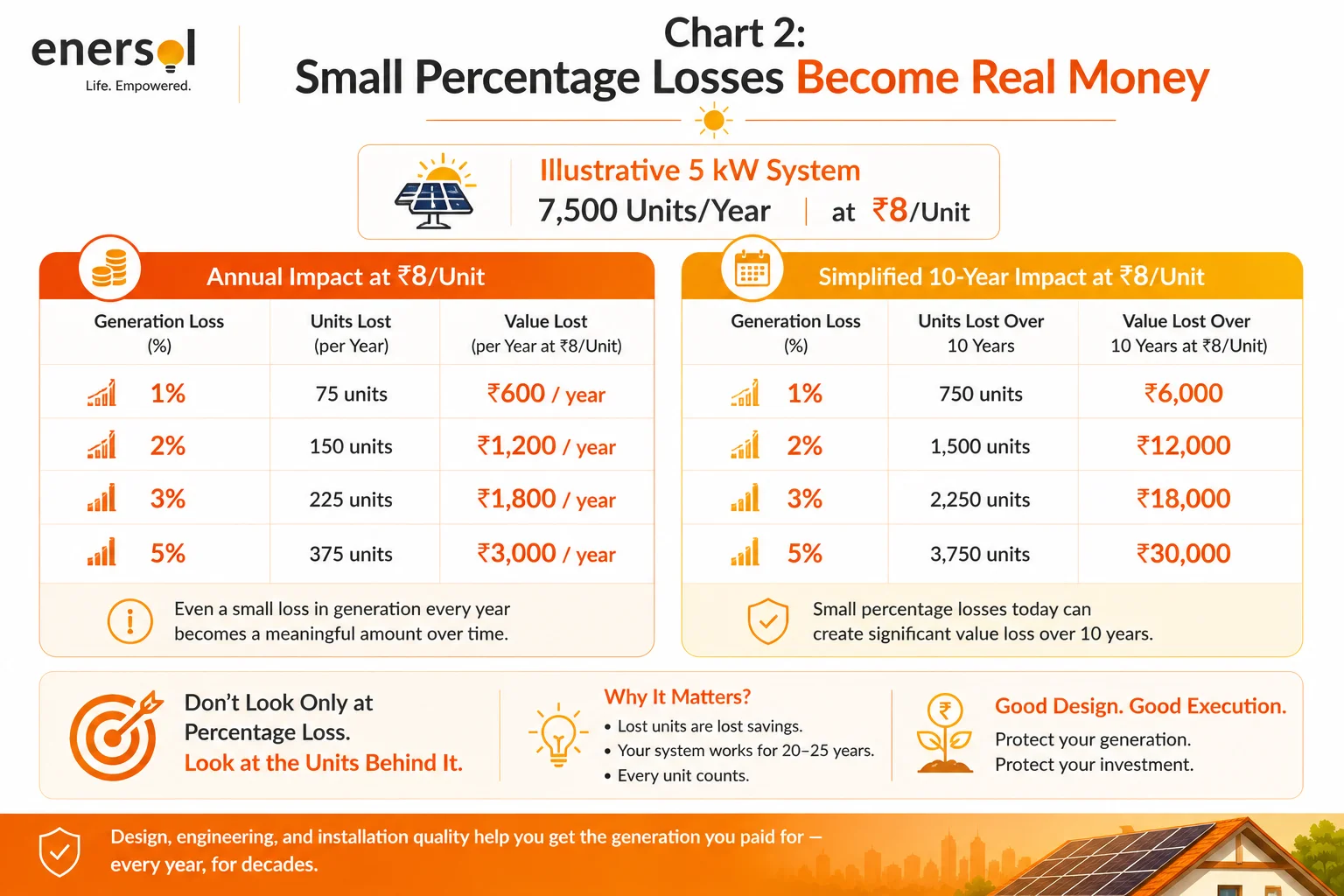
Suppose an illustrative 5 kW home solar system is expected to generate:
7,500 units annually
Assume an electricity value of:
₹8 per unit
Annual energy value:
7,500 × ₹8 = ₹60,000
Now look at the financial effect if electrical and system issues contributed to different levels of avoidable generation loss.
| Illustrative Loss | Units Lost/Year | Value at ₹8/unit |
|---|---|---|
| 1% | 75 units | ₹600 |
| 2% | 150 units | ₹1,200 |
| 3% | 225 units | ₹1,800 |
| 5% | 375 units | ₹3,000 |
These figures do not imply that loose wiring always causes a particular percentage loss. Actual losses depend on the fault and system conditions.
The example simply converts percentages into something homeowners can understand:
units and rupees.
What Does That Look Like Over 10 Years?
If an avoidable performance issue averaged 3% in our simplified example:
225 units/year × ₹8 = ₹1,800/year
Over 10 years:
₹18,000
At 5%:
₹3,000/year
Over 10 years:
₹30,000
Again, this excludes tariff changes, module degradation, downtime, maintenance and other factors.
More importantly, the concern with poor electrical connections isn't limited to lost generation.
Electrical safety and equipment reliability matter too.
Chart 2: Small Percentage Losses Become Real Money
Illustrative 5 kW System — 7,500 Units/Year at ₹8/Unit
1% loss → ₹600/year
2% loss → ₹1,200/year
3% loss → ₹1,800/year
5% loss → ₹3,000/year
A second version can show the simplified 10-year impact:
1% → ₹6,000
2% → ₹12,000
3% → ₹18,000
5% → ₹30,000
Headline:
“Don't Look Only at Percentage Loss. Look at the Units Behind It.”
Your Inverter Depends on Everything Connected to It
A solar power inverter for home converts DC electricity from the panels into AC electricity used by the household.
But the inverter doesn't operate independently.
It depends on:
- Correct DC input
- Proper cable sizing
- Reliable connectors
- Appropriate protection
- Stable AC connections
- Earthing
- Correct system design
Whether you use a household solar inverter, house solar inverter, or another home power inverter for solar, reliable electrical infrastructure around the inverter is essential.
A premium inverter cannot compensate for poor workmanship elsewhere in the system.
Not All Solar Cables Are the Same
One of the most actionable questions homeowners can ask is:
“What cable are you actually installing?”
Don't accept only:
“Solar cable.”
Depending on the system, the installer should be able to provide relevant information such as:
- Cable type
- Conductor material
- Cross-sectional area in mm²
- Voltage rating
- Temperature rating
- UV/weather suitability
- Applicable certification/standard
- Cable route
- Maximum expected current
- Design voltage drop
Cable sizing should be calculated for the specific circuit rather than chosen because “we always use this size.”
Why Cable Size Matters
Every cable has electrical resistance.
As cable length increases, resistance increases.
As conductor cross-sectional area increases, resistance generally decreases.
This means a long cable run may require a different design from a short one.
An installer should therefore consider:
Current + Voltage + Cable Length + Conductor Size + Installation Conditions + Acceptable Voltage Drop
not cable size in isolation.
For example, two homes may both have 5 kW solar systems but require different cable routes and lengths.
Using the same cable design automatically for both projects isn't necessarily good engineering.
Ask for Voltage-Drop Calculations
Voltage drop is one useful design parameter homeowners rarely ask about.
Instead of accepting:
“Cable size is sufficient.”
Ask:
“What voltage drop has been calculated for this cable run?”
The acceptable value should be determined according to applicable electrical standards and system design requirements.
This gives you a measurable engineering parameter instead of an adjective.
Connectors Are Small Components With a Big Responsibility
Solar arrays use connectors to create reliable electrical connections between modules and cables.
These connectors spend years exposed to:
- Heat
- UV radiation
- Moisture
- Temperature changes
- Dust
- Outdoor conditions
Compatibility and correct assembly matter.
Homeowners can ask:
- What connector system is being used?
- Are mating connectors compatible?
- Are manufacturer-recommended assembly procedures followed?
- Are connectors properly secured and protected from unnecessary strain?
- Are connections positioned to minimize water exposure?
A connector may cost very little compared with the overall solar system.
But every amp passing through it still depends on that connection being made correctly.
Cable Management Isn't Just About Looking Neat
Professional cable routing isn't simply cosmetic.
Cables should not be left:
- Hanging loosely
- Resting unnecessarily on roof surfaces
- Exposed to sharp edges
- Under mechanical tension
- Positioned where water can accumulate around connections
- Routed where future maintenance could damage them
Good cable management helps protect electrical components throughout the life of the installation.
Electrical Protection Is Part of the Solar System
A professionally designed installation may include different protection components depending on system architecture and applicable requirements.
These can include:
- DC isolation/protection
- AC isolation/protection
- Surge protection
- Earthing
- Appropriate overcurrent protection
- Electrical enclosures
- Cable management
- Safety labeling
These aren't decorative accessories around your solar power inverter for home.
They are part of the electrical design.
What Should Be Tested Before Commissioning?
A quality solar installation shouldn't move directly from:
“Last panel installed” → “System ON.”
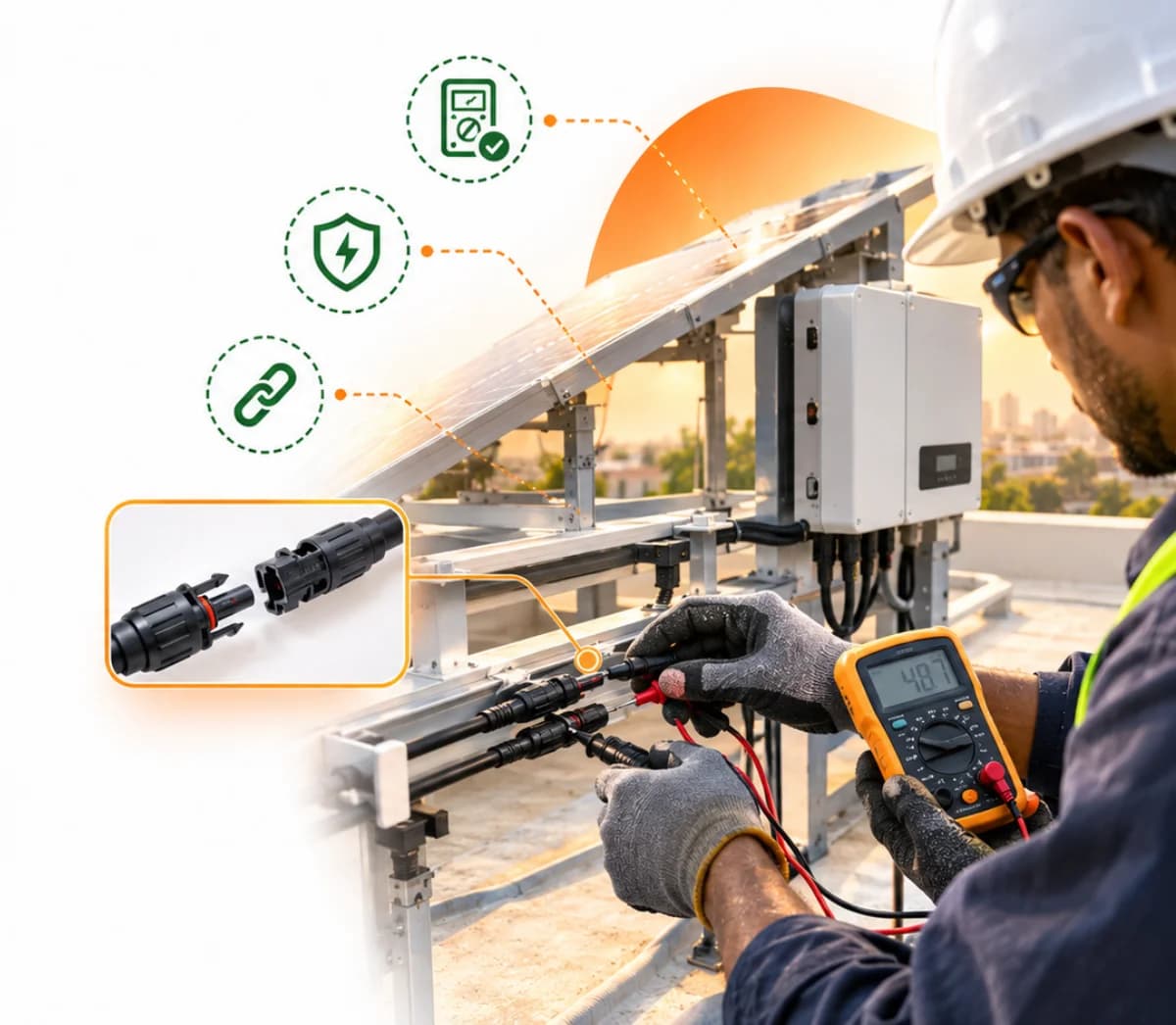
Before commissioning, relevant electrical checks should be completed by qualified personnel.
Depending on the system and applicable requirements, these may include:
Polarity Verification
Confirms positive and negative connections are correctly arranged.
Voltage Checks
Verifies electrical values are consistent with the design.
Continuity Checks
Helps verify circuit integrity where applicable.
Insulation Testing
Helps assess electrical insulation integrity where required.
Earthing Verification
Confirms the earthing system has been installed and tested according to applicable requirements.
Inverter Commissioning
Checks inverter startup, configuration, operation and monitoring.
Protection Verification
Confirms required protective devices are installed and functioning as intended.
The exact test procedure and acceptance values should follow applicable standards, manufacturer requirements and system design.
Ask for Numbers, Not “Testing Done”
This is where the client feedback becomes especially useful.
Homeowners shouldn't necessarily receive a highly technical engineering dossier, but they should be able to ask:
What tests were performed?
What were the measured results?
Were they within the applicable acceptance limits?
Who performed the tests?
Is there a commissioning report?
Instead of:
Testing: Done ✓
A better handover process records measurable commissioning information.
What Should Your Solar Handover File Contain?
After installation, ask your installer for documentation such as:
- System capacity
- Module and inverter details
- Basic electrical layout/single-line information where provided
- Cable specifications
- Protection-device details
- Earthing information
- Commissioning/test records
- Inverter configuration and monitoring access
- Warranty documents
- Emergency/service contact details
This gives the homeowner a useful baseline for future maintenance.
Professional vs Poor Electrical Installation
| Professional Installation | Poor Electrical Installation |
|---|---|
| Cable sizing based on design | Generic cable selection |
| Properly terminated connections | Loose/inconsistent terminations |
| Compatible connectors | Unverified connector compatibility |
| Protected cable routes | Loose or exposed cabling |
| Electrical protection documented | Protection details unclear |
| Commissioning measurements recorded | “System working” treated as testing |
| Organized inverter area | Difficult-to-service installation |
| Handover documentation | Limited documentation |
Don't Compare Solar Quotations Only by Panel Brand
Imagine two installers offer the same:
5 kW capacity
Same panel brand
Same inverter brand
The quotations may still represent very different installations.
Ask both installers to fill in this comparison:
| Electrical Parameter | Installer A | Installer B |
|---|---|---|
| DC cable specification | ? | ? |
| AC cable specification | ? | ? |
| Cable sizing basis | ? | ? |
| Connector specification | ? | ? |
| DC protection | ? | ? |
| AC protection | ? | ? |
| Surge protection | ? | ? |
| Earthing design | ? | ? |
| Commissioning tests | ? | ? |
| Test report provided | ? | ? |
| Monitoring configured | ? | ? |
Those question marks tell you more about installation quality than a glossy brochure.
Signs Your Solar System May Need Professional Inspection
Contact a qualified solar professional if you notice:
- Frequent inverter fault codes
- Unexpected system shutdowns
- Significant unexplained generation changes
- Visible cable deterioration
- Damaged electrical enclosures
- Water inside electrical equipment
- Burn marks or discoloration
- Unusual heat or smell around electrical components
Do not open energized solar equipment yourself.
DC solar circuits can remain energized whenever panels receive sufficient light.
What About Routine Maintenance?
Solar systems are generally low-maintenance, but “low-maintenance” does not mean “never inspect.”
The appropriate inspection schedule depends on system design, manufacturer requirements, environmental exposure and applicable regulations.
Rather than using an arbitrary universal schedule, homeowners should ask the installer:
“What electrical inspection schedule do you recommend for my system, and why?”
Relevant inspections can include:
- Cable condition
- Connector condition
- Enclosures
- Earthing
- Protection devices
- Inverter logs
- Visible moisture/corrosion
- Abnormal heating
Monitoring data can also help identify unusual changes in system behaviour.
Four Numbers Worth Asking for Before Installation
If the electrical discussion becomes too technical, remember these four measurable items:
1. Cable Size
What conductor cross-sectional area is being used and why?
2. Calculated Voltage Drop
What is the expected voltage drop across the cable run?
3. Maximum Design Current
What current is the circuit designed to carry?
4. Commissioning Measurements
What actual electrical readings were recorded before handover?
These questions immediately move the conversation from sales language to engineering.
Why This Matters Over 25 Years
A solar system isn't installed for a few months.
It is expected to operate for decades.
During that time, its electrical components may experience thousands of cycles of:
Heating → Cooling → Heating → Cooling
along with exposure to outdoor environmental conditions.
Good electrical design therefore considers not just whether the system works today, but whether its connections, cables and protection systems are suitable for long-term operation.
Electrical Safety Starts on Day One
Homeowners frequently compare solar quotations based on:
₹ per kW
But consider what is actually included in that price.
A complete system isn't just:
Panels + Inverter
It is:
Panels + Mounting + DC Wiring + Connectors + Protection + Inverter + AC Wiring + Earthing + Installation + Testing + Documentation
Saving money by compromising hidden electrical components can be difficult for homeowners to detect during quotation comparison.
That is exactly why specifications matter.
What Should Homeowners Remember?
If you remember only five things from this article, remember these:
1. Loose electrical connections can create heat.
The basic relationship P = I²R shows why current and connection resistance matter.
2. Ask for cable specifications.
“Solar cable” isn't enough information.
3. Ask about voltage drop.
Cable design should consider length, current and conductor size.
4. Ask what commissioning tests were performed.
“System ON” is not the same as documented testing.
5. Keep the electrical handover records.
They provide a useful baseline for future inspection and maintenance.
Final Thoughts
A home solar system is much more than panels sitting on a rooftop.
Every unit of electricity has to travel through cables, connectors, protection devices and the solar power inverter for home before it becomes useful electricity for your household.
That's why solar wiring and electrical safety deserve serious attention.
Our simplified example demonstrated how the heating effect at a resistive connection can increase rapidly with current.
At an illustrative resistance of 0.1 Ω:
10 A → 10 W of heat
20 A → 40 W of heat
The purpose of this example isn't to predict a specific solar fault. It shows why connection quality is an engineering issue.
Whether your system uses a household solar inverter, house solar inverter, or another home power inverter for solar, ask your installer for measurable information:
What cables are being used?
How were they sized?
What voltage drop was calculated?
What protection is installed?
What tests were performed?
Where is the commissioning record?
At Enersol Solar, a strong solar system shouldn't simply generate electricity on Day 1. Its electrical design, installation and testing should support dependable performance for years to come.
Because some of the most important components in your solar investment are the ones you barely see.