
Learn why a solar site shade assessment is essential before home solar installation. Understand home solar installation cost and choose the right rooftop solar installer.
Quick Summary
A successful home solar project begins with a professional site assessment, not simply choosing panels or comparing quotations. Every rooftop has different sunlight exposure, shading, structural conditions, usable space, and electricity requirements.
For example, consider a 5 kW residential solar system expected to generate around 7,500 units annually under the site's assumed conditions. If avoidable shading reduces generation by 10%, approximately 750 units can be lost every year.
At an illustrative electricity value of ₹8 per unit, that's around ₹6,000 worth of potential energy generation annually.
A detailed solar site shade assessment, structural inspection, electricity-bill analysis, and generation estimate therefore help determine the right system size and realistic home solar installation cost before installation begins.
Solar Installation Shouldn't Start With a Quotation
Installing solar panels can reduce electricity costs and create long-term energy independence. But before selecting panels, comparing brands, or negotiating the solar installation for home cost, there is a more important question:
What can your specific rooftop realistically generate?
Two neighbouring houses can install identical 5 kW systems and still achieve different annual generation.
Why?
One roof may receive uninterrupted sunlight.
The other may have a water tank casting shadows between 2 PM and 4 PM.
One may have enough clear area for an optimized layout.
The other may have lift rooms, parapet walls, pipes or trees affecting usable space.
That's why a professional site assessment should come before the final system design.
What Is a Solar Site Assessment?
A solar site assessment is a technical evaluation of your property before installation.
Instead of assuming that every roof is suitable, an experienced rooftop solar installer studies factors including:
- Usable rooftop area
- Roof condition
- Structural capacity
- Sunlight exposure
- Shadow patterns
- Roof orientation
- Electrical infrastructure
- Electricity consumption
- Water tanks and other obstacles
- Maintenance access
The objective is not simply to answer:
“Can solar panels fit here?”
A useful assessment should answer:
“How much solar capacity can be installed safely, how much electricity can it realistically generate, and what financial value could that generation create?”
That difference matters.
Is Your Home Ready for Solar?
Reduce your monthly electricity bills and build long-term energy independence with Enersol's rooftop solar solutions.
Why Site Assessment Matters
Every home is different.
Even two houses on the same street can require completely different residential solar systems.
A professional assessment should help establish five important numbers:
1. Recommended System Capacity
For example: 5 kW
2. Estimated Annual Generation
For example: 7,500 kWh/year
3. Specific Generation
7,500 kWh ÷ 5 kW = 1,500 kWh/kWp/year
4. Estimated Electricity Value
At an illustrative ₹8/unit:
7,500 × ₹8 = ₹60,000/year
5. Estimated Generation Losses
For example:
Shading loss: 5% Other modeled system losses: separately accounted for in the generation study.
These figures give homeowners something concrete to evaluate rather than simply receiving a price per kW.
Note: The figures above are illustrative. Actual generation depends on location, irradiation, equipment, shading, weather, system design, soiling and other losses.
The Role of Sunlight in Solar Performance
Solar panels need access to solar irradiation to generate electricity effectively.
But determining solar access is more complicated than checking whether the rooftop “looks sunny.”
A rooftop may appear completely open at noon while experiencing significant shadows in the morning or late afternoon.
The sun's position also changes throughout the year.
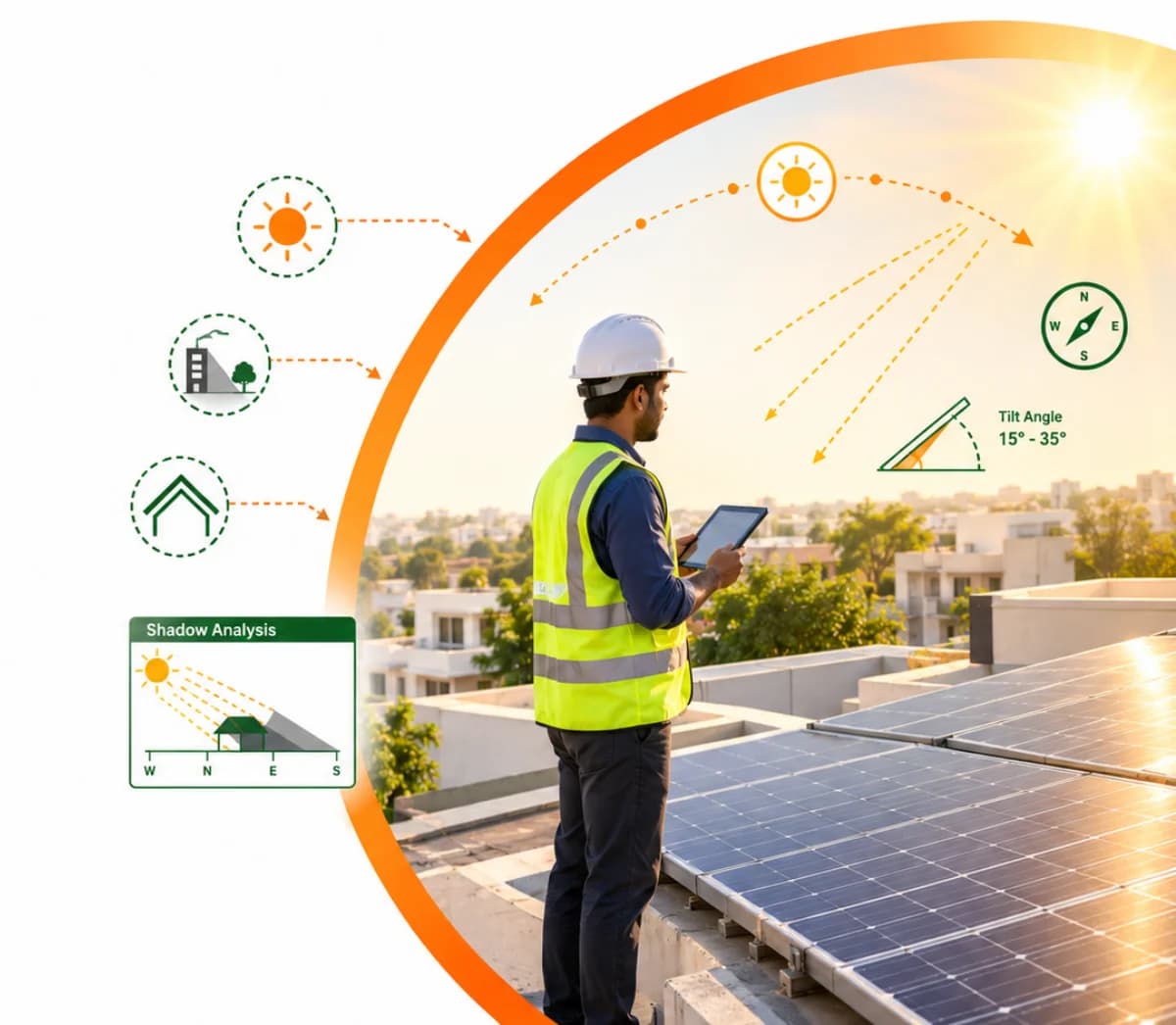
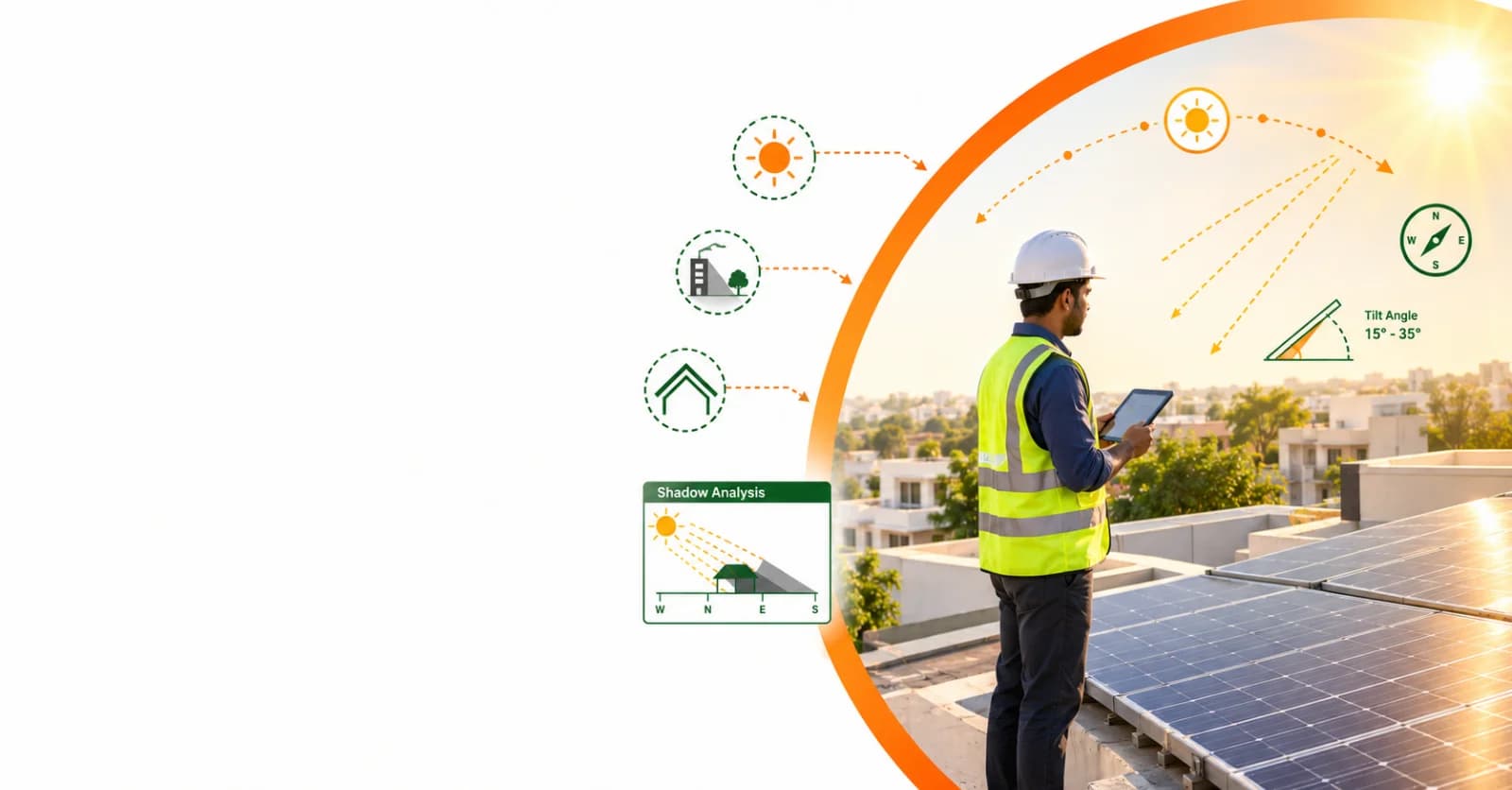
This is why a professional solar site shade assessment evaluates how surrounding obstacles affect the proposed panel area across different periods.
What Is a Solar Site Shade Assessment?
A solar site shade assessment identifies objects that could cast shadows on the solar array.
Typical obstacles include:
- Trees
- Neighbouring buildings
- Water tanks
- Lift rooms
- Antennas
- Chimneys
- Parapet walls
- Other rooftop equipment
The important question isn't simply whether shade exists.
It is:
How much could that shade cost you?
Put Shading Loss Into Actual Numbers
Consider our illustrative 5 kW system.
Expected annual generation without the avoidable shading being modeled:
7,500 units/year
Now look at what different levels of generation loss could mean.
| Scenario | Annual Generation | Units Lost | Value Lost at ₹8/unit |
|---|---|---|---|
| Base generation | 7,500 | 0 | ₹0 |
| 5% loss | 7,125 | 375 | ₹3,000/year |
| 10% loss | 6,750 | 750 | ₹6,000/year |
| 15% loss | 6,375 | 1,125 | ₹9,000/year |
| 20% loss | 6,000 | 1,500 | ₹12,000/year |
This is why a solar site shade assessment isn't just another item on an installation checklist.
It can influence the financial performance of the system.
What Could a 10% Generation Difference Mean Over Time?
Using the same simplified example:
Annual units lost: 750
Illustrative electricity value: ₹8/unit
Annual value difference: ₹6,000
Over 5 years:
₹30,000
Over 10 years:
₹60,000
Over 25 years:
₹1,50,000
This simplified calculation does not include electricity tariff increases, module degradation, financing, maintenance, taxes or other variables.
It demonstrates why even a relatively small design difference matters when the asset is expected to operate for decades.
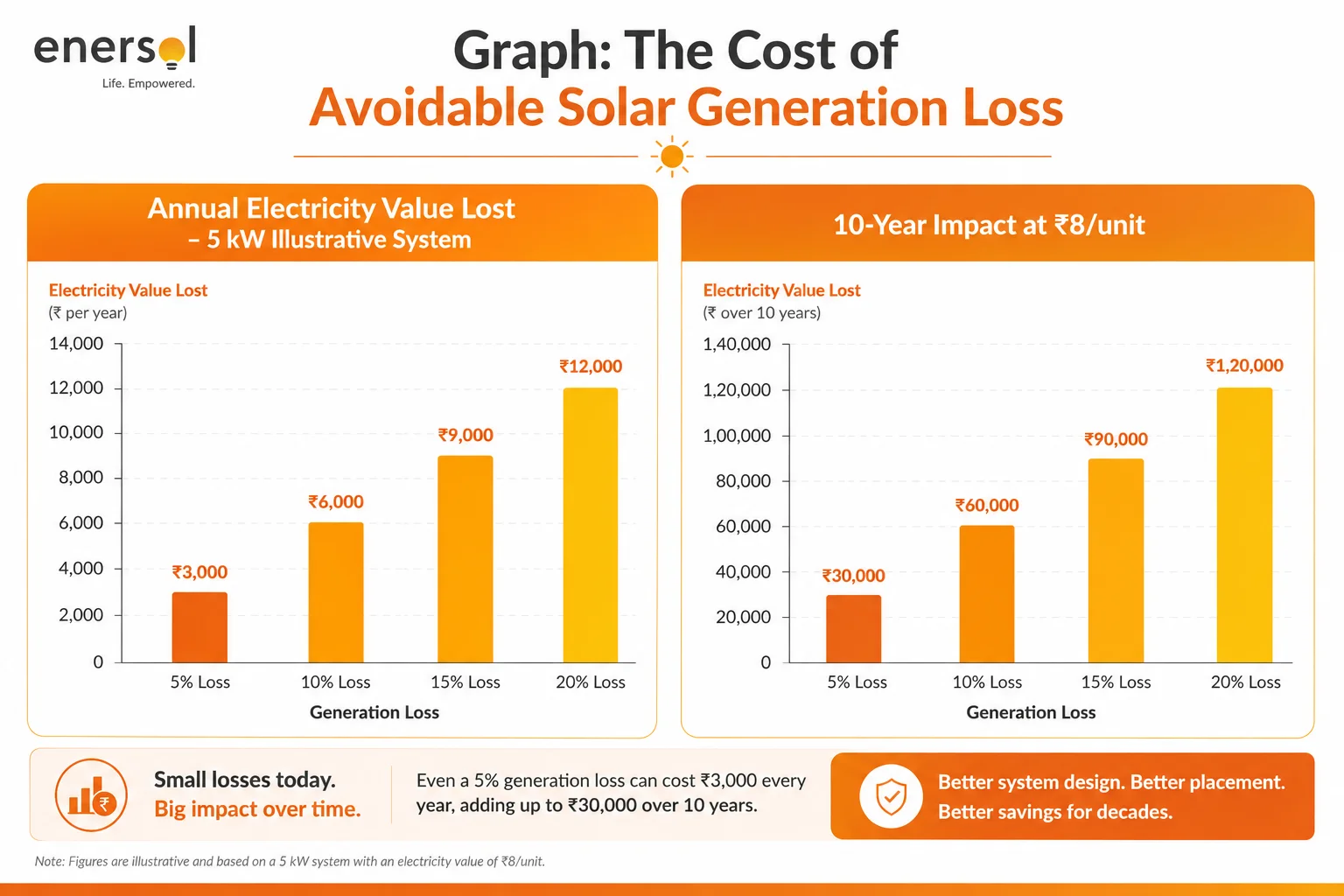
Graph: The Cost of Avoidable Solar Generation Loss
This data can be used directly for a bar graph in the blog.
Annual Electricity Value Lost – 5 kW Illustrative System
5% Generation Loss → ₹3,000/year
10% Generation Loss → ₹6,000/year
15% Generation Loss → ₹9,000/year
20% Generation Loss → ₹12,000/year
A second graph can show:
10-Year Impact at ₹8/unit
5% Loss → ₹30,000
10% Loss → ₹60,000
15% Loss → ₹90,000
20% Loss → ₹1,20,000
These numbers immediately show homeowners why system design deserves as much attention as panel selection.
Structural Evaluation Is Equally Important
Generation is only one part of site assessment.
Solar panels can remain on a rooftop for 25 years or more, so the roof and mounting arrangement need to support the system safely.
Engineers should evaluate:
- Roof condition
- Building age
- Structural capacity
- Waterproofing
- Available mounting area
- Existing rooftop equipment
- Wind exposure
- Drainage
- Maintenance pathways
A roof may have enough physical space for 5 kW of panels but still require a different mounting layout because of structural or operational constraints.
That is exactly why capacity shouldn't be decided from satellite images or electricity bills alone.
Your Electricity Bill Is Part of the Site Assessment
Another common mistake is assuming:
More panels = more savings.
Not necessarily.
The right system should be designed around your electricity consumption and applicable grid/export arrangements.
An experienced rooftop solar installer should review recent electricity bills to understand:
- Monthly consumption
- Annual consumption
- Seasonal peaks
- Daytime electricity requirements
- Existing connected load
- Expected future consumption
Suppose a household consumes approximately 7,200 units annually.
If the proposed 5 kW system is modeled to generate around 7,500 units annually, the capacities are broadly comparable at an annual-energy level.
But if the same household consumes only 3,500 units annually, the installer needs to explain the economics of the proposed capacity rather than automatically recommending the largest system the roof can accommodate.
Site Assessment Helps Estimate the Right Budget
Many homeowners search for home solar installation cost before contacting a solar company.
That's understandable, but online prices usually provide only a starting point.
The final solar installation for home cost can depend on:
- System capacity
- Panel technology
- Inverter
- Mounting structure
- Roof type
- Cable routing
- Electrical protection
- Earthing
- Structural requirements
- Installation complexity
- Accessibility
A meaningful quotation should therefore connect cost with expected generation.
Don't Compare Solar Only by ₹/kW
Imagine two illustrative quotations.
Proposal A
5 kW system Project cost: ₹3,00,000 Expected generation: 7,500 units/year
Proposal B
5 kW system Project cost: ₹2,85,000 Expected generation: 6,750 units/year
Proposal B is ₹15,000 cheaper.
But its modeled generation is 750 units lower annually.
At ₹8/unit, that's approximately ₹6,000 less energy value per year.
Under this simplified comparison, the ₹15,000 upfront difference could be outweighed by the modeled generation gap in around:
₹15,000 ÷ ₹6,000 = 2.5 years
This doesn't automatically make Proposal A better the assumptions, equipment, warranties, tariff and actual design must all be verified.
But it demonstrates why comparing only installation prices can be misleading.
Comparison: Without vs With Professional Site Assessment
| Without Proper Assessment | With Professional Assessment |
|---|---|
| Generic system capacity | Capacity based on consumption and roof |
| Visual assumption about sunlight | Detailed solar site shade assessment |
| No quantified shading impact | Generation losses estimated |
| Price-focused quotation | Cost + generation comparison |
| Generic panel layout | Site-specific layout |
| Uncertain yearly generation | Modeled annual generation |
| Difficult ROI comparison | Measurable financial assumptions |
What Should You Receive After a Site Assessment?
This is where the assessment becomes actionable.
Don't settle for:
“Sir, 5 kW will fit easily.”
Ask your rooftop solar installer for measurable outputs.
Ideally, your proposal should show:
System capacity: e.g. 5 kW
Estimated annual generation: e.g. 7,500 kWh
Specific yield: e.g. 1,500 kWh/kWp/year
Estimated shading loss: e.g. 3–5%
Proposed panel direction and tilt
Usable rooftop area
Estimated annual savings
Total project cost
Key equipment specifications
Generation assumptions
This allows you to compare two solar proposals on engineering and economics—not sales claims.
Questions to Ask Your Rooftop Solar Installer
Before finalizing your home solar installation, ask:
- What annual generation are you estimating?
- What kWh/kWp/year have you assumed?
- What shading percentage did the assessment identify?
- Which areas of my roof should be avoided?
- How did you calculate the recommended system size?
- Have you checked structural suitability?
- What electricity tariff are you using for savings?
- What assumptions are included in the ROI?
- What is included in the quoted home solar installation cost?
If these questions cannot be answered clearly, the quotation may need deeper technical evaluation.
Why One-Size-Fits-All Doesn't Work
A standardized solar package may be convenient, but rooftops aren't standardized.
A 5 kW residential solar system on one property may generate differently from a 5 kW system just a few houses away.
The difference could come from:
- Shading
- Orientation
- Roof layout
- Temperature
- Panel placement
- Equipment selection
- System losses
Professional solar engineering attempts to quantify these variables before installation.
Long-Term Benefits of Proper Planning
A professional assessment helps improve more than installation quality.
It gives homeowners a measurable basis for their investment.
Instead of simply knowing:
“I'm installing 5 kW solar.”
You should ideally know:
“I'm installing 5 kW, expected to generate approximately X units annually, against my current consumption of Y units, at a project cost of Z.”
That is actionable solar information.
It helps homeowners understand:
- Expected electricity generation
- Potential savings
- System sizing
- Shading losses
- Roof utilization
- Payback assumptions
- Long-term performance
Choosing the Right Solar Partner
When comparing companies, don't ask only:
“What's your price for 5 kW?”
Ask:
“What will your 5 kW system generate on my roof, and show me how you calculated it?”
A reliable solar company should be able to explain the connection between:
Roof → Sunlight → System Design → Generation → Savings → ROI
At Enersol Solar, the objective of site assessment is to understand the property before recommending the system.
Because a solar proposal shouldn't be based on how many panels a company wants to sell.
It should be based on how much usable electricity the property can realistically generate.
Final Thoughts
A successful solar project doesn't begin when the first panel reaches your roof.
It begins when the roof is measured, shadows are studied, electricity consumption is understood, structural conditions are checked and expected generation is calculated.
A professional solar site shade assessment can identify generation losses before they become 25-year problems.
Using our illustrative 5 kW example, a 10% generation difference represented approximately 750 units annually around ₹6,000 per year at an assumed ₹8/unit.
That's why homeowners evaluating the solar installation for home cost should look beyond the quotation amount.
Ask for the expected generation.
Ask for shading losses.
Ask how system size was calculated.
Ask what assumptions were used for ROI.
The right rooftop solar installer should give you numbers, not just promises.
At Enersol Solar, we believe strong residential solar systems start with understanding the roof first because when the assessment is right, every decision that follows becomes more informed.