
Learn how the right solar panel angle and orientation improve home solar installation efficiency and maximize your solar power setup for home.
Quick Summary
The efficiency of a solar system depends on more than just high-quality panels. The right solar panel angle and orientation play a crucial role in maximizing sunlight, improving electricity generation, and increasing long-term savings.
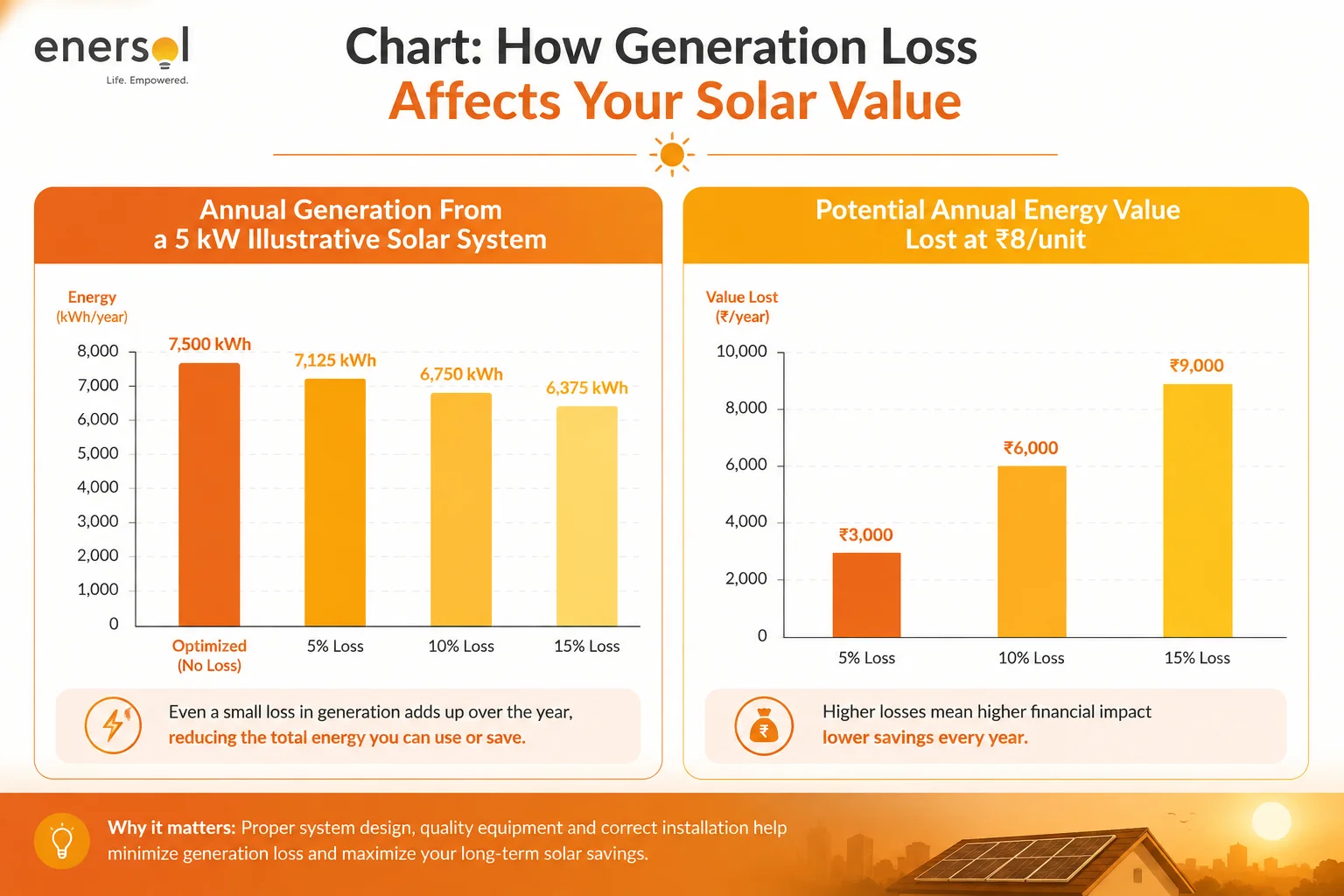
For example, assume a properly designed 5 kW home solar installation generates around 7,500 units annually under the site's assumed generation conditions. If poor orientation, avoidable shading, or unsuitable positioning causes even a 10% generation loss, that represents approximately 750 units of electricity lost every year.
At an illustrative electricity value of ₹8 per unit, that is roughly ₹6,000 of potential annual energy value. Over 10 years, before considering tariff changes or system degradation, that difference could reach approximately ₹60,000.
This is why every solar power setup for home should be designed around roof direction, tilt, shading, structural conditions and actual energy requirements instead of using a standard layout.
Choosing Panels Is Only Half the Decision
Choosing the right solar panels is only one part of building an efficient solar system. Even high-quality panels can underperform if they are installed at an unsuitable angle, face an inefficient direction, or experience avoidable shading.
When homeowners think about a solar power setup for home, they often compare panel brands, inverters, warranties or subsidies.
But here's the more useful question:
How many units will this system actually generate on my roof every year?
The right solar panel angle and orientation can help your system capture more sunlight throughout the year, improve electricity generation and strengthen your long-term return on investment.
Why Panel Angle Matters
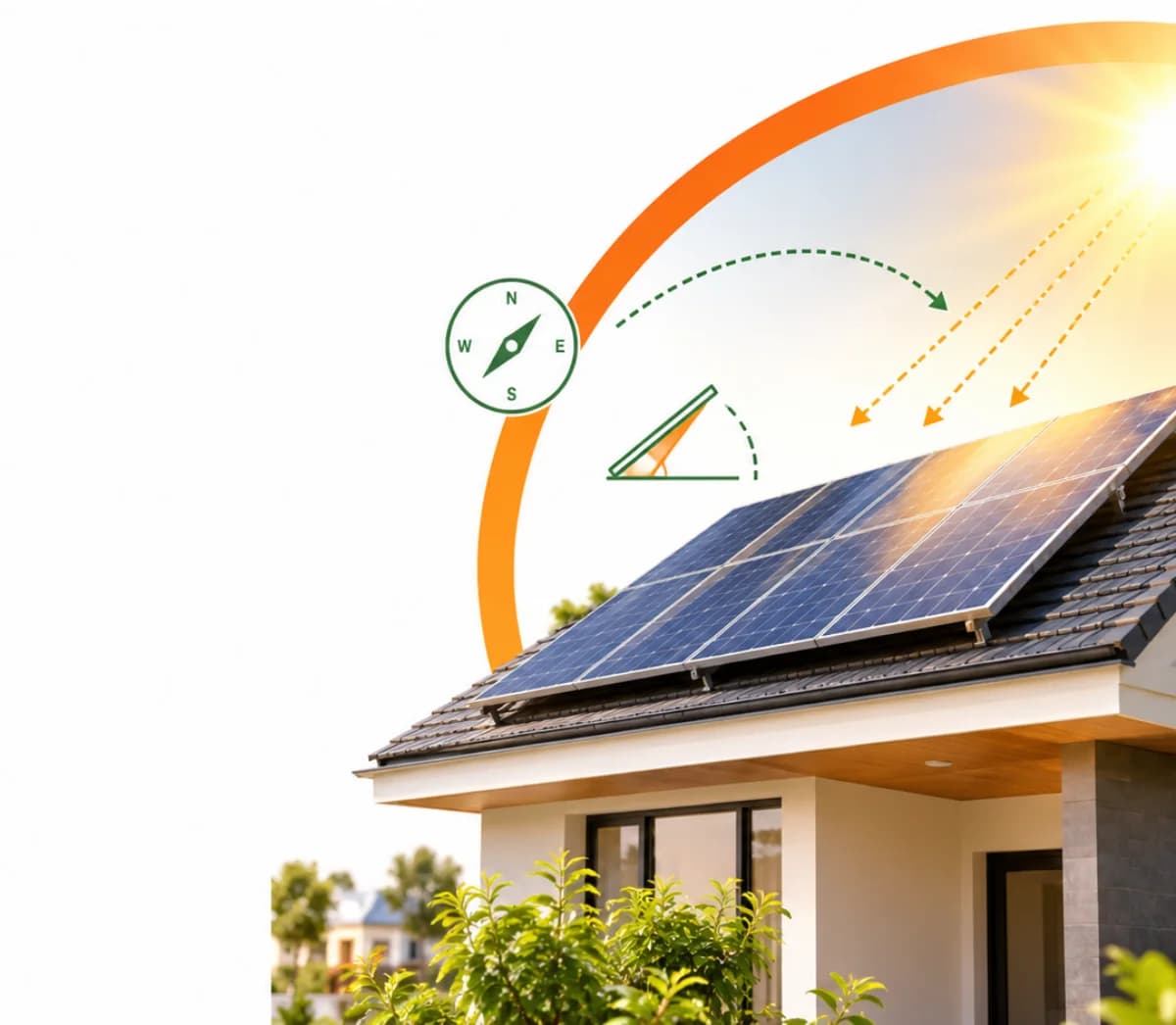
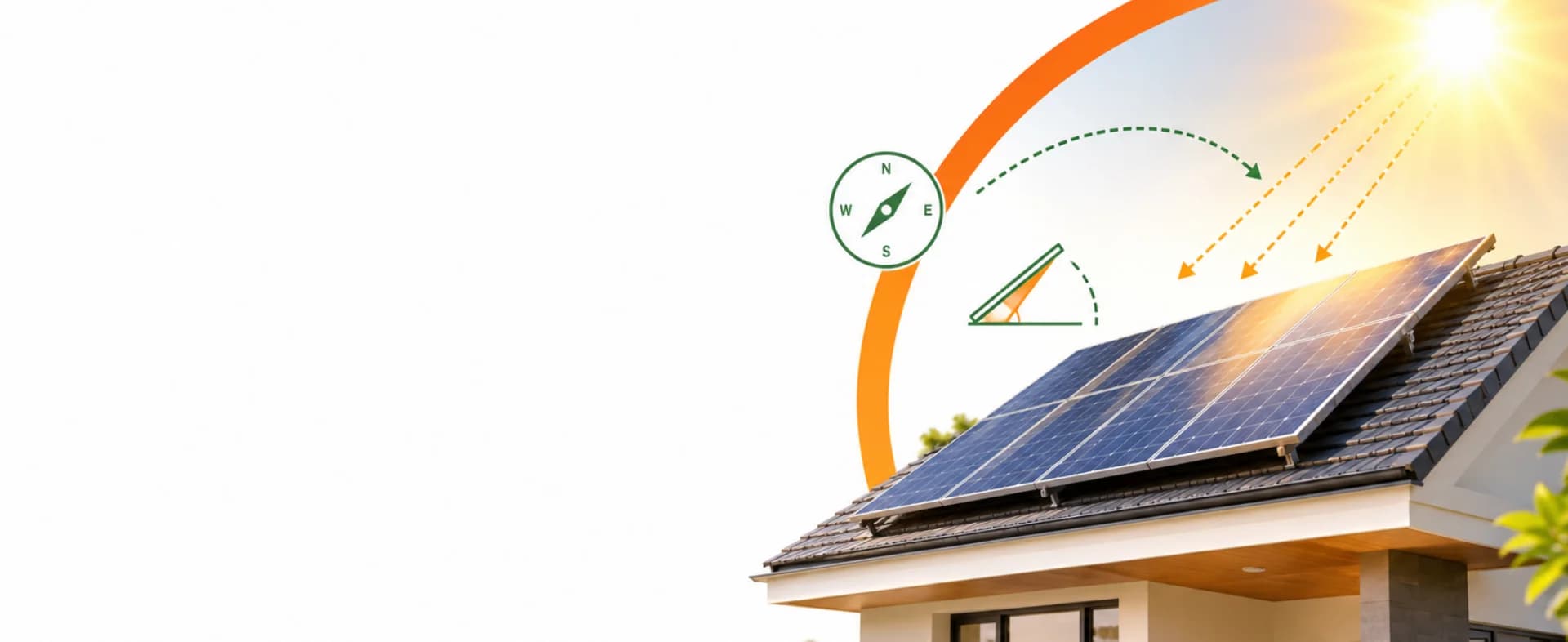
Solar panels generate electricity by converting sunlight into usable energy. How directly sunlight reaches the panel surface influences the solar energy available to the array.
Think about holding a book under a flashlight.
When the book directly faces the light, it receives concentrated light. Tilt it away, and the same light spreads across a larger area.
Solar panels follow the same basic principle.
But the practical goal isn't to chase one universally “perfect” angle.
The right tilt must balance:
- Annual solar irradiation
- Geographic location
- Roof design
- Row-to-row shading
- Available rooftop area
- Wind loading
- Drainage
- Maintenance access
For many fixed-tilt systems, orientation and tilt can be optimized through solar simulation before installation.
Is Your Home Ready for Solar?
Reduce your monthly electricity bills and build long-term energy independence with Enersol's rooftop solar solutions.
Why Panel Direction Is Equally Important
Direction determines when and how effectively panels receive sunlight throughout the day.
In the Northern Hemisphere, south-facing fixed arrays are commonly used as a reference for maximizing annual solar exposure.
However, this does not mean every home must have a perfectly south-facing installation.
A professional installer should evaluate:
- Roof structure
- Local solar resource
- Nearby buildings
- Trees and shading
- Water tanks and rooftop obstacles
- Daily energy consumption pattern
- Available installation area
A southeast- or southwest-facing roof, for example, may still be highly suitable depending on the site.
The right question isn't:
“Is my roof perfectly south-facing?”
It is:
“What annual generation can realistically be achieved from my available roof?”
Put the Difference Into Numbers
Consider an illustrative 5 kW solar setup for home.
Assume the optimized design is expected to generate:
7,500 kWh/year
Now compare different levels of avoidable generation loss.
| Scenario | Annual Generation | Units Lost | Value Lost at ₹8/unit |
|---|---|---|---|
| Optimized design | 7,500 kWh | 0 | ₹0 |
| 5% lower generation | 7,125 kWh | 375 | ₹3,000/year |
| 10% lower generation | 6,750 kWh | 750 | ₹6,000/year |
| 15% lower generation | 6,375 kWh | 1,125 | ₹9,000/year |
Important: This is an illustrative calculation, not a guaranteed generation forecast. Actual production depends on location, solar irradiation, module technology, temperature, inverter efficiency, shading, soiling and other system losses.
But it demonstrates something important:
A percentage loss on paper becomes real electricity and real money over time.
What Can a 10% Difference Mean Over Time?
Using the same example:
Optimized annual generation: 7,500 units
10% avoidable loss: 750 units/year
Assumed electricity value: ₹8/unit
Potential annual value difference:
750 × ₹8 = ₹6,000
Over 10 years:
₹6,000 × 10 = ₹60,000
Over 25 years, a simple undiscounted calculation would equal:
₹1,50,000
This simplified example excludes tariff escalation, degradation, maintenance, financing, taxes and changes in consumption.
The point isn't that every poorly oriented system loses exactly ₹1.5 lakh.
The point is that small engineering decisions can compound into meaningful financial differences over a solar system's operating life.
Chart: How Generation Loss Affects Your Solar Value
Chart Title: Annual Generation From a 5 kW Illustrative Solar System
Optimized — 7,500 kWh
5% Loss — 7,125 kWh
10% Loss — 6,750 kWh
15% Loss — 6,375 kWh
Chart Title: Potential Annual Energy Value Lost at ₹8/unit
5% Loss — ₹3,000
10% Loss — ₹6,000
15% Loss — ₹9,000
These numbers make the engineering decision easier for a homeowner to understand.
How the Right Angle Improves Performance
A properly designed solar energy installation for home offers advantages beyond simply positioning panels neatly on a roof.
1. Better Annual Energy Generation
Correct positioning helps the panels capture solar irradiation more effectively across the year.
2. Better Return on Investment
More usable electricity generated from the same installed capacity can translate into greater electricity-bill savings.
3. Better Seasonal Performance
The sun's position changes throughout the year. System design should therefore consider annual performance rather than optimizing for one particular day or season.
4. Better Use of Available Roof Area
The highest possible tilt isn't automatically the best commercial decision.
On a flat roof, increasing tilt can require greater spacing between rows to prevent one row from shading another.
The optimum design therefore balances energy yield per panel with total usable roof capacity.
Panel Angle vs Panel Direction
| Panel Angle | Panel Direction |
|---|---|
| Tilt of the panel from horizontal | Compass direction the panel faces |
| Influences solar irradiation reaching the module | Influences when sunlight reaches the array |
| Selected according to site and mounting design | Selected according to geography and available roof |
| Can affect row spacing and wind loading | Can affect morning vs afternoon generation |
| Should be modeled before final installation | Should be evaluated with shading and roof constraints |
Does Every Home Need the Same Installation Angle?
No.
This is exactly where one-size-fits-all solar proposals become questionable.
Professional solar engineers determine the appropriate solar panel angle and orientation after evaluating:
- Roof slope
- Available rooftop area
- Shadow profile
- Geographic location
- Structural safety
- Row spacing
- Wind exposure
- Maintenance accessibility
The homeowner should receive more than a statement that the roof is “suitable.”
A useful assessment should ideally tell you:
1. Recommended system capacity
Example: 5 kW
2. Expected annual generation
Example: approximately 7,500 kWh/year under the stated assumptions
3. Estimated specific generation
In this example:
7,500 ÷ 5 = 1,500 kWh/kWp/year
4. Estimated annual electricity value
At ₹8/unit:
7,500 × ₹8 = ₹60,000/year
These are the kinds of numbers that allow homeowners to compare proposals intelligently.
What About Flat Roofs?
Flat rooftops offer flexibility because installers can use mounting structures to establish the required panel tilt and direction.
But there is an engineering trade-off.
Higher tilt can improve the orientation of individual modules, but it may also:
- Increase row-to-row shading
- Require greater spacing
- Reduce the number of panels that fit
- Increase wind loading
- Require a stronger mounting structure
Therefore, the best design is not necessarily the angle that gives one panel the highest theoretical output.
It is the layout that produces the strongest overall result from the available roof while maintaining structural safety.
Does Monsoon Affect Panel Positioning?
Yes, but positioning should be designed around annual generation, not only monsoon performance.
Cloudy conditions reduce available solar irradiation, but photovoltaic panels can still generate electricity from available direct and diffuse light.
Tilt also influences water drainage and how easily loose surface dirt may wash away during rainfall.
However, rain should never be treated as a substitute for proper panel maintenance.
Common Mistakes Homeowners Make
Many homeowners compare quotations using only ₹/kW.
That misses a major part of the decision.
A cheaper 5 kW system that generates fewer units each year may ultimately deliver less value than a better-engineered 5 kW system.
Before comparing quotations, ask for these numbers:
- Installed capacity in kW
- Estimated annual generation in kWh
- Specific yield in kWh/kWp/year
- Estimated shading loss
- Proposed tilt and direction
- Generation assumptions
- Expected annual savings
- Major system-loss assumptions
This turns a solar quotation into something you can actually evaluate.
Why Professional Site Assessment Is So Important
Before beginning a solar energy installation for home, a detailed site survey should evaluate:
- Roof measurements
- Structural condition
- Shadow analysis
- Panel layout
- Tilt and azimuth
- Energy consumption
- Safety requirements
- Estimated annual generation
Simulation tools can model how changes in tilt, direction and shading influence expected energy yield.
The result should be a solar system designed around measurable performance—not simply the maximum number of panels that can physically fit on the roof.
A Simple ROI Example Homeowners Can Understand
Assume:
System size: 5 kW Expected annual generation: 7,500 units Illustrative electricity value: ₹8/unit Annual energy value: ₹60,000
Now assume the optimized design costs ₹3,00,000 after considering whichever incentives are actually applicable to the homeowner.
Simple payback:
₹3,00,000 ÷ ₹60,000 = approximately 5 years
Now assume avoidable design losses reduce generation by 10%.
Annual generation becomes:
6,750 units
Annual value becomes:
₹54,000
Simple payback becomes:
₹3,00,000 ÷ ₹54,000 ≈ 5.6 years
The difference may appear small annually, but it compounds across a system designed to operate for decades.
Note: This is only an illustrative ROI example. Actual project cost, tariff, subsidy eligibility, generation, degradation, financing and maintenance must be calculated for the specific property.
Questions to Ask Before Installing Solar
Before finalizing your home solar installation, don't only ask:
“How much will the system cost?”
Also ask:
- What is my expected first-year generation?
- What kWh/kWp/year have you assumed?
- What shading loss have you considered?
- Why have you selected this tilt?
- Why are the panels facing this direction?
- What electricity tariff is used in the savings calculation?
- What annual degradation has been assumed?
- What is my estimated simple payback period?
A knowledgeable installer should be able to show the assumptions behind the numbers.
Final Thoughts
A successful solar power setup for home is about much more than putting high-efficiency panels on a rooftop.
It is about turning available roof space into the maximum practical amount of usable electricity.
Panel angle, direction, shading, row spacing and structural design all influence that outcome.
In our illustrative 5 kW example, a 10% difference in generation represented approximately 750 units per year, or around ₹6,000 annually at ₹8 per unit.
That is why homeowners should compare solar proposals based not only on price per kW, but also on expected kWh generated per year.
At Enersol Solar, every installation begins with a detailed site assessment so that panel placement, system capacity and expected generation can be evaluated before installation.
Because the strongest solar proposal shouldn't simply tell you how many panels you're buying.
It should show you how much electricity those panels are expected to produce—and why.