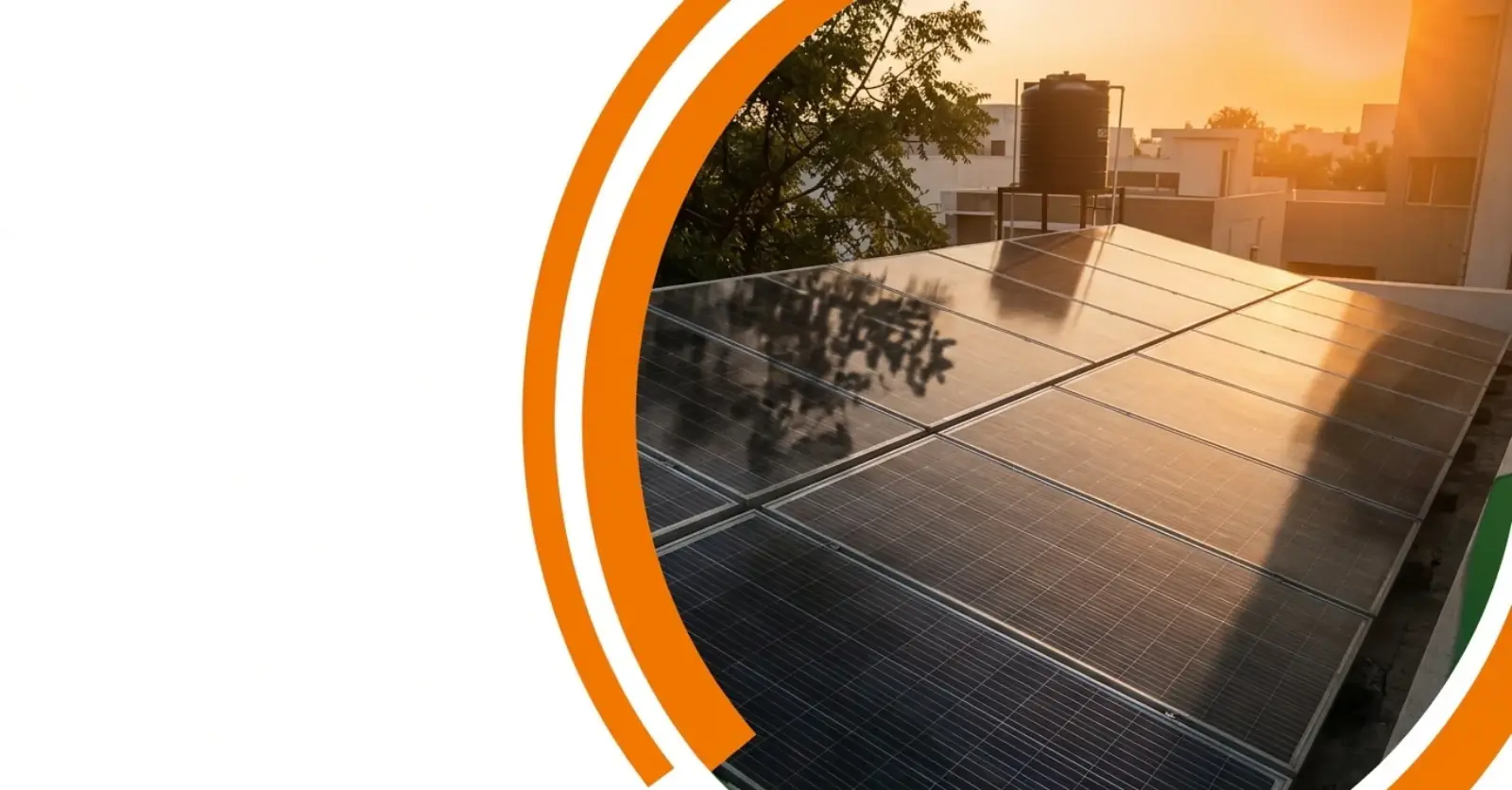

Learn how trees, water tanks, buildings and rooftop obstacles can cause solar panel shading, reduce home solar output and affect long-term generation.
Your solar panels are clean. The inverter shows no fault. The system was sized correctly.
Yet generation is consistently below what you expected.
Before blaming the panels, look around the rooftop.
A water tank casting a shadow for two hours, a tree that has grown since installation, a neighbouring building, a parapet wall, an antenna or even another row of modules can reduce solar generation.
Shading is particularly easy to underestimate because homeowners often judge a rooftop at one moment of the day. A roof that looks completely sunny at noon may have a very different solar profile at 8 AM or 4 PM.
For a residential solar system expected to operate for 20–25 years or more, understanding those changing shadows is an important part of system design.
A Shadow Is Not Just a Shadow
Solar modules need sunlight to generate electricity. When part of a module is shaded, the affected cells receive less solar irradiance.
But the impact is not always as simple as:
10% panel shaded = 10% less power.
Solar cells inside modules are electrically interconnected, and modules are connected into strings. Depending on module design, string configuration, bypass diodes and inverter technology, partial shading can affect output in more complicated ways.
NREL explains that shading of PV modules can create mismatch losses because shaded and unshaded cells or modules operate differently. Modern system design and power electronics can reduce some effects, but they do not make shade irrelevant.
This is why professional residential solar installation should include shade analysis rather than simply counting how many panels physically fit on a roof.
The Water Tank Problem
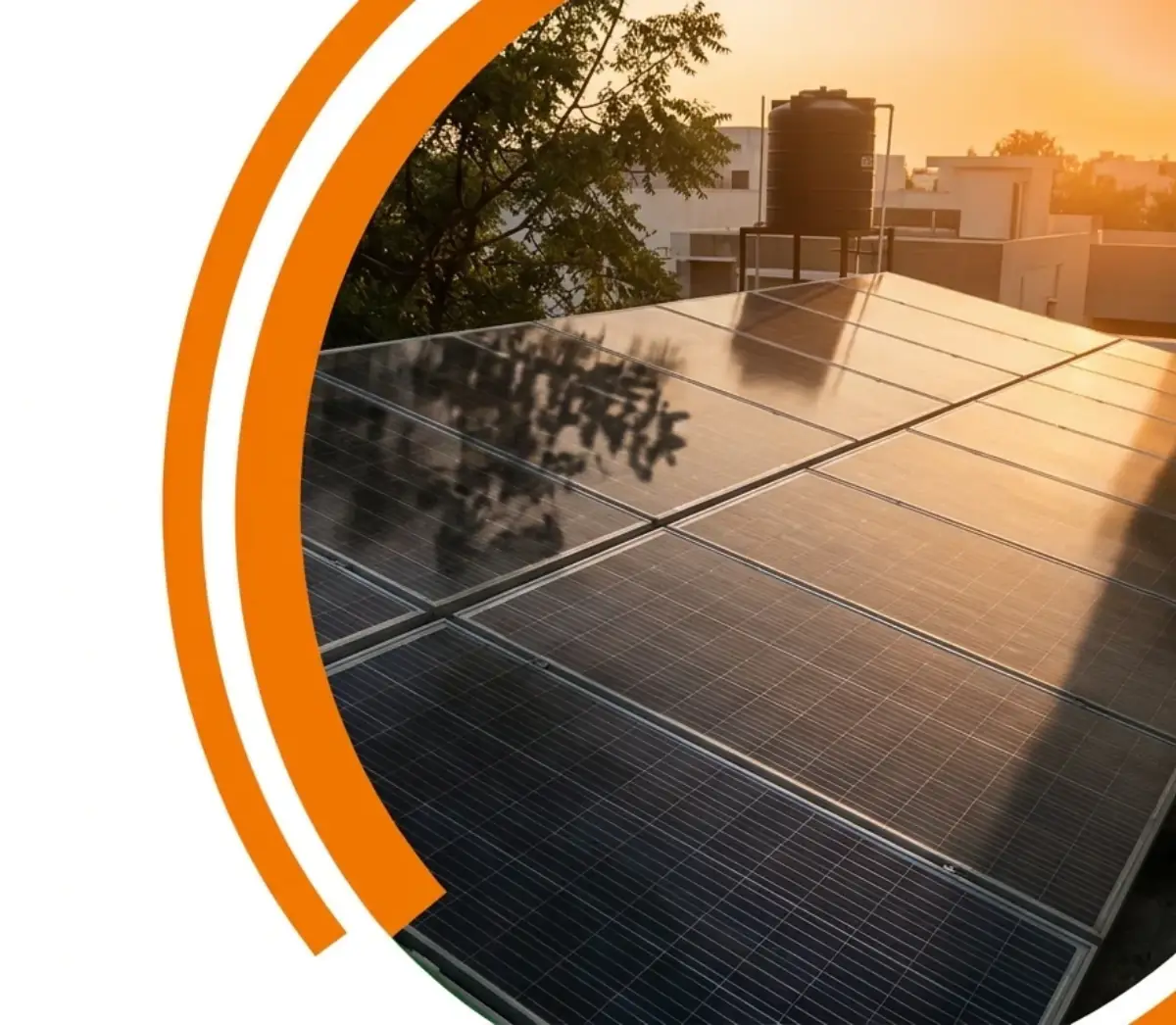
Consider a common Indian rooftop.
There is enough open space for a 5 kW system, but a large overhead water tank stands near one side.
At noon, its shadow may fall almost directly underneath it.
At 9 AM, however, the shadow stretches westward.
Later in the afternoon, it stretches in the opposite direction.
If modules are installed too close to the tank, part of the array may experience shade every day.
An Illustrative Example
Assume a 5 kW rooftop system is expected to generate:
7,500 units/year
For illustration, suppose recurring shading contributes to these annual generation differences:
| Illustrative Generation Loss | Units Lost/Year | Value at ₹8/unit |
|---|---|---|
| 2% | 150 | ₹1,200 |
| 5% | 375 | ₹3,000 |
| 10% | 750 | ₹6,000 |
| 15% | 1,125 | ₹9,000 |
These percentages are examples, not predictions of what a particular water tank will cause. Actual loss depends on when, where and for how long the shade falls.
But the financial lesson is useful.
A seemingly small 5% annual generation difference on this illustrative system represents 375 units every year.
Over ten years, ignoring tariff changes and degradation, that's:
3,750 units
At the same illustrative ₹8/unit:
₹30,000 of energy value.
Small Shading Losses Can Become Real Energy Loss
Illustrative 5 kW system generating 7,500 units/year before shading losses.
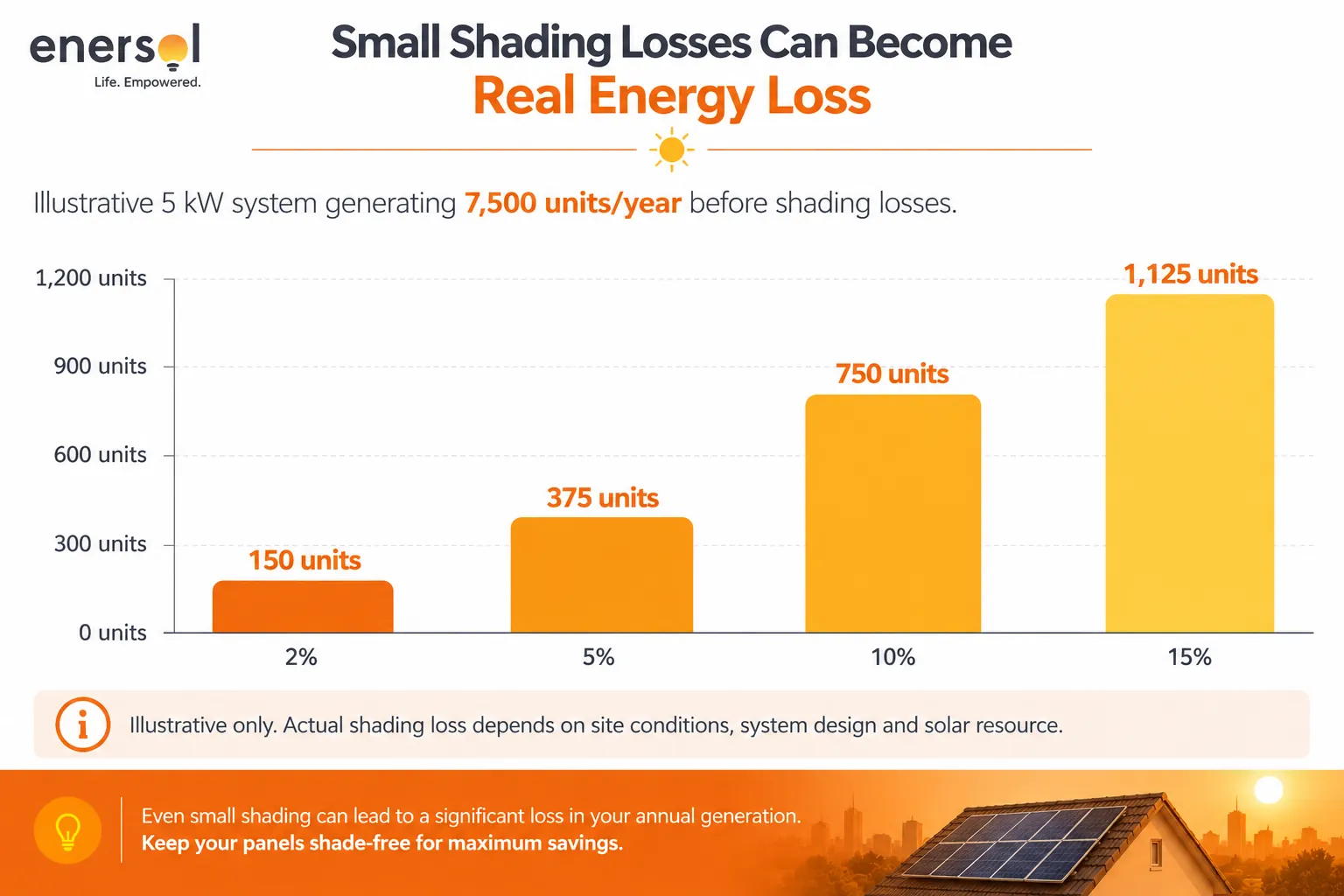
Illustrative only. Actual shading loss depends on site conditions, system design and solar resource.
That is why panel placement matters as much as panel count.
Trees Create a Different Challenge: They Grow
A water tank is relatively predictable.
A tree isn't.
Imagine installing residential rooftop solar panels in 2026. A nearby tree does not shade the array significantly during the initial site survey.
Five years later, its canopy is larger.
Now several modules receive afternoon shade.
Nothing has failed. The panels haven't suddenly become inefficient. The environment around the system has changed.
Trees also move with wind, lose and regrow foliage, and create different shading patterns across seasons.
Cutting down trees simply to improve solar production is not automatically the right answer. Instead, the system should be designed intelligently around existing vegetation where practical, and future growth should be considered during planning.
Homeowners can also periodically compare current generation with historical performance to identify unexplained changes.
Is Shade Quietly Cutting Your Solar Output?
Book a site assessment with Enersol and get a layout designed around real shadow paths, not just roof area.
Your Neighbour's Building Can Become Your Solar Problem
This issue is harder because it may not exist when the system is installed.
Suppose your home is two storeys tall and receives excellent sunlight.
Three years later, the neighbouring property adds another floor.
The new structure creates morning shade across one side of your array.
Your home solar panel efficiency has not changed.
Your available solar resource has.
This is particularly important in dense urban areas where redevelopment is common.
No installer can perfectly predict what every neighbouring property will look like 15 years from now. But good site assessment can identify obvious risks such as an existing building very close to the solar-facing side of the roof.
Why Checking the Roof at Noon Isn't Enough
One of the simplest mistakes in solar planning is visiting a site at noon, looking at an apparently sunny roof and concluding:
“No shading problem.”
The sun moves.
So do shadows.
A rooftop should ideally be considered across relevant hours and seasons.
A water tank might create a long morning shadow in winter but a much shorter one around midday in summer.
This happens because the sun's position changes through both the day and the year.
Solar designers can use sun-path and shading-analysis tools to model these conditions before finalising module placement.
That is considerably more useful than taking one photograph during a site visit.
Row-to-Row Shading Can Be Self-Inflicted
Sometimes the shading object isn't a tree, tank or neighbour.
It's the solar installation itself.
Tilted modules cast shadows.
If multiple rows are placed too close together, the front row can shade the row behind it when the sun is lower in the sky.
Imagine gaining space for two extra modules by reducing row spacing but creating recurring shade across another row.
You've increased installed capacity on paper.
You may not have increased useful generation proportionately.
This is why the best residential solar system is not necessarily the design that squeezes the maximum possible kW onto a rooftop.
The better objective is useful long-term energy production.
How Much Does Timing Matter?
A shadow at 7 AM and a shadow around midday are not necessarily equivalent.
Solar irradiance changes throughout the day.
Suppose, purely for illustration, a system's daily generation is distributed like this:
| Period | Share of Daily Generation |
|---|---|
| Early morning | 10% |
| Late morning | 30% |
| Midday/early afternoon | 40% |
| Late afternoon | 20% |
A shading event affecting a high-generation period can have a different impact from an equivalent-duration shadow early in the morning.
This is why asking:
“How many hours of shade are there?”
is incomplete.
A better question is:
“Which modules are shaded, at what time, and how much generation is available during that period?”
That is actionable information.
Why Module-Level Electronics Don't Make Shade Disappear
Homeowners may hear that optimisers or microinverters “solve shading.”
That's too simplistic.
Module-level power electronics can help reduce certain mismatch effects because individual modules can operate more independently than they would in some conventional string configurations.
But they cannot create sunlight where there is none.
If a tree completely blocks sunlight reaching part of the array, electronics cannot recover all the energy that was never available in the first place.
The correct order should therefore be:
Avoid unnecessary shade first.
Design around unavoidable shade second.
Then choose appropriate system technology.
Not the other way around.
A ₹0 Test Homeowners Can Do
You don't need engineering software to notice obvious shading changes after installation.
On a clear day, safely observe the rooftop from an accessible location at approximately:
9 AM → 12 PM → 3 PM → 5 PM
Do not walk on modules or climb onto unsafe roof areas.
Look for shadows from:
- water tanks;
- parapet walls;
- trees;
- neighbouring buildings;
- antennas;
- pipes;
- rooftop rooms; and
- other module rows.
Take photographs from the same safe position.
Repeat the exercise in a different season if you suspect seasonal shading.
This is not a replacement for professional shade analysis, but it can reveal obvious issues.
Use Generation Data to Find Changes
Your inverter monitoring can provide another clue.
Suppose a system historically generated around:
25 units on comparable clear days
Now it repeatedly generates:
21 units
That's approximately:
4 units/day lower, or around 16% relative to the earlier 25-unit reference.
Don't immediately conclude that shading caused it.
Check:
- Has a tree grown?
- Has neighbouring construction changed?
- Are panels dirty?
- Is the inverter reporting errors?
- Has new equipment appeared on the rooftop?
- Is the comparison being made under similar weather and seasonal conditions?
If physical surroundings have changed, ask the installer to reassess shading.
This turns “my solar seems low” into a much more useful diagnostic conversation.
What Should Happen Before Installation?
Before approving residential solar solutions, ask your installer to show you the proposed layout, not just the system capacity.
Then ask:
Where will the water tank's shadow fall?
Have nearby trees been considered?
Could the parapet shade the first row?
Is row spacing designed to control self-shading?
Were morning and afternoon conditions considered?
How will unavoidable shaded modules affect string design?
If your proposal simply says “5 kW solar system”, you still don't know whether those 5 kW have been positioned intelligently.
A Useful Comparison Before You Sign
Imagine two proposals.
Proposal A
5.5 kW installed capacity
More panels fitted into available space
Several modules experience recurring shade
Proposal B
5 kW installed capacity
Fewer modules
Cleaner solar exposure
Better-designed spacing
You cannot conclude from those facts alone that Proposal B will always generate more. Detailed modelling is required.
But you also cannot conclude that Proposal A is better simply because 5.5 kW > 5 kW.
Ask both installers for:
Estimated annual generation in kWh not just installed kW.
That single number, backed by documented assumptions, makes proposals much easier to compare.
Final Thoughts
Shade is rarely dramatic.
That's exactly why it gets ignored.
A water tank doesn't look like a solar problem. Neither does a growing tree, parapet wall or neighbouring building.
But residential solar panels don't respond to how harmless an obstruction looks. They respond to how much sunlight reaches the cells.
A good residential solar installation therefore starts with more than measuring available roof area.
It considers where shadows move, how seasons change them, whether trees may grow, how rows interact and how unavoidable shading affects electrical design.
Once your system is operating, keep watching the numbers.
If generation changes unexpectedly, look at both the equipment and the environment around it.
Because sometimes nothing is wrong with your solar panels.
The sunlight simply isn't reaching them the way it used to.