
Learn how ALMM List-II is affecting solar panel prices, compliance and procurement for commercial and industrial solar projects in India.
A company planning a 2 MW solar project in early 2026 could compare module quotations largely on technology, manufacturer, efficiency, warranty and price.
By the second half of 2026, there is another question that can materially affect procurement:
Which solar cells are inside those modules and are they eligible for the project being developed?
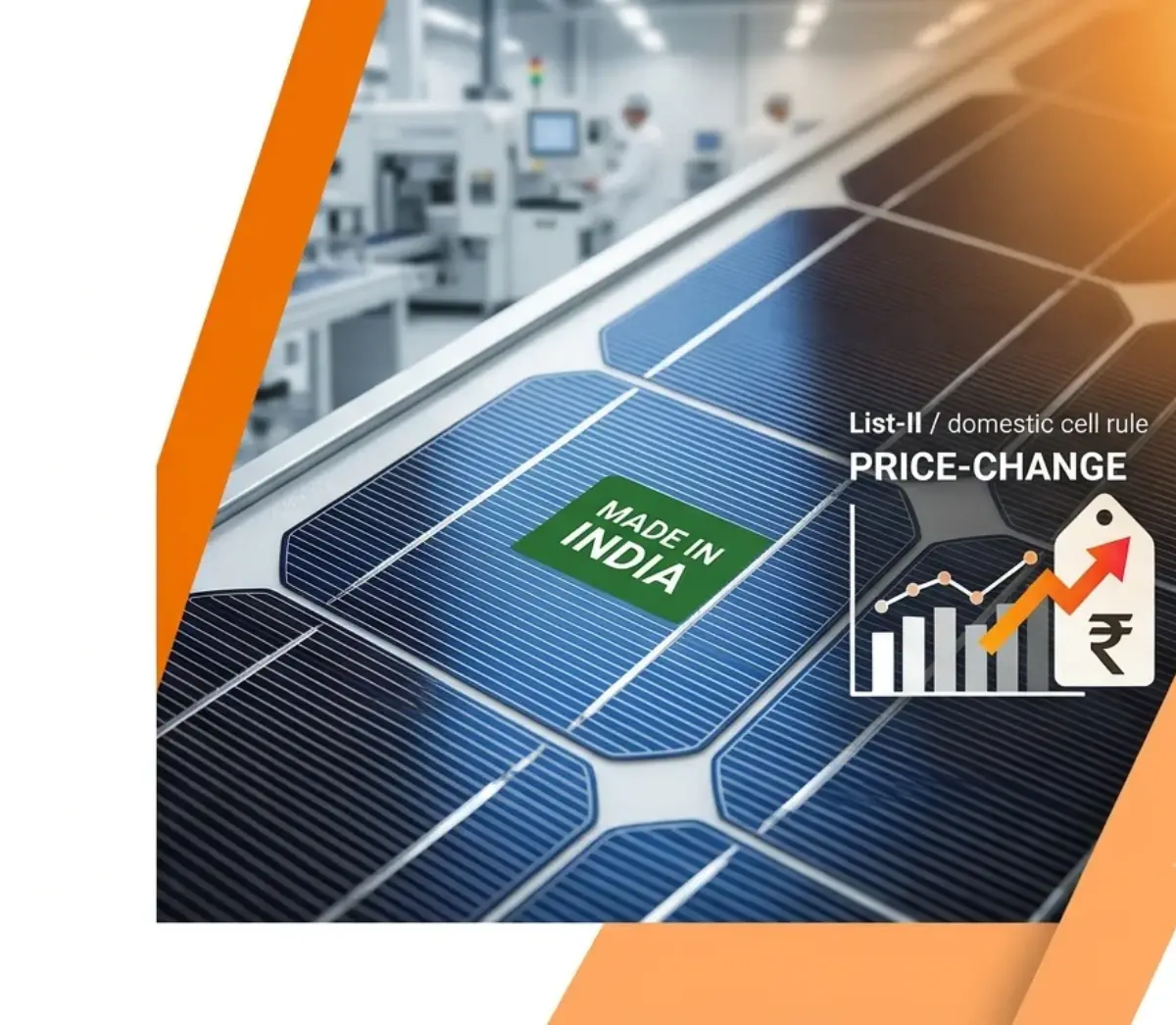
That change comes from India's ALMM List-II framework for solar PV cells.
And it matters particularly to the commercial and industrial solar market because large projects magnify even small differences in module price.
There is, however, an important correction to the way this topic is sometimes described.
There isn't a new blanket “October 2026 DCR rule” taking effect across India's solar market. MNRE's ALMM List-II cell requirement became operational from June 1, 2026, with specific investment-protection provisions and a limited commissioning window until December 31, 2026 for qualifying net-metering and open-access projects. As of September 28, MNRE had already published the 10th revision of ALMM List-II. Ministry of New and Renewable Energy
October is still important for procurement because the market is moving through this transition and more domestic cell manufacturing capacity is coming online. But businesses should not plan a project around a supposed universal October deadline that does not exist.
Here is what is actually changing and why it can affect what a factory pays for solar.
First, What Exactly Is ALMM List-II?
ALMM stands for:
Approved List of Models and Manufacturers.
MNRE's framework now has two particularly important solar lists:
List-I: approved solar PV module models and manufacturers.
List-II: approved solar PV cell models and manufacturers.
MNRE issued the first ALMM List-I for modules in March 2021. The first List-II for solar cells was issued on July 31, 2025 and has since been revised repeatedly. Ministry of New and Renewable Energy
Why introduce a list for cells when there was already one for modules?
Because assembling a module in India does not necessarily mean the cells inside it were manufactured in India.
India developed module-manufacturing capacity much faster than domestic cell-manufacturing capacity. List-II pushes the supply chain further upstream.
For applicable projects, the conversation is therefore moving from:
“Is this an approved module?”
to:
“Is the module approved, and does its cell sourcing satisfy the applicable requirement?”
That is a much bigger change than it initially sounds.
ALMM and DCR Are Not the Same Thing
This distinction is essential.
The terms are frequently used together in quotations and market conversations, but technically they describe different things.
ALMM is an approved-list framework.
DCR, or Domestic Content Requirement, refers to domestic-content conditions applicable to specified programmes or projects.
So a buyer should not assume:
ALMM = DCR
or that every solar project in India has identical domestic-content requirements.
For businesses, the better questions are:
Which rules apply to our project structure?
Does List-II apply?
Does DCR separately apply?
Does our project qualify for a transition provision?
This matters particularly in the commercial solar industry, where projects can be structured as behind-the-meter installations, net-metered projects, captive projects or open-access projects.
What Changed on June 1, 2026?
The important implementation date for ALMM List-II was:
June 1, 2026
MNRE did not provide a blanket extension of the List-II implementation date.
It subsequently introduced specific protections for investments already made and, in July, provided a limited window until December 31, 2026 for qualifying net-metering and open-access renewable-energy projects. Ministry of New and Renewable Energy
That distinction matters.
A factory owner hearing:
“List-II has been extended until December”
could reach the wrong conclusion.
It is not a universal postponement of the framework.
The project category, procurement history and commissioning conditions need to be checked against the actual MNRE notification.
As of September 28, 2026, MNRE's official ALMM page lists the 10th revision of List-II, showing how quickly the eligible domestic cell landscape is still developing. Ministry of New and Renewable Energy
Check Your Solar Project Against ALMM List-II
Get an engineering and procurement review that compares price, compliance, availability and commissioning date.
Why Is This Affecting Solar Panel Prices?
The basic economics come down to supply.
India has built a very large module-manufacturing base.
Domestic cell capacity has grown too but from a much smaller base.
Recent manufacturing data illustrates the gap.
India had approximately 261.7 GW of annual module manufacturing capacity as of June 2026, compared with only 36.6 GW of solar cell manufacturing capacity. About 225.5 GW of module capacity was included under ALMM List-I, while close to 35.5 GW of cell capacity was covered under List-II. Solar Now
That is a huge difference.
Manufacturing capacity, June 2026
| Supply Chain Stage | Approx. Capacity |
|---|---|
| Solar module manufacturing | 261.7 GW |
| Solar cell manufacturing | 36.6 GW |
| ALMM List-I module capacity | 225.5 GW |
| ALMM List-II cell capacity | ~35.5 GW |
The immediate challenge is clear:
India can manufacture far more modules than its domestic cell base can currently feed.
And installed manufacturing capacity does not necessarily equal immediately available merchant supply.
This creates competition for compliant cells.
The Supply Gap Is Showing Up in Procurement
Recent market analysis describes domestic cell availability as one of the key constraints facing Indian module manufacturers.
There is another complication.
A large share of cell production is tied to vertically integrated manufacturers that can consume those cells internally rather than sell them freely to every standalone module assembler.
One recent industry analysis estimated that roughly 33 GW of around 35 GW of cell manufacturing capacity was tied to integrated companies, leaving a much smaller merchant market available to standalone module manufacturers. Solar Now
That means two numbers can both be true:
India has rapidly growing domestic cell capacity.
And:
A module manufacturer may still struggle to procure enough compliant cells at the price and technology it needs.
That pressure can reach the final project quotation.
How Large Can the Price Difference Be?
Recent market data gives us a useful concrete example.
PV Tech reported that in Q2 2026, DCR TOPCon modules were approximately 40% more expensive than non-DCR TOPCon modules. PV Tech
That does not mean every ALMM List-II-compliant module will always cost 40% more.
Prices move.
Technologies differ.
Project requirements differ.
Manufacturer integration matters.
Order size matters.
And DCR and ALMM remain distinct concepts.
But the number demonstrates why domestic-cell availability has become a serious procurement issue rather than a minor compliance detail.
Interestingly, domestic module prices overall were actually declining in Q2 2026: Mono PERC module prices fell around 2.8% quarter-on-quarter, while TOPCon module prices fell about 2.1%. PV Tech
So the market isn't simply:
“New rule = all solar panels become more expensive.”
The more accurate picture is:
General module prices can fall while compliant or DCR-specific products still carry a meaningful premium because their supply chain is more constrained.
That distinction matters for industrial buyers.
Put a Small Price Difference Into an Industrial Project
Imagine a factory planning a:
5 MW solar project
Suppose two otherwise comparable procurement options differ by:
₹1/W
Additional module procurement value:
5,000,000 W × ₹1 = ₹50 lakh
At:
₹2/W → ₹1 crore
At:
₹3/W → ₹1.5 crore
Small ₹/W Changes Become Big Numbers at Industrial Scale
Illustrative impact on module procurement for a 5 MW solar project.
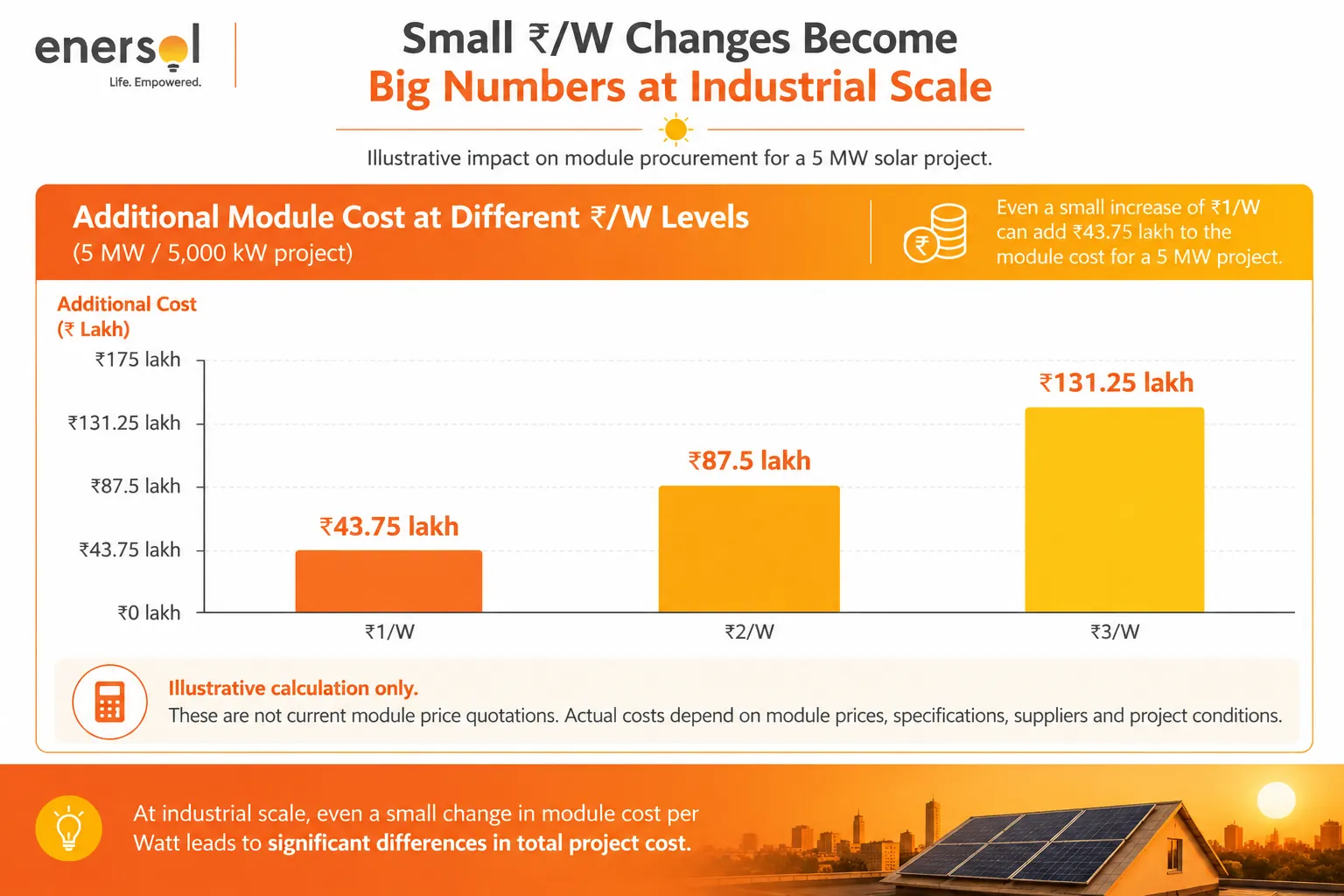
Illustrative calculation only. These are not current module price quotations.
For a residential customer, a few rupees per watt changes the project cost by thousands.
For a large commercial and industrial solar project, it can change procurement economics by lakhs or crores.
That's why factory owners should understand the supply-chain change rather than leaving it entirely to the EPC contractor.
But Don't Look at Module Price Alone
Suppose a 5 MW project generates an illustrative:
75 lakh units/year
At an avoided electricity value of:
₹8/unit
those units represent:
₹6 crore/year
of gross energy value before considering the actual tariff structure, self-consumption, O&M and other project-specific factors.
Now suppose compliant procurement adds:
₹50 lakh
to project cost.
That ₹50 lakh matters.
But so does the cost of delaying a ₹6-crore-per-year energy asset.
A one-month commissioning delay would represent approximately:
₹50 lakh of deferred gross energy value
under this simplified example.
That leads to one of the most important procurement lessons of 2026:
Availability can matter almost as much as price.
A cheaper module that cannot be supplied in sufficient quantity or cannot be used for the project structure may be more expensive in practical terms.
Why the Commercial Solar Industry Feels This More Strongly
Large C&I projects are particularly exposed because they buy modules in volume.
A 500 kW system using 600 W modules needs roughly:
834 modules
A 5 MW project needs roughly:
8,334 modules
A 20 MW project needs roughly:
33,334 modules
Suddenly, procurement isn't:
“Can I find this module?”
It is:
“Can this manufacturer deliver more than 30,000 eligible modules of the required technology within our commissioning schedule?”
That's a supply-chain question.
And it can directly affect:
- EPC pricing;
- project schedule;
- technology choice;
- working capital;
- financing; and
- expected commissioning.
TOPCon Makes the Discussion Even More Relevant
TOPCon has rapidly become the dominant module technology in India's manufacturing pipeline.
Recent H1 2026 manufacturing data shows that TOPCon represented about 80% of ALMM-listed module manufacturing capacity. Solar Now
That matters because industrial projects often prefer higher-wattage, higher-efficiency modules where roof or land optimisation is important.
Suppose a factory has room for:
5,000 modules
With 550 W modules:
2.75 MW
With 600 W modules:
3.00 MW
Difference:
250 kW
At an illustrative generation of 1,500 units/kW/year:
3,75,000 additional units/year
At ₹8/unit:
₹30 lakh/year
So a procurement decision cannot be based only on:
Which compliant module has the lowest ₹/W?
It should also consider:
How much energy can this module generate from the available project area?
For space-constrained C&I projects, efficiency has an economic value.
Why Imported Cells Still Matter to the Market
India's domestic manufacturing push is strong, but recent import data shows why the transition is complex.
In Q2 2026, India's solar module imports fell by approximately 75%, reflecting tighter ALMM requirements and growing domestic module manufacturing.
Solar cell imports moved in the opposite direction.
Cell imports increased 39% quarter-on-quarter, with developers and manufacturers building inventory ahead of List-II implementation while domestic cell supply remained constrained. PV Tech
That is an unusually clear picture of the supply chain:
India has become much stronger at manufacturing modules.
But:
The cell layer is still catching up.
ALMM List-II is designed to accelerate that next stage.
Why October 2026 Is Being Talked About
October is appearing in industry discussions because additional domestic cell manufacturing capacity has been expected to ramp through the second half of 2026.
That can increase available supply and gradually change pricing.
But businesses should distinguish market ramp-up dates from regulatory implementation dates.
The official ALMM List-II implementation milestone was June 1, 2026 not October.
And the current MNRE framework provides a limited commissioning window to December 31 for specified qualifying projects. Ministry of New and Renewable Energy
So if someone tells a factory:
“Prices will definitely rise after the October DCR deadline.”
ask them:
Which MNRE notification and which project category are you referring to?
There may be a valid commercial point behind the statement.
But it should be supported by the actual regulation.
Domestic Cell Capacity Is Expanding Quickly
The supply picture is not static.
India added approximately:
9.7 GW of solar cell manufacturing capacity
during the first half of 2026 alone.
Total annual cell manufacturing capacity reached around:
36.6 GW
by June 2026. Solar Now
And MNRE continues to add approved capacity.
The July 22 revision of List-II, for example, took total ALMM-listed domestic cell manufacturing capacity to approximately 31.76 GW at that point. Mercomindia.com
By the latest September data, List-II-covered capacity had increased further.
This means today's supply constraint should not automatically be projected unchanged over the next five years.
As more cell lines achieve commercial production and utilisation improves, competition among domestic suppliers can increase.
That could help narrow the compliant-product premium over time.
The Real Question for a Factory: Buy Now or Wait?
This is where the discussion becomes practical.
Suppose your factory is evaluating a 3 MW rooftop project.
Should you wait for more domestic cell capacity in the hope that prices fall?
Maybe.
But price is only one variable.
Assume:
Expected annual generation = 45 lakh units
Avoided grid electricity value = ₹8/unit
Potential annual gross energy value:
₹3.6 crore
Monthly equivalent:
₹30 lakh
Now suppose waiting four months saves:
₹25 lakh on module procurement
but delays commissioning by four months.
Illustrative deferred energy value:
₹30 lakh × 4 = ₹1.2 crore
You saved ₹25 lakh on procurement.
But delayed ₹1.2 crore of potential gross energy value.
This is simplified, but it illustrates why waiting for the lowest module price can be a false economy.
A better decision compares:
expected price movement
against
cost of delayed generation.
Build a “Cost of Waiting” Calculation
Before postponing a commercial and industrial solar project because module prices might fall, calculate:
| Metric | Your Project |
|---|---|
| Proposed capacity | ___ MW |
| Current module price | ₹___/W |
| Expected future module price | ₹___/W |
| Potential procurement saving | ₹___ |
| Monthly expected generation | ___ units |
| Grid electricity value | ₹___/unit |
| Monthly value of delayed generation | ₹___ |
| Expected delay | ___ months |
| Total deferred energy value | ₹___ |
Now management can make a financial decision rather than a market-price guess.
Don't Confuse Compliance With Quality
Another important point:
Being included under ALMM does not automatically make a module the best technical option for your factory.
Industrial buyers should still compare:
- module efficiency;
- TOPCon/PERC/HJT technology;
- temperature coefficient;
- degradation;
- product warranty;
- performance warranty;
- mechanical-load capability;
- manufacturer track record;
- after-sales support.
Compliance answers:
“Is this product eligible under the applicable framework?”
Engineering answers:
“Is it suitable for this project?”
Commercial analysis answers:
“Does it deliver good lifetime value?”
A serious procurement process needs all three.
What Should C&I Buyers Ask Their EPC Company Right Now?
For a project being procured in late 2026, ask for these details in writing:
1. Exact module manufacturer and model
Don't accept “Tier-1 TOPCon” as the complete specification.
2. Current ALMM List-I status
Check the exact model.
3. Solar cell manufacturer and model
Understand what is inside the module.
4. Current List-II status
Where applicable, confirm it against MNRE's latest list.
5. Whether DCR applies separately
Ask for the regulatory basis.
6. Whether any transition provision is being used
If yes, ask for the applicable MNRE notification and eligibility basis.
7. Guaranteed delivery schedule
For MW-scale projects, availability matters.
8. Alternative approved module
What happens if the original manufacturer cannot deliver?
This final question can save weeks later.
A Cheap Quote Can Become Expensive Very Quickly
Imagine two EPC proposals.
Proposal A
5 MW plant
Project cost: ₹15 crore
Module supply uncertain
Commissioning: potentially delayed
Proposal B
5 MW plant
Project cost: ₹15.4 crore
Confirmed eligible module allocation
Commissioning: on schedule
At first glance:
Proposal A saves ₹40 lakh.
Now assume the plant is expected to generate energy worth:
₹50 lakh/month
and Proposal A is delayed three months.
Deferred energy value:
₹1.5 crore
The ₹40 lakh saving suddenly looks very different.
This does not mean the more expensive EPC should automatically win.
It means:
Price, compliance, availability and commissioning date need to be compared together.
What Does This Mean for the Commercial Solar Industry?
In the short term, ALMM List-II can create friction.
Domestic cell supply is still catching up with India's much larger module-manufacturing base. That can constrain certain compliant products and create pricing differences.
In the medium term, however, the policy is encouraging investment further upstream.
India has already built enormous module capacity.
Now manufacturers have a stronger commercial reason to invest in:
cells
and eventually:
wafers and other upstream manufacturing.
That can reduce long-term dependence on imported components and build a deeper domestic solar supply chain.
For the commercial solar industry, the transition creates both challenges and opportunities.
Projects need more careful procurement today.
But a larger domestic manufacturing ecosystem can ultimately create greater supply-chain resilience.
Where Enersol Fits
For Enersol, the response to ALMM List-II should not be:
“Use domestic panels because the rule says so.”
The conversation with a commercial or industrial customer should be more useful.
First identify the project structure.
Then establish which ALMM and DCR requirements actually apply.
Verify the module and cell combination against the latest lists.
Check current availability.
Compare compliant module options on both price and performance.
And most importantly, connect procurement decisions back to project economics.
If Option A costs ₹20 lakh less but delays commissioning by three months, calculate that delay.
If Option B has higher-efficiency modules and produces more energy from a constrained industrial roof, calculate that value too.
If waiting for more domestic cell capacity may reduce prices, compare the possible savings with the cost of waiting.
That's how a policy change becomes a business decision.
Final Thoughts
ALMM List-II is changing India's solar market at a deeper level than List-I did.
List-I focused attention on where modules were manufactured.
List-II pushes that scrutiny further upstream to the solar cells inside those modules.
As of June 2026, India had roughly 261.7 GW of annual module manufacturing capacity but only 36.6 GW of cell capacity, demonstrating why the transition is creating short-term supply pressure. Solar Now
At the same time, domestic manufacturing is expanding rapidly, and MNRE's List-II is being updated frequently; the 10th revision was published on September 28, 2026. Ministry of New and Renewable Energy
For businesses considering commercial and industrial solar, the takeaway is not simply:
“Solar panels are becoming more expensive.”
The market is more nuanced.
Some domestic module prices have fallen even while DCR products carry a significant premium. Cell availability, technology, project eligibility and commissioning timelines are now influencing procurement alongside ₹/W. PV Tech
So before approving a large solar purchase in late 2026, ask four questions:
Which rule applies to our project?
Which module-and-cell combination is eligible?
What is available today and at what price?
What will waiting or changing suppliers do to our commissioning date and electricity savings?
For a 5 MW or 20 MW industrial project, those questions can be worth far more than negotiating another few paise per watt.
In 2026, the smartest solar buyer isn't simply finding the cheapest panel. It's calculating the cheapest path to compliant, on-time generation.