

Understand why DCR solar panel prices are rising in 2026 and how domestic cell supply, ALMM List-II and demand are affecting solar project costs.
A business planning solar in 2026 may notice something confusing in its quotations.
Two panels can have similar wattage. Both may use TOPCon technology. Their efficiencies may be close. Even the warranties may look comparable.
Yet one quotation can be significantly higher.
The explanation may have less to do with the panel's visible specifications and more to do with where the solar cells inside it were manufactured.
India's solar manufacturing policy entered an important new phase in 2026. The Approved List of Models and Manufacturers (ALMM) framework now includes List-II for solar PV cells, in addition to List-I for modules. MNRE confirmed that there would be no blanket extension of List-II beyond June 1, 2026, although specified transition protections and a limited window for qualifying projects were subsequently provided. Ministry of New and Renewable Energy
For projects where domestic-content requirements apply, this is changing the supply equation.
India has built a large domestic module-manufacturing industry. But the domestic cell manufacturing base, the part of the supply chain underneath the module, is still catching up with demand.
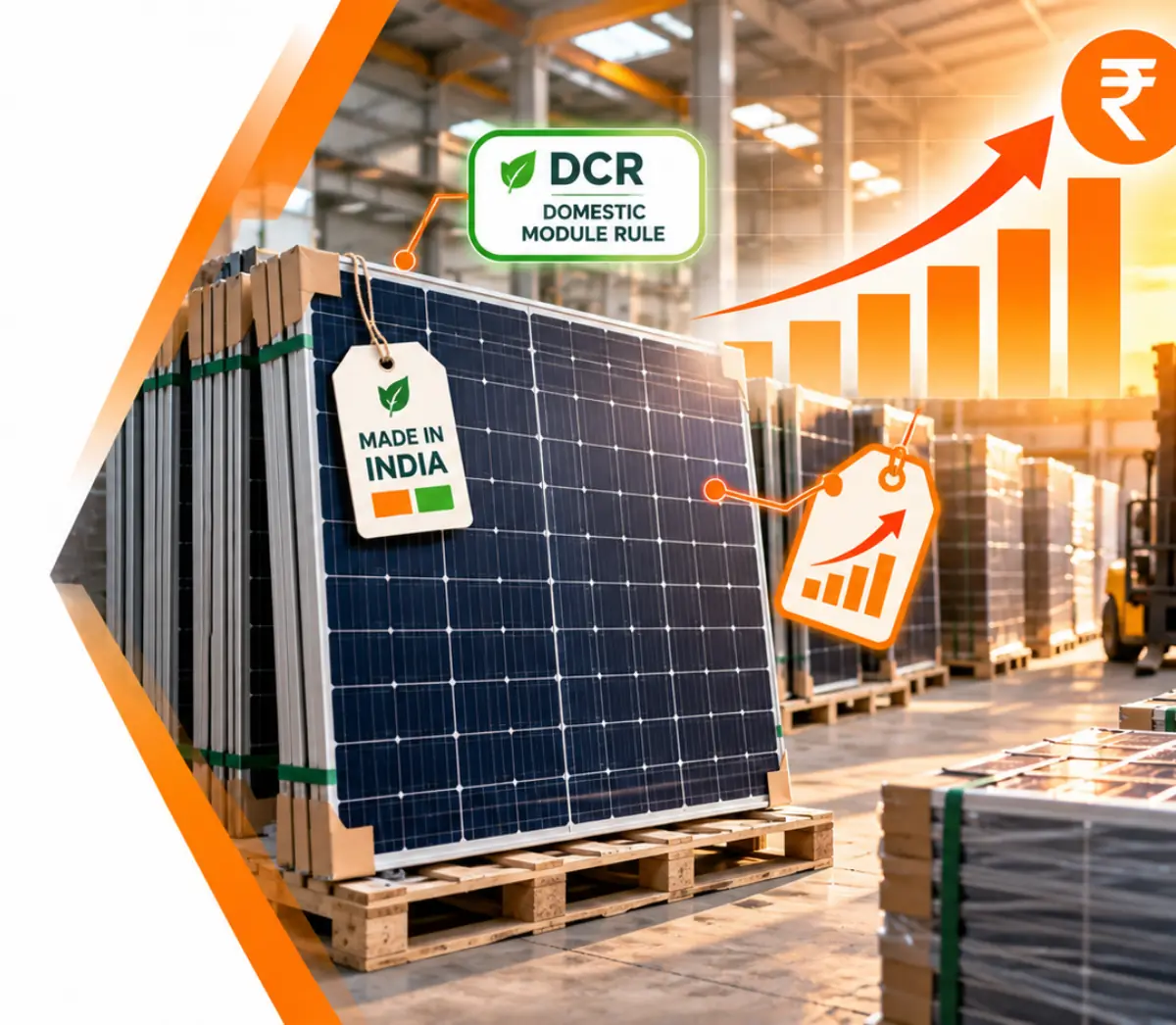
That imbalance is one reason some DCR solar modules are commanding a premium in 2026.
For a homeowner, that can change the installation budget.
For a 1 MW, 5 MW or 20 MW commercial and industrial project, even a small increase in price per watt can mean lakhs or crores of additional capital.
So what is actually happening to solar panel prices and should buyers wait?
First, What Does DCR Actually Mean?
DCR stands for Domestic Content Requirement.
In simple terms, where DCR conditions apply, specified solar components must meet domestic-manufacturing requirements.
But one point is important:
DCR and ALMM are not interchangeable.
DCR deals with domestic-content requirements.
ALMM is the government's Approved List of Models and Manufacturers framework.
MNRE's ALMM currently consists of:
List-I: solar PV modules
List-II: solar PV cells
The first ALMM List-I was issued in March 2021. The first List-II for solar cells was published on July 31, 2025 and has been updated repeatedly since. As of September 28, 2026, MNRE lists the 10th revision of List-II. Ministry of New and Renewable Energy
This distinction matters because buyers sometimes receive a quotation labelled simply:
“DCR Panel”
That is not enough information for a serious procurement decision.
You should know:
- Who manufactured the module?
- Who manufactured the cells?
- Which exact model is being offered?
- Which requirement applies to your project?
Why Did 2026 Change the Market?
The major milestone was:
June 1, 2026
MNRE confirmed that ALMM List-II would not receive a blanket extension beyond this date, subject to protections for investments already made. Ministry of New and Renewable Energy
Later, the ministry provided a limited window through December 31, 2026 for commissioning specified net-metering and open-access renewable-energy projects under stated conditions. Ministry of New and Renewable Energy
This matters because the module supply chain is no longer only about whether a module itself is eligible.
For applicable projects, cell sourcing has become part of the procurement equation.
That increased demand for eligible domestic cells at a time when domestic cell supply was still relatively constrained.
Mercom India Research identified exactly this issue when analysing India's record solar additions in Q1 2026. According to Mercom, the approaching implementation of ALMM List-II contributed to developers accelerating project commissioning amid concerns about limited domestic DCR cell availability and rising module procurement costs. Mercomindia.com
That is an important point.
The price pressure isn't simply:
“Manufacturers decided to increase panel prices.”
It reflects a supply-chain transition.
India Can Make More Modules Than Cells
Think of a solar panel as a finished product.
Inside it are solar cells.
A module manufacturer can have enough factory capacity to assemble large numbers of panels, but that doesn't automatically mean it has access to enough eligible domestic cells to produce the required DCR modules.
That creates a bottleneck.
Imagine:
Module assembly capacity = 100
but
available eligible cell supply = 40
You cannot produce 100 compliant finished modules simply because the assembly line has capacity for 100.
The upstream component becomes the constraint.
This is essentially what makes cell manufacturing so important to India's current solar transition.
Is Your DCR Module Quote Really the Cheapest Path?
Get a complete project cost and delay-cost comparison before you approve a solar purchase.
Why Does Limited Supply Push DCR Module Prices Higher?
Basic economics applies.
Suppose 20 developers collectively require:
5 GW of compliant modules
but manufacturers have only enough eligible cells immediately available to support:
3 GW
Developers begin competing for the same supply.
Manufacturers with captive domestic cell production gain an advantage.
Standalone module manufacturers may have to procure cells from a smaller merchant market.
Delivery slots become valuable.
And the price of compliant finished modules can rise relative to products with a broader sourcing pool.
This does not mean every DCR module will become continuously more expensive.
As new domestic cell factories ramp up, supply can increase.
But during the transition, constrained cell availability can create a premium.
Even ₹1/W Changes the Economics of a Large Solar Project
For homeowners, a ₹1/W increase is noticeable.
For businesses, it becomes substantial.
Consider the same ₹1/W difference across different project sizes:
| Solar Capacity | ₹1/W Difference | ₹2/W Difference |
|---|---|---|
| 5 kW | ₹5,000 | ₹10,000 |
| 100 kW | ₹1 lakh | ₹2 lakh |
| 500 kW | ₹5 lakh | ₹10 lakh |
| 1 MW | ₹10 lakh | ₹20 lakh |
| 5 MW | ₹50 lakh | ₹1 crore |
| 10 MW | ₹1 crore | ₹2 crore |
These are simple mathematical examples, not current module quotations.
But they demonstrate why a small change in solar panel prices matters much more for commercial and industrial buyers.
A procurement team negotiating a 10 MW project cannot treat ₹1/W as a rounding error.
It represents:
₹1 crore.
But Module Price Is Only One Part of Solar Project Cost
This is where buyers can make the opposite mistake.
If DCR modules are more expensive, it is tempting to focus entirely on reducing the panel price.
But the cheapest module quotation does not necessarily produce the cheapest completed solar project.
A rooftop or ground-mounted solar system also includes:
- mounting structures;
- inverters;
- DC and AC cables;
- transformers where required;
- switchgear and protection;
- civil work;
- engineering;
- installation;
- testing and commissioning;
- O&M.
For rooftop projects, structural work and waterproofing can also affect cost.
So if module prices increase by 5%, the complete project cost does not necessarily increase by exactly 5%.
The impact depends on what share of total project CAPEX the modules represent.
The Cost of Waiting Can Be Bigger Than the Module Premium
This is particularly important for commercial and industrial buyers.
Suppose a factory is planning a:
2 MW solar installation
Expected generation:
30 lakh units/year
Assume those solar units would offset electricity worth an average:
₹8/unit
Potential annual electricity value:
₹2.4 crore
Monthly equivalent:
₹20 lakh
Now suppose management delays the project by four months because it expects module prices to fall.
Potential deferred electricity value:
₹20 lakh × 4 = ₹80 lakh
If waiting reduces procurement cost by only:
₹25 lakh
then the business has potentially delayed ₹80 lakh of energy value to save ₹25 lakh upfront.
This is simplified—the actual result depends on generation seasonality, tariff structure, project financing and commissioning timing—but it demonstrates the calculation every business should perform.
Don't ask only:
“Will panels become cheaper?”
Also ask:
“What does every month without solar cost us?”
A Useful “Wait vs Install” Calculation
Consider a 1 MW industrial system.
Assume:
Expected annual generation: 15 lakh units
Avoided electricity cost: ₹9/unit
Annual gross energy value:
15,00,000 × ₹9 = ₹1.35 crore
Average monthly value:
₹11.25 lakh
Now suppose module prices are expected to fall enough to reduce project cost by:
₹20 lakh
But waiting takes:
6 months
Simplified deferred energy value:
₹11.25 lakh × 6 = ₹67.5 lakh
Possible procurement saving:
₹20 lakh
Potential deferred energy value:
₹67.5 lakh
Again, this isn't a project ROI calculation. It is a framework for making a better decision.
Waiting for cheaper panels is useful only when the saving from waiting outweighs the value and risks associated with delayed commissioning.
Why DCR Prices Don't Move Exactly Like Global Module Prices
This is another source of confusion.
A factory owner may read:
“Global solar module prices have fallen.”
Then receive a higher domestic DCR quotation.
Both can be true.
Global module prices reflect international supply and demand.
DCR module pricing depends much more directly on the eligible domestic supply chain.
If international cell and module manufacturing has excess capacity, global prices may fall.
But if demand for eligible domestic cells temporarily exceeds available supply, DCR products can still command a premium.
That means businesses should avoid using an international module-price chart as the only benchmark for an Indian DCR project.
You need to compare the actual eligible product available for your project.
Policy Deadlines Can Also Influence Prices
Solar equipment prices do not move only because of manufacturing costs.
Project deadlines matter.
Imagine hundreds of developers trying to commission projects before the same regulatory milestone.
They all need modules.
At roughly the same time.
Demand becomes concentrated.
That can affect:
inventory;
delivery schedules;
module premiums;
and even
EPC execution capacity.
Mercom reported that India installed a record 15.3 GW of solar capacity in Q1 2026, up 143% from Q1 2025. It specifically cited approaching policy deadlines, including ALMM List-II implementation, as one factor driving developers to accelerate commissioning. Mercomindia.com
So when discussing 2026 module prices, timing cannot be separated from regulation.
What Does This Mean for Residential Solar?
Residential customers should be careful not to turn this policy discussion into:
“Solar has become too expensive.”
The economics of a home system depend on the final installed cost after applicable subsidy, expected generation and household electricity consumption.
Suppose a household is considering a:
3 kW residential solar system
A ₹2/W difference in module price equals:
3,000 × ₹2 = ₹6,000
That matters.
But if one system has better engineering, stronger installation quality, suitable equipment and reliable after-sales support, choosing purely on a ₹6,000 difference may not be wise for an asset expected to operate for decades.
For homeowners, compare the complete installed system, not just module ₹/W.
DCR Matters Particularly Under Government-Linked Requirements
Domestic-content requirements have an important role in government-supported solar programmes.
But buyers should not assume that every private solar installation in India automatically has exactly the same DCR requirement.
The applicable framework depends on the project.
Similarly, ALMM List-I applies to specified categories including government and government-assisted projects, projects under government schemes, open-access projects and net-metering projects. MNRE's official ALMM framework should therefore be checked against the actual project structure. Ministry of New and Renewable Energy
For a business, the practical question should be:
“Which equipment requirements apply to our exact project?”
not:
“Is DCR compulsory everywhere?”
Don't Buy a Panel Only Because It Says “Made in India”
Domestic manufacturing and technical quality are related to different questions.
A solar buyer should still evaluate:
- module efficiency
- technology
- temperature coefficient
- first-year degradation
- annual degradation
- product warranty
- performance warranty
- mechanical load ratings
- manufacturer track record
- after-sales support.
Likewise, ALMM eligibility does not automatically mean every listed module is technically identical.
The objective should be:
compliant + technically suitable + commercially sensible.
Not merely:
compliant.
Higher-Efficiency Panels Can Justify a Higher Price on a Limited Roof
Consider a commercial property that can physically accommodate:
1,000 modules
Option A:
550 W/module
Total:
550 kW
Option B:
600 W/module
Total:
600 kW
Difference:
50 kW
Assume an illustrative generation yield of:
1,500 units/kW/year
Additional annual generation:
50 × 1,500 = 75,000 units
At an avoided electricity value of ₹9/unit:
₹6.75 lakh/year
So if the 600 W option costs slightly more, the correct question is not:
“Which panel has the lowest price?”
It is:
“What additional lifetime energy value does the higher-performing system create from our limited roof?”
This is especially relevant for factories and commercial buildings where roof area is finite.
Procurement Certainty Has a Financial Value Too
Consider two quotations for a 5 MW project.
Supplier A
Lower module price
Delivery: uncertain, 10–14 weeks
Supplier B
₹0.60/W higher
Confirmed delivery: 6 weeks
Difference:
50,00,000 W × ₹0.60 = ₹30 lakh
Supplier B appears ₹30 lakh more expensive.
But suppose the project is expected to generate electricity worth:
₹40 lakh/month
and Supplier A causes a two-month commissioning delay.
Deferred energy value:
₹80 lakh
Now the commercial comparison looks very different.
This is why 2026 procurement should evaluate:
Price + eligibility + availability + commissioning date
together.
Will DCR Solar Module Prices Stay High?
Nobody can responsibly promise the direction of module prices.
Several competing forces are at work.
Prices could ease if:
domestic solar-cell capacity expands rapidly;
new manufacturers enter List-II;
factory utilisation improves;
competition increases; and
cell supply catches up with module manufacturing.
Prices could remain firm or rise if:
project demand grows faster than eligible supply;
specific high-efficiency cells remain constrained;
developers rush to meet commissioning deadlines;
input costs increase; or
certain technologies have limited domestic availability.
MNRE's List-II is already evolving quickly. The ministry published the first list in July 2025 and, as of September 28, 2026, had reached its 10th revision. Ministry of New and Renewable Energy
That suggests domestic eligible supply is not static.
For buyers, the better strategy is not to predict the exact lowest price.
It is to understand whether today's project economics already work.
What Businesses Should Ask Before Approving a DCR Module Quote
For a large solar project, ask your EPC company for these numbers in writing:
| Question | Project Answer |
|---|---|
| Module manufacturer | ___ |
| Exact module model | ___ |
| Cell manufacturer | ___ |
| Module technology | ___ |
| Module wattage | ___ W |
| Module price | ₹___/W |
| Applicable ALMM status | ___ |
| DCR required for this project? | Yes / No |
| Expected module delivery | ___ |
| Expected commissioning | ___ |
| Expected annual generation | ___ kWh |
| Estimated annual savings | ₹___ |
Then ask one additional question:
“If this module is unavailable next month, what is the approved alternative and how does it change our cost and generation?”
That question is particularly valuable in a supply-constrained market.
What Homeowners Should Compare
For a residential installation, the checklist can be simpler.
Don't compare quotations based only on:
₹ per kW
Compare:
- Panel make and model
- Inverter
- Mounting structure
- Electrical protection
- Expected annual generation
- Warranty
- Workmanship
- Monitoring
- After-sales service
- final cost after applicable subsidy
The cheapest panel does not necessarily create the cheapest electricity over 20–25 years.
How Enersol Can Approach the 2026 Price Shift
For Enersol, changing module prices should not result in pushing whichever panel happens to be cheapest that month.
A better process begins with the project itself.
For a residential customer:
What is the annual consumption?
How much roof is usable?
Which subsidy or scheme requirements apply?
Which eligible system offers appropriate performance and value?
For a commercial or industrial customer:
What project structure is being used?
Does DCR apply?
Which ALMM requirements apply?
How many MW are required?
Which modules are genuinely available in that quantity?
What happens to generation if commissioning is delayed?
Would a higher-efficiency module create more value from the available area?
That turns a discussion about panel price into a discussion about the cost of solar electricity over the life of the project.
And that is the number that ultimately matters.
Final Thoughts
Domestic solar modules are not getting more expensive in 2026 for one simple reason.
Several forces are interacting.
India's module-manufacturing base has expanded rapidly, while eligible domestic cell supply is still developing. ALMM List-II became a major procurement consideration from June 1, 2026, increasing the importance of cell sourcing for applicable projects. MNRE has continued expanding and revising List-II, reaching its 10th revision by September 28. Ministry of New and Renewable Energy
At the same time, developers accelerated commissioning ahead of policy deadlines because of concerns around domestic DCR cell availability and module procurement costs. Mercomindia.com
For buyers, however, the takeaway should not be:
“Solar is expensive now, so wait.”
Nor should it be:
“Buy immediately before prices rise again.”
Both are too simplistic.
Instead, calculate four numbers:
Today's complete project cost
Expected annual solar generation
Annual electricity savings
Financial cost of delaying commissioning
Then compare those numbers against any realistic module-price saving you expect from waiting.
For a homeowner, a few rupees per watt may change the budget by a few thousand rupees.
For a 5 MW factory, the same price movement can change CAPEX by tens of lakhs.
But a delayed project can also postpone electricity savings worth tens of lakhs every month.
The right time to install solar is therefore not necessarily when panels reach their lowest price. It is when the complete project's economics make sense and the right equipment can be procured, installed and commissioned with confidence.