
Learn what happens to commercial solar when you shift, rent or sell your premises, including plant ownership, relocation, transfer, leases and OPEX contracts.
A company installs a 500 kW rooftop solar plant in its factory.
The project economics look strong. The system is designed for 20–25 years of operation.
Then, five years later, the business decides to move to a larger facility.
Now comes a question that probably wasn't discussed when the solar proposal was signed:
What happens to the solar plant?
Can you take it with you?
Does it stay with the building?
Can the new tenant use it?
If the property is sold, does the buyer automatically get the solar benefits?
And if the plant was installed under an OPEX or RESCO arrangement, who actually owns it?
For businesses, these questions matter because a commercial solar project can outlive a lease, a manufacturing unit, a warehouse agreement or even the ownership structure of the property.
The right answer depends on three things:
Who owns the solar asset, who controls the premises, and what agreements connect the system to that electricity connection.
That is why property strategy should be discussed before not after a commercial solar panel installation.
Start With One Question: Who Owns the Solar Plant?
Before discussing relocation, separate the two most common commercial structures.
CAPEX Solar
The business generally funds and owns the solar system.
In simplified terms:
Your company pays → Your company owns the plant → Your company receives the energy benefit
OPEX / RESCO Solar
A third-party developer typically funds and owns the system while the business purchases the electricity under a contractual arrangement.
In simplified terms:
Developer invests → Developer owns plant → Business purchases solar electricity
That difference becomes extremely important when a business leaves the premises.
With CAPEX, the company has an asset to deal with.
With OPEX, it has a contractual obligation to deal with.
Those are not the same problem.
Scenario 1: You Own the Building and Sell It
Suppose your company owns a factory and has installed a 500 kW CAPEX rooftop solar plant.
Five years later, you sell the entire property.
There are broadly three commercial possibilities.
Option A: Solar Is Included in the Property Sale
The buyer acquires the premises along with the solar asset, subject to the contractual, regulatory and electricity-connection formalities that apply.
This can potentially strengthen the property's value proposition.
Instead of selling:
Factory + roof
you are effectively selling:
Factory + operational energy-generating asset
But the buyer should understand:
- plant ownership;
- remaining warranties;
- generation history;
- O&M requirements;
- inverter condition;
- applicable electricity arrangement;
- interconnection documentation; and
- regulatory approvals.
Solar should therefore appear explicitly in the asset-sale documentation.
Do not assume that selling the building automatically settles every electricity and solar agreement.
Option B: Solar Is Valued Separately
The property and solar plant can be commercially valued as separate assets within the transaction.
For example:
Property value: ₹20 crore
Remaining solar asset value: ₹1.2 crore
Negotiated transaction: based on both assets
The actual valuation would depend on plant age, generation, equipment condition, remaining useful life, warranties and future energy value.
Option C: You Intend to Remove the Solar Plant
Technically, rooftop modules and many balance-of-system components can be dismantled.
But that doesn't automatically mean relocation makes financial sense.
More on that shortly.
Scenario 2: Your Business Rents the Premises
This is where planning becomes much more important.
Imagine a business signing a:
5-year factory lease
and installing a solar plant expected to operate for:
20–25 years.
Immediately, there is a mismatch.
Solar asset life: decades
Confirmed site control: 5 years
That does not mean a tenant should never install solar.
It means the lease needs to answer the solar questions.
Before investing, clarify:
Does the landlord permit rooftop solar?
Who owns the system?
Who has rights over the rooftop?
Can the system remain after the lease expires?
Who pays for removal?
Who pays for roof restoration?
Can the landlord purchase the system when the tenant leaves?
Can the tenant transfer the system to the next occupier?
What happens if the lease ends early?
Without these clauses, a good solar investment can become a property dispute.
Will Your Solar Investment Survive a Move, Lease Exit or Sale?
Talk to our team about CAPEX, OPEX and lease-aligned commercial solar structures.
Legal Possession Matters Too
For Gujarat businesses, this is not merely a private contractual issue.
GERC's rooftop solar regulations state that an eligible consumer must be a consumer of the local distribution licensee and must own or be in legal possession of the premises, including the rooftop, terrace, building, infrastructure or relevant open area where the system is installed. The system is also connected to the distribution network at that premises. Gercin
That reinforces an important practical point:
Commercial rooftop solar is tied to a specific site and electricity arrangement—not simply to the company that paid for the panels.
The applicable rules have also continued to evolve. GERC's current renewable-energy regulations page lists the original rooftop net-metering regulations and subsequent amendments, while further distributed-renewable-energy regulations have been under development in 2026. Gercin
So any transfer should be checked against the rules applicable at the time rather than assuming today's process will remain unchanged for 15 years.
Scenario 3: You Shift Your Factory
This is usually the first solution management thinks of:
“We'll just move the solar panels.”
Possible?
Potentially.
Simple?
Not necessarily.
A commercial solar plant is more than modules.
It can include:
- solar modules;
- mounting structures;
- inverters;
- DC cabling;
- AC infrastructure;
- protection systems;
- earthing;
- monitoring;
- metering arrangements; and
- structural modifications.
The existing mounting structure was also designed around the original roof.
Your new facility may have:
- different roof dimensions;
- different structural capacity;
- different shading;
- different orientation;
- different electrical infrastructure;
- different contract demand;
- a different DISCOM connection.
Moving 1,000 panels does not mean you can recreate the same plant simply by putting those panels on another roof.
The Relocation Cost Can Be Bigger Than Expected
Consider an illustrative 500 kW CAPEX plant.
Assume the original investment was:
₹2 crore
Five years later, the company moved.
Suppose dismantling, transport, testing, new structures, installation and electrical work collectively cost an illustrative:
₹30 lakh
That's already:
15% of the original project investment.
And the business still needs to consider:
- downtime;
- damaged components;
- new structural requirements;
- new approvals;
- interconnection;
- warranty implications; and
- roof restoration at the old property.
This is why relocation should be modelled financially rather than treated as a default solution.
Sometimes Leaving the Plant Behind Makes More Sense
Consider two options.
Option 1 — Relocate
Illustrative relocation cost: ₹30 lakh
Remaining useful operating period: 20 years
Additional engineering and approval work required.
Option 2 — Sell the Plant With the Property
Suppose the incoming owner values the operational system at:
₹50 lakh
Instead of spending ₹30 lakh to relocate it, the outgoing business realises ₹50 lakh through the property transaction.
Difference in immediate cash position:
₹80 lakh
This is purely illustrative, but it demonstrates why the answer should come from financial analysis.
Move the Solar Plant or Transfer Its Value?
Illustrative comparison for an existing commercial rooftop solar asset.
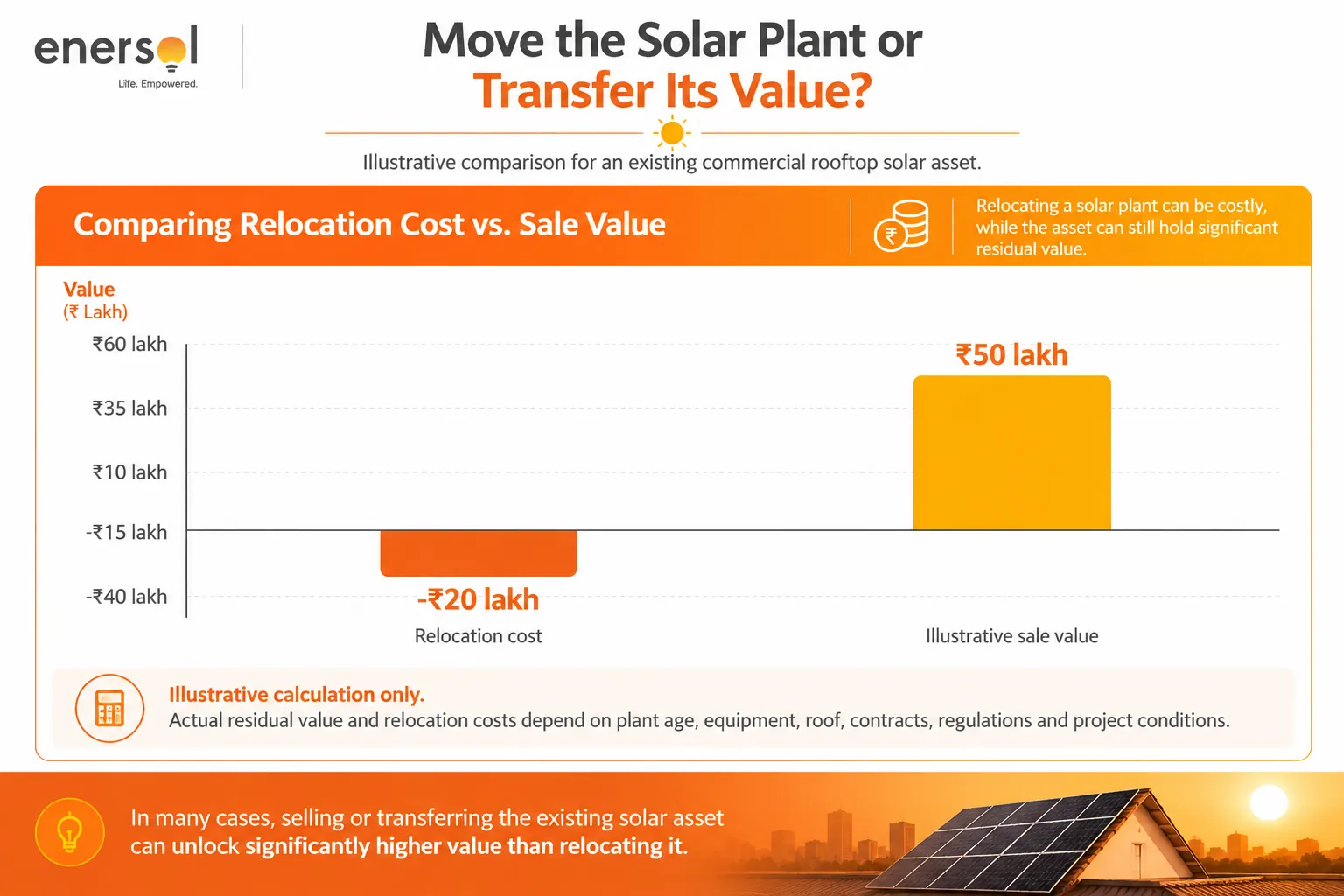
The economically correct decision could be:
Move it.
Or:
Leave it and sell it.
Or even:
Leave the existing plant and install a new, better-designed system at the new facility.
Scenario 4: You Sell the Business but Keep the Property
Now consider the opposite arrangement.
The business changes ownership, but operations continue at the same premises.
This may be easier physically because the plant doesn't move.
But commercial and legal questions still remain.
You need to establish:
Who owns the solar asset after the transaction?
Who holds the electricity connection?
Does the solar interconnection agreement require updating?
Who receives the benefit of generated electricity?
Are equipment warranties transferable?
Who takes responsibility for O&M?
The fact that the panels remain physically untouched does not mean the paperwork can be ignored.
In Gujarat, rooftop projects operate within a formal regulatory and interconnection framework, and disputes over applicable rooftop solar agreements and regulatory provisions continue to come before GERC. Recent 2026 matters involving industrial consumers demonstrate the importance of interconnection agreements and the regulatory framework applicable to commercial rooftop projects. Gercin
For a substantial C&I solar asset, documentation should therefore form part of transaction due diligence.
Scenario 5: You're Under an OPEX or RESCO Agreement
This changes the discussion significantly.
Suppose a third-party developer owns the 500 kW solar plant installed on your factory.
Your business has signed a:
Five years later, you want to leave the premises.
You cannot simply say:
“We're moving. Keep the panels.”
The contract may contain provisions relating to:
- minimum offtake;
- early termination;
- termination payments;
- change of control;
- property access;
- transfer to another consumer;
- landlord obligations;
- plant buyout; and
- relocation.
This is why an OPEX proposal should never be evaluated only on:
“Solar tariff = ₹X/unit.”
You are signing a long-term commercial agreement.
Exit terms matter.
The Question to Ask Before Signing an OPEX PPA
Ask the developer:
“What happens if we leave this property in Year 5?”
Then ask for the answer in the contract.
Not verbally.
If the company has a 7-year lease but is considering a 15-year solar PPA, that mismatch should be addressed before signing.
A low solar tariff is much less attractive if leaving the premises triggers a large termination payment.
Scenario 6: You Own the Plant but the New Tenant Uses the Building
Here's another interesting case.
Your company owns a commercial property.
You install solar.
Later, you rent the property to another business.
Can the tenant simply use solar electricity?
Commercially, this may be possible under an appropriately structured arrangement, but the answer depends on:
electricity connection ownership;
applicable regulations;
metering structure;
solar ownership;
lease terms; and
how electricity is legally supplied and settled.
Do not create an informal arrangement where the landlord simply starts “selling solar power” to a tenant without checking the applicable electricity regulations and contractual structure.
The property lease, electricity connection and solar arrangement need to work together.
The Solar Plant Has a Residual Value
Businesses often calculate solar like this:
Investment → Savings → Payback
But if you may sell the facility later, add another concept:
Residual asset value.
Suppose a plant costs:
₹2 crore
and has operated for:
7 years
It still potentially has many years of productive life remaining.
The modules haven't suddenly become worthless because the original owner is leaving.
A buyer could value the plant based on:
historical generation;
remaining module performance;
inverter condition;
remaining warranties;
expected future electricity savings;
O&M history; and
applicable regulatory arrangement.
That information can strengthen your negotiating position during a property transaction.
Keep a Solar Asset File From Day One
This is one of the most actionable steps a business can take.
Create a digital folder containing:
- Original EPC contract
- Approved system drawings
- Module serial numbers
- Inverter details
- Warranty certificates
- Commissioning reports
- Electrical diagrams
- Structural documents
- DISCOM/interconnection documents
- Generation history
- O&M records
- Insurance records
- Repair/replacement history
- Applicable PPA, if any
Imagine buying a factory with a 700 kW rooftop plant.
Would you rather hear:
“Solar installed around 2021. It works fine.”
or receive five years of documented generation and maintenance records?
The second plant is easier to assess and potentially easier to value.
Your Generation Data Becomes Due-Diligence Evidence
Suppose your 500 kW plant has generated:
7.3 lakh units
7.2 lakh units
7.1 lakh units
across its last three complete years.
Now a property buyer has evidence of the plant's actual operating performance.
At an illustrative electricity value of ₹9/unit, 7.2 lakh annual units represent:
₹64.8 lakh/year of gross energy value
before accounting for the actual tariff structure and other factors.
That's much more compelling than saying:
“The factory has solar.”
A well-documented commercial solar plant can be presented as a measurable operating asset.
What About Commercial Solar Battery Storage?
If the site also includes commercial solar battery storage, relocation becomes even more specialised.
Battery systems require consideration of:
- battery chemistry;
- remaining cycle life;
- state of health;
- fire and safety requirements;
- transport regulations;
- inverter/PCS compatibility;
- thermal management;
- warranties;
- commissioning; and
- new-site electrical design.
A battery system should therefore not be treated like office furniture that can simply be loaded onto a truck.
Before relocation, the original manufacturer, EPC/O&M provider and relevant engineering specialists should assess whether relocation is technically and economically sensible.
Five Questions to Ask Before Installing Solar on Rented Commercial Property
If your factory, hotel, warehouse or office is leased, answer these questions before approving the project:
| Question | Why It Matters |
|---|---|
| How many years remain on our lease? | Compare site control with project life |
| Who owns the solar plant? | Determines asset rights |
| Does the landlord approve installation? | Establishes rooftop rights |
| What happens when the lease ends? | Prevents exit disputes |
| Who pays for removal/restoration? | Reveals future liabilities |
Then add one more:
Can the plant or contract be transferred to the landlord or next tenant?
If nobody has discussed this, the solar proposal isn't finished.
Add a “Property Exit Test” to Your Solar ROI
Consider a company evaluating a solar project with:
Simple payback: 3 years
That sounds excellent.
But the business expects to relocate in four years.
Now ask:
Project investment: ₹2 crore
Four-year savings: ₹___
Residual plant value: ₹___
Relocation cost: ₹___
Roof restoration cost: ₹___
Contract termination cost: ₹___
Value if transferred with property: ₹___
The investment decision may still be excellent.
But now you're analysing the project against the company's actual property strategy.
That is far more useful than a generic 25-year savings calculation.
Where Enersol Fits
For Enersol, a C&I solar project should not be designed only around today's electricity bill.
The conversation should also consider the business's operating horizon.
Does the company own the property?
Is it leased?
How many years remain?
Is expansion planned?
Could manufacturing shift to another site?
Is the project CAPEX or OPEX?
Could the solar asset need to transfer with the property?
Those questions can influence system design, financing and contractual structure.
For a company that owns its industrial facility and expects to remain there for decades, a long-term commercial solar investment can be relatively straightforward.
For a company with a short lease and aggressive expansion plans, the structure may need much more thought.
The objective isn't simply to install solar successfully.
It is to make sure the solar investment still makes sense when the business changes.
Final Thoughts
Commercial solar is a long-life energy asset.
Commercial property decisions are often much shorter.
Businesses move.
Factories expand.
Warehouses change tenants.
Companies merge.
Properties are sold.
Leases expire.
A solar project designed without considering those possibilities can create unnecessary financial and contractual complications later.
So before signing your next commercial solar panel installation agreement, ask a question that has nothing to do with panel efficiency:
“What happens to this plant if we're no longer operating from this property?”
For a CAPEX system, understand ownership, residual value, relocation and transfer.
For an OPEX project, understand PPA tenure, termination and transfer provisions.
For leased premises, align the solar agreement with the property lease.
And if the business does eventually move, don't automatically dismantle the plant.
Compare the economics of:
relocating it, selling it with the property, transferring it to the next occupier, or installing a new system at the new site.
A well-designed solar project should work for your business today.
A well-planned one should also have an answer for the day your business moves on.