

Learn how dust, bird droppings and monsoon residue affect home solar panel efficiency, plus when solar panel cleaning and maintenance really matter.
Your rooftop solar system can be working normally, show no inverter fault, and still generate less electricity than it should.
The reason may be sitting directly on the glass.
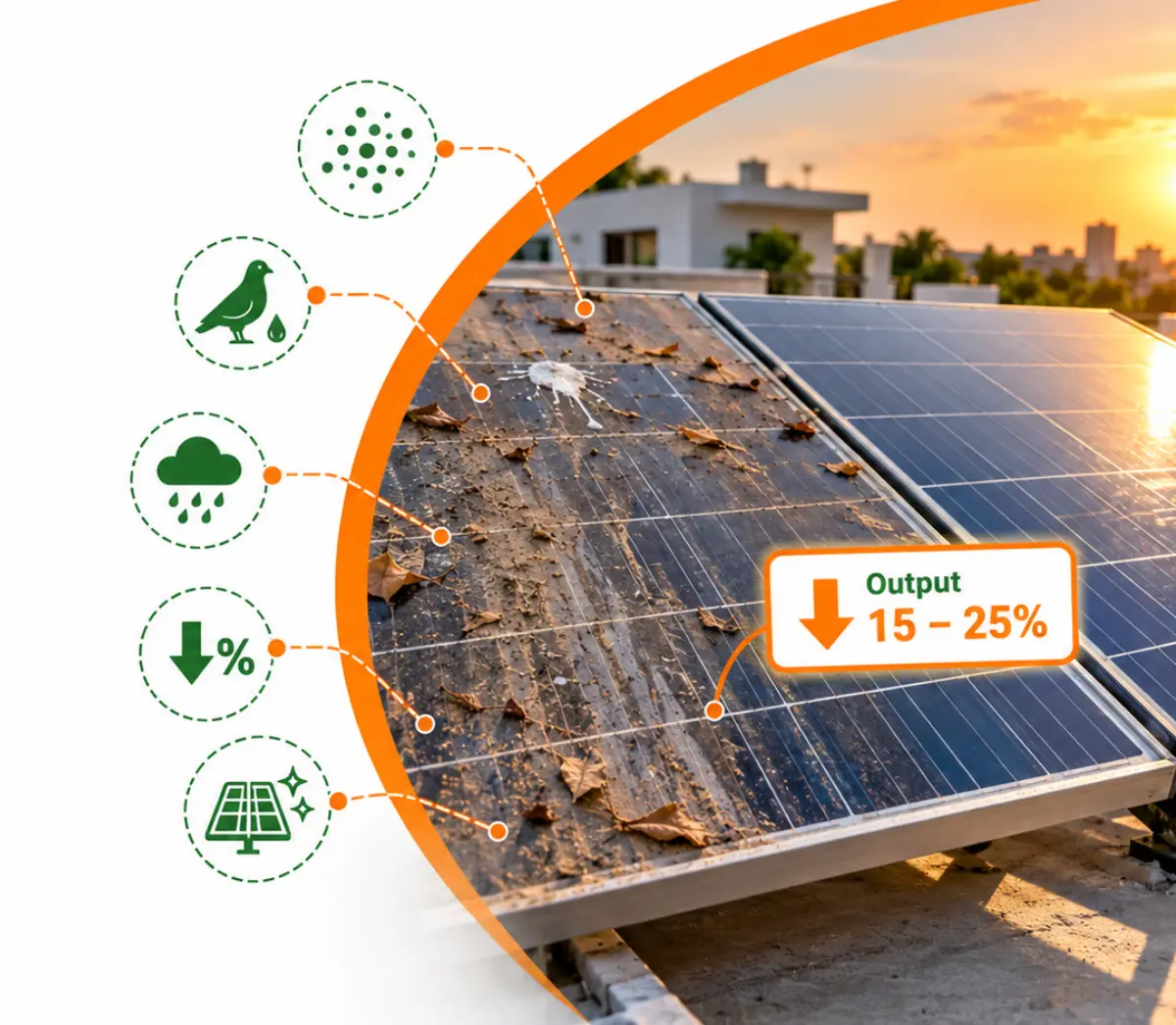
Dust, pollution, bird droppings, leaves and residue left after rain can reduce the sunlight reaching solar cells. The difficult part is that this loss often happens gradually. There is no dramatic shutdown to alert you. You may simply notice that monthly generation is lower than expected.
As residential rooftop solar expands rapidly in India MNRE reported 32.59 GW of grid-connected rooftop solar capacity as of August 31, 2026 routine performance checks are becoming just as important as installation quality. Ministry of New and Renewable Energy
For homeowners, that means residential solar panel maintenance should not be reduced to “clean the panels occasionally.” Cleaning should respond to what is actually happening on your roof.
Dust Doesn't Need to Cover the Entire Panel to Matter
Solar modules work by allowing sunlight to reach photovoltaic cells. A layer of dust reduces the amount of light getting through.
The effect is highly location-dependent.
A field study in Gandhinagar, western India, measured PV energy-production losses from soiling at approximately 0.37% per day, with a ±0.09% variation, during the studied conditions. The researchers also found that heavy rain could clean modules, while light rain and high humidity could actually worsen particulate deposition. ScienceDirect
Another Indian rooftop study found clear seasonal differences: maximum measured soiling loss reached 0.39% per day in spring, compared with 0.24% per day during monsoon conditions, when heavy rainfall provided more natural cleaning. ScienceDirect
These figures should not be treated as universal predictions for every home. A 2026 India-wide analysis found substantial geographical variation in soiling, influenced particularly by PM10 concentrations, wind and rainfall; even site-level estimates can vary considerably.
That gives homeowners an important lesson:
There is no scientifically sensible “clean every X days” rule for every rooftop in India.
What Could a 5% Output Loss Actually Cost?
Percentages sound small until they are converted into electricity.
Consider an illustrative 5 kW home solar system expected to generate:
7,500 units per year
Assume each unit of solar electricity is worth ₹8 in avoided electricity cost.
Annual energy value:
7,500 × ₹8 = ₹60,000
Now consider different levels of avoidable generation loss.
| Generation Loss | Energy Lost | Illustrative Value Lost |
|---|---|---|
| 2% | 150 units | ₹1,200/year |
| 5% | 375 units | ₹3,000/year |
| 10% | 750 units | ₹6,000/year |
| 15% | 1,125 units | ₹9,000/year |
When soiling becomes real money
Illustrative annual value lost from a 5 kW system generating 7,500 units/year, assuming ₹8/unit.
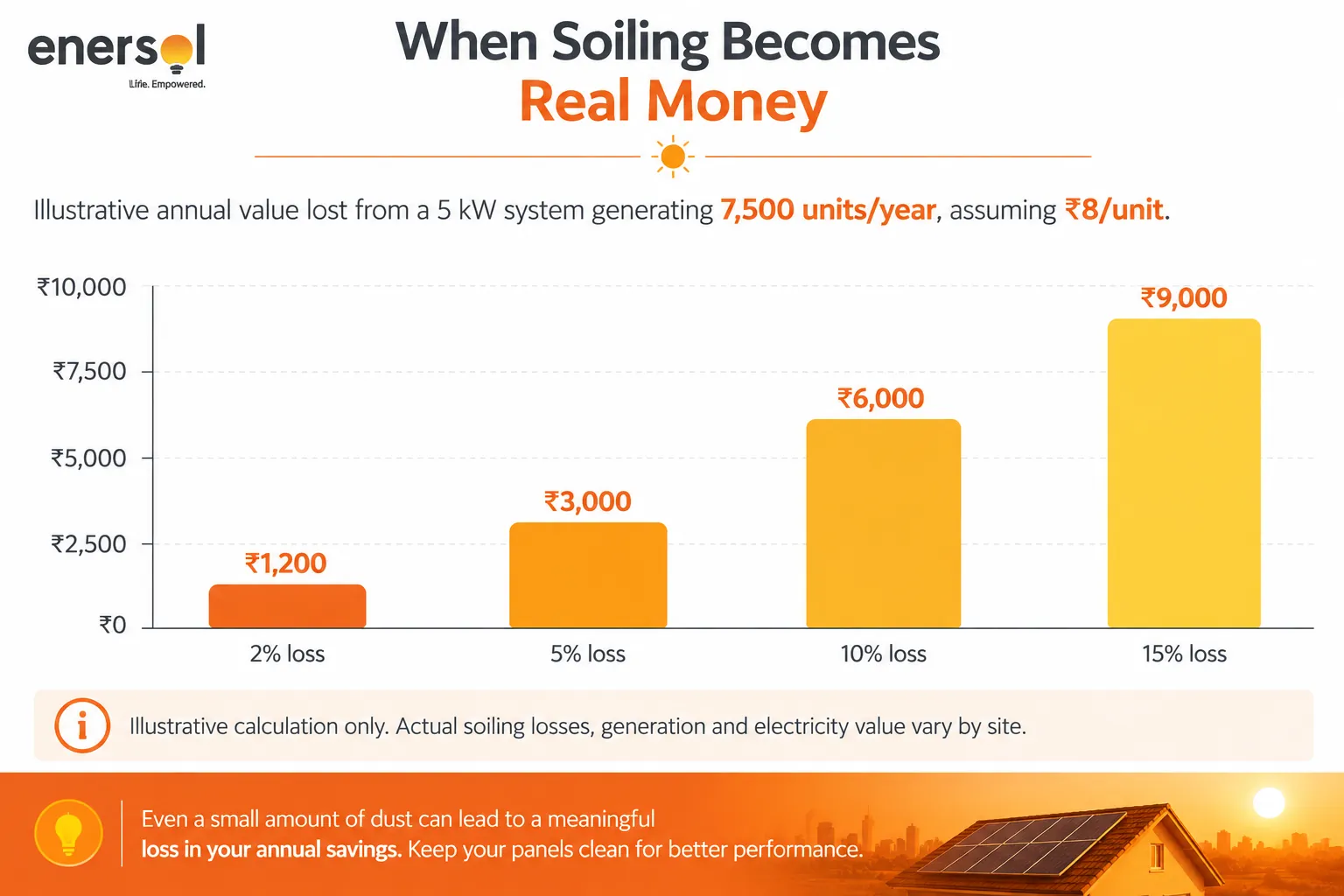
The purpose of this calculation is not to suggest that every dirty rooftop loses 5%, 10% or 15%.
It shows why solar panel power loss due to dust deserves to be measured rather than dismissed because “the panels don't look very dirty.”
Bird Droppings Are Different From Ordinary Dust
Dust often creates a relatively distributed layer across a module.
Bird droppings create a concentrated obstruction.
That distinction matters because a small opaque patch can completely block light from reaching the cells underneath it. Depending on module design, bypass-diode configuration and the position of the obstruction, localized shading can affect more than just the visibly covered area.
This is why a rooftop that appears mostly clean can still deserve attention.
Bird activity also tends to repeat in the same places near parapets, water tanks, antennas or favourite perching points. During solar panel cleaning for home, recurring contamination is therefore more useful to record than simply washing it away and forgetting about it.
If the same modules repeatedly become dirty, discuss preventive measures with your installer rather than increasing cleaning frequency indefinitely.
Is Your Solar Output Slipping?
Enersol's maintenance team can inspect, clean and restore your home solar system to full performance.
Doesn't the Monsoon Clean Solar Panels for Free?
Sometimes, yes.
But the complete answer is more interesting.
Research in Gandhinagar found dry-period soiling rates of around 0.45 ± 0.10% per day, while soiling during the monsoon was negligible overall because rain provided significant natural cleaning. Yet researchers also observed moisture-related caking and changes in deposited particles. ScienceDirect
Earlier work at the same western Indian location found another important distinction:
Heavy rain cleaned panels. Light rain combined with high humidity could increase soiling behaviour.
Think about what happens to a dusty car after a few drops of rain.
It does not necessarily become clean.
Sometimes the water simply rearranges the dust and leaves marks after evaporation.
Solar modules can experience a similar effect.
That is why solar panel maintenance after monsoon should include an inspection rather than assuming months of rain have left every module spotless.
Three Homes May Need Three Different Cleaning Schedules
Imagine three otherwise similar houses.
Home A is surrounded by relatively clean residential streets.
Home B faces an active construction site.
Home C sits near a dusty road and has frequent bird activity.
Giving all three homeowners the instruction “clean every three months” ignores the actual operating environment.
A recent India-wide study reinforces this point: researchers found substantial spatial differences in PV soiling and cleaning requirements across the country. ScienceDirect
The smarter question is therefore not:
“How often should I clean my solar panels?”
It is:
“How quickly does my particular rooftop lose performance between cleanings?”
That can actually be measured.
Use Your Inverter Data Before Reaching for a Hose
Modern solar monitoring gives homeowners a useful advantage.
Record your system's daily generation when the modules are reasonably clean. Then compare it with generation after several dry weeks.
Don't compare two random days because solar irradiation and weather may be different.
Instead, look for persistent patterns over comparable sunny periods.
For example:
Normal sunny-day output: 24–25 units
Later comparable sunny days: 21–22 units
That does not prove dirt is responsible. Temperature, inverter behaviour, shading or electrical issues could also contribute.
But it gives you a reason to investigate.
If generation improves materially after cleaning under similar weather conditions, you have useful site-specific evidence for deciding your future cleaning schedule.
That's far better than blindly cleaning every Sunday.
A Practical Home Solar Maintenance Routine
For most homeowners, residential solar panel maintenance can start with a simple monthly check.
Review the monitoring app and compare generation with previous periods. Look at the modules from a safe location for obvious dust, leaves or bird droppings. After prolonged dry weather, pay closer attention to generation trends. After monsoon, inspect for stubborn residue rather than assuming rainfall handled everything.
Most importantly, do not climb onto an unsafe roof or walk on modules to clean them.
Cleaning should follow the module manufacturer's instructions. Abrasive materials, inappropriate chemicals, unsafe pressure washing or cleaning hot modules without considering manufacturer guidance can create problems of their own.
If access is difficult, use a trained professional.
When Should You Call the Installer Instead?
Cleaning is not the answer to every generation problem.
Suppose your system normally generates around 25 units on comparable sunny days. It suddenly drops to 16 units and remains there even after the panels are cleaned.
That is a 36% reduction.
At that point, repeatedly washing the modules makes little sense.
Ask your installer to investigate:
- inverter warnings or downtime;
- string-level performance;
- new shading;
- damaged connectors or cabling;
- module faults;
- monitoring errors; and
- other electrical issues.
A clean module cannot compensate for a system fault.
This distinction prevents homeowners from confusing maintenance with troubleshooting.
Cleaning More Often Isn't Automatically Better
This is another misconception.
If a ₹1,000 professional cleaning recovers only ₹300 worth of electricity before the next rainfall naturally cleans the modules, the economics are poor.
Cleaning frequency should balance:
Energy recovered − cleaning cost − water/resource use − safety risk
An Indian rooftop study that considered both energy loss and cleaning cost concluded that the economically optimal frequency for its particular monitored system was twice annually once in spring and once in winter. That is a finding for that site, not a universal recommendation.
This distinction is crucial.
The best cleaning schedule is site-specific.
A Simple 30-Day Test for Your Own Roof
Instead of guessing, homeowners can create a basic performance record.
For 30 days, note:
Date | Weather | Solar Generation | Visible Soiling | Cleaning/Rain Event
If cleaning occurs, compare generation before and after using days with reasonably similar weather.
After a few cycles, you may discover that your system needs attention every six weeks during dry construction activity but hardly needs manual cleaning during a heavy monsoon.
That is actionable maintenance based on your roof, not internet advice.
Final Thoughts
One of the biggest benefits of residential solar panels is that they can generate electricity for decades with relatively limited routine intervention.
But “low maintenance” does not mean “no maintenance.”
Dust can gradually reduce the sunlight reaching modules. Bird droppings can create concentrated shading. Heavy rain may clean a rooftop effectively, while light rain and humidity can sometimes leave or worsen residue.
The most useful approach is therefore not obsessive cleaning.
It is performance-based maintenance.
Track generation. Understand your local environment. Inspect after long dry spells and seasonal changes. Clean when there is evidence that cleaning is worthwhile. And if output remains unexpectedly low after cleaning, investigate the system rather than assuming the glass is still dirty.
Good solar panel cleaning for home isn't about making modules look shiny.
It's about making sure the electricity you're expecting from your rooftop is actually reaching your meter.