Compare grid-tied and battery-backed home solar systems. Learn how power cuts, backup needs, energy use and costs can help you choose the right setup.
When homeowners plan rooftop solar, the first conversation usually revolves around system capacity: 3 kW, 5 kW or perhaps 10 kW.
Then comes another question:
Should I add a battery?
There is no universal yes.
A battery can keep selected appliances running during a power cut and store solar energy for later use. But it also adds cost, has finite usable capacity and changes how the system needs to be designed.
For a home with a reliable grid and favourable net-metering arrangement, a straightforward grid-tied system may make economic sense. For another home experiencing frequent outages, backup may be worth paying for.
The right decision starts by understanding what each system actually does.
First: What Does a Grid-Tied Solar System Do?
A standard grid-connected rooftop system works alongside the electricity grid.
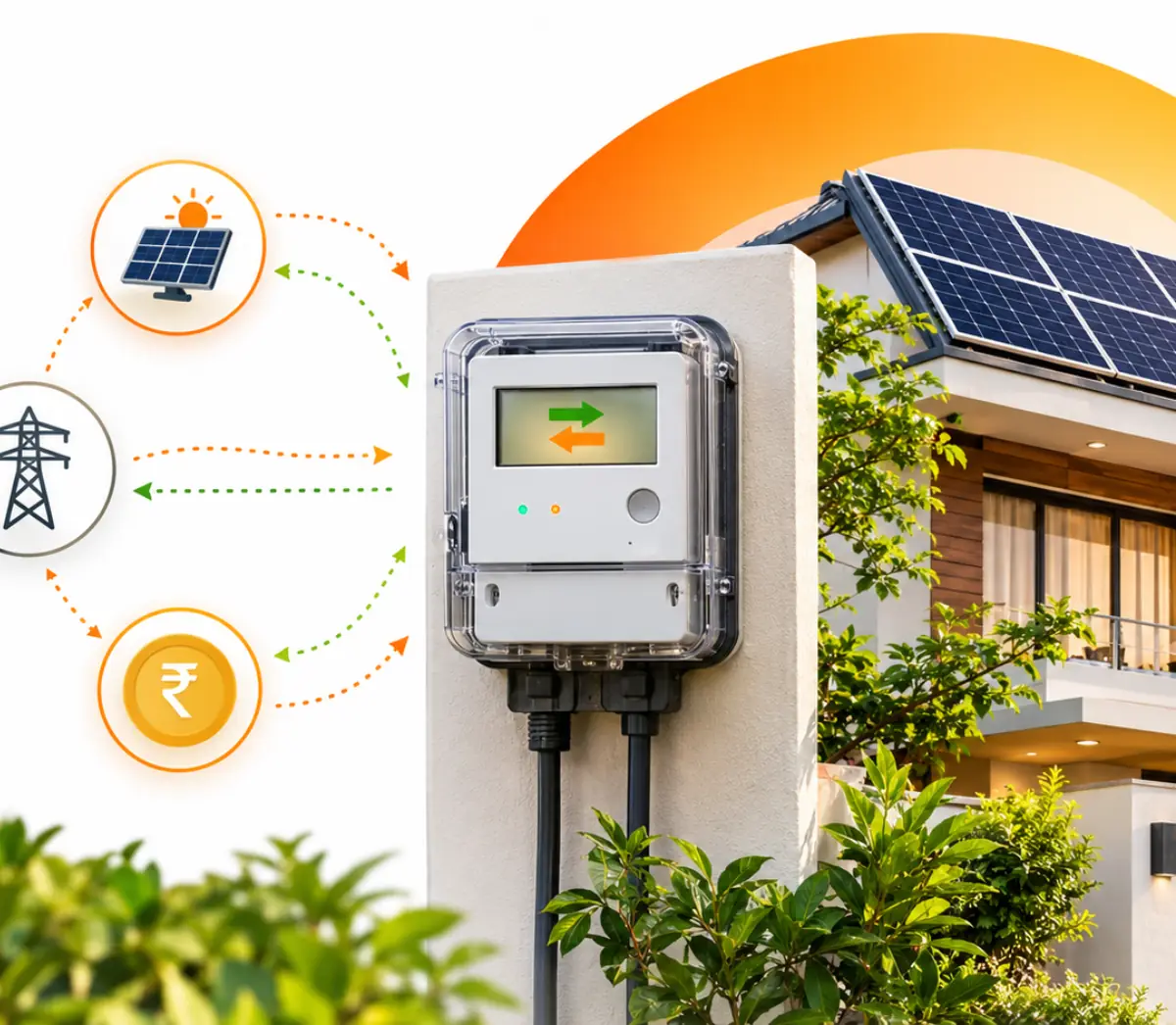
During sunny hours, your panels generate electricity. Your home uses solar generation while it is available. Depending on the applicable metering arrangement, surplus electricity may be exported to the grid. When solar generation is insufficient, your home imports electricity.
India already had 32.59 GW of grid-connected rooftop solar capacity as of August 31, 2026, according to MNRE, so grid-connected rooftop solar is now a substantial part of the country's solar market.
There is one detail homeowners frequently miss:
Ordinary grid-tied solar generally does not mean backup during a blackout.
For safety, a conventional grid-tied inverter normally stops supplying the grid when grid power fails. If you need solar-supported backup during an outage, the system must be specifically designed for that function.
So:
Solar panels ≠ automatic power backup.
That distinction should be clear before you sign a proposal.
Where Does a Battery Change the Equation?
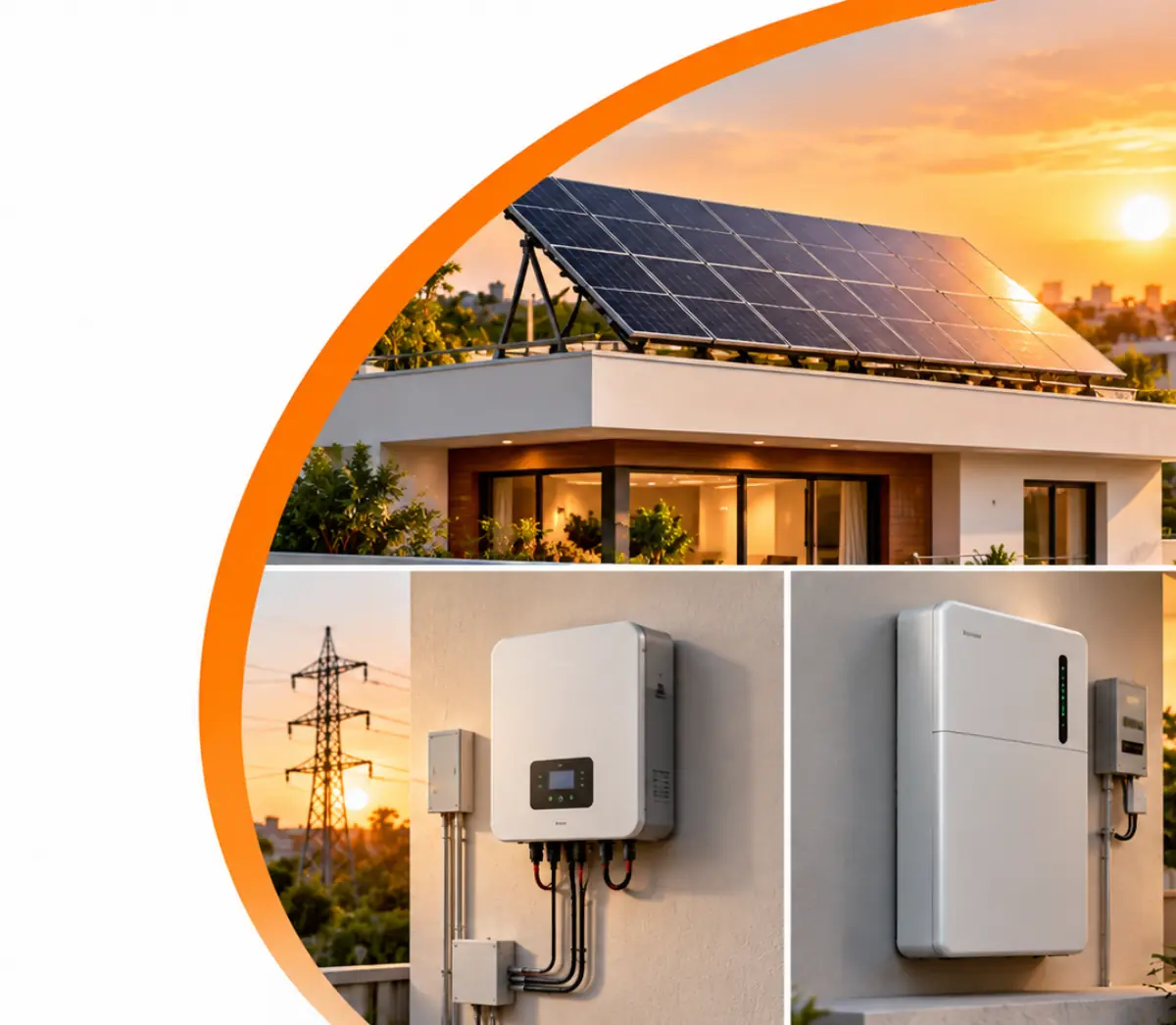
A battery allows electricity to be stored rather than necessarily being consumed at the instant it is generated.
That stored energy can potentially be used later for example, after sunset or during a power cut depending on system configuration.
This principle is important well beyond homes. MNRE describes energy storage as a way to shift renewable energy to periods when it is required and to help manage the variability of renewable generation. India's projected storage requirement is substantial: the National Electricity Plan 2023 projected 82.37 GWh for 2026–27, rising to 411.4 GWh by 2031–32. Ministry of New and Renewable Energy
At household level, however, the decision is much more personal.
You are not designing India's grid.
You are deciding whether your home needs stored electricity enough to justify the additional equipment and cost.
Start With Your Power Cuts, Not the Battery Catalogue
Imagine two homes with identical 5 kW rooftop solar systems.
Home A
Power cuts: perhaps a few short interruptions a year.
Critical equipment during an outage: nothing beyond normal household convenience.
For this homeowner, paying substantially more for battery backup may offer limited practical value.
Home B
Power cuts: frequent or prolonged.
The homeowner works from home.
During an outage, they need:
- Wi-Fi
- fans
- lights
- refrigerator
- laptop/workstation
Here, backup has a clear function.
Both homeowners have the same solar capacity.
They do not necessarily need the same solar solution.
That is why good residential solar solutions should begin with an energy-use discussion rather than automatically adding or removing a battery.
Battery or No Battery?
Let Enersol's engineers size your solar and backup around your real loads and outage history.
Don't Size a Battery in kWh Alone
A common mistake is asking:
“Should I buy a 5 kWh battery?”
before deciding what the battery actually needs to run.
Start with loads.
Suppose you want backup for:
| Essential Load | Illustrative Power |
|---|---|
| 4 fans | 280 W |
| 6 LED lights | 60 W |
| Refrigerator | 150 W |
| Wi-Fi + router | 20 W |
| Laptop | 90 W |
| Approx. running load | 600 W |
If those loads operated at an average 600 W for five hours:
0.6 kW × 5 hours = 3 kWh
At first glance, you might conclude that you need a 3 kWh battery.
Not quite.
Real battery design must also account for usable depth of discharge, conversion losses, battery chemistry, inverter efficiency, appliance cycling and starting/surge loads.
The calculation is therefore a starting point, not a final battery specification.
But it is much more useful than saying, “A 5 kWh battery should be enough.”
Backup Time Changes the Requirement Fast
Using the same simplified 600 W average load:
How backup duration changes energy requirement
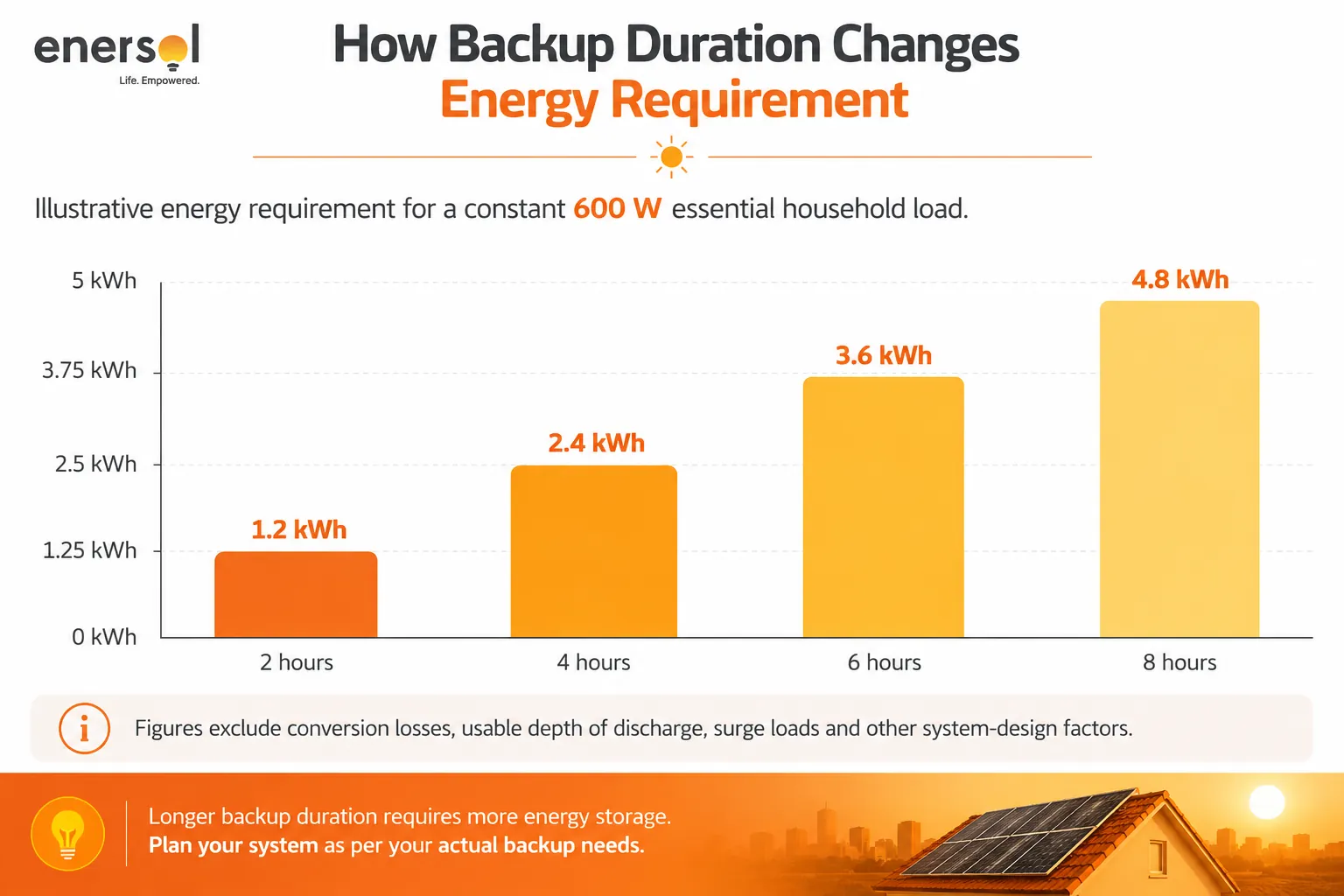
Illustrative energy requirement for a constant 600 W essential household load.
Notice what happens.
Moving from two hours of backup to eight hours does not require a small upgrade. The theoretical energy requirement becomes four times larger.
This is why “I want whole-home backup” can become expensive very quickly.
Whole-Home Backup or Essential-Load Backup?
This may be the most valuable question to ask.
During a blackout, do you genuinely need to operate:
Air conditioners?
Electric geysers?
Induction cooktop?
Large pumps?
Every socket in the house?
Or do you need:
Lights?
Fans?
Wi-Fi?
Refrigerator?
Charging?
A work computer?
Consider a simplified comparison.
Essential loads
Average load: 600 W
For 5 hours:
3 kWh theoretical energy requirement
Larger home load
Average load: 3 kW
For the same 5 hours:
5 kWh theoretical energy requirement
That is a 5× difference before considering system losses and battery operating limits.
A homeowner who defines essential loads carefully may therefore avoid buying far more battery capacity than is actually useful.
Battery Storage and Solar Capacity Are Two Different Decisions
Another misconception is that a larger solar system automatically provides longer backup.
Solar panels determine how much energy can be generated under available sunlight.
Battery capacity influences how much energy can be stored and later delivered, subject to the battery and inverter design.
Imagine a 5 kW solar array paired with a relatively small battery.
On a sunny day, the panels may have plenty of generation potential, but once the battery reaches its permitted state of charge, it cannot simply continue storing unlimited energy.
The reverse also matters.
A very large battery paired with insufficient solar generation may not consistently recharge as expected.
A properly designed system therefore balances:
Solar generation + household consumption + battery capacity + inverter capability + backup requirement.
When Grid-Tied Solar May Be the Better Choice
A battery-free grid-tied system deserves serious consideration when:
- the local grid is highly reliable;
- outages are rare and short;
- reducing electricity purchases is the primary objective;
- applicable net-metering/export rules are favourable;
- backup power has little value to the household; and
- the homeowner wants to keep initial investment simpler.
MNRE's rooftop programme itself is centred on grid-connected rooftop solar, with residential consumers able to access applicable central financial assistance subject to scheme conditions.
Battery-free does not mean incomplete.
For the right home, it can be the more rational design.
When Battery Backup Starts Making More Sense
Storage deserves closer consideration when:
- outages are frequent;
- outages last several hours;
- someone works or studies from home;
- refrigeration or other critical equipment needs continuity;
- the household places a high value on backup;
- solar generation is available when the battery can recharge; or
- the homeowner specifically wants greater control over when stored solar is consumed.
There is also a distinction between grid-connected solar with backup capability and a completely off-grid system.
MNRE's rooftop FAQ notes that behind-the-meter plants not connected to the grid are possible, but MNRE subsidy is not available for such plants under the residential rooftop framework referenced by the FAQ, and relevant state rules still apply. Solar Rooftop
That is another reason not to use “grid-tie,” “hybrid,” “backup” and “off-grid” interchangeably.
They describe different system architectures.
Put a Rupee Value on Backup Before Buying It
Battery economics should not be judged only by electricity savings.
Backup itself has value.
Suppose two battery options add, illustratively:
Option A: ₹1.5 lakh
Option B: ₹3 lakh
If your area experiences only three 30-minute outages annually, ask yourself whether that additional investment is solving a meaningful problem.
Now imagine a household facing 60 outages a year, several lasting two or three hours, while two people work from home.
The value proposition changes.
This is not something a generic ROI calculator can decide for you.
Ask:
How many outage hours did we actually experience last year?
Then estimate:
Additional battery cost ÷ expected useful backup hours over its warranted life
It is not a complete financial model, but it forces the conversation toward actual value rather than fear of blackouts.
Battery Life Needs More Than a “Years” Claim
Be cautious when a proposal says:
“This battery lasts 15 years.”
Ask for the actual warranty and technical conditions.
Battery ageing depends on factors including:
- chemistry;
- cycle count;
- depth of discharge;
- temperature;
- charge/discharge rate;
- operating strategy; and
- manufacturer limits.
If a battery is marketed around cycle life, ask what remaining capacity is guaranteed after the specified period or cycle count.
A claim of “6,000 cycles” by itself does not tell you everything.
A Simple Decision Table
| Your Situation | Grid-Tie | Battery/Backup Worth Exploring |
|---|---|---|
| Reliable grid | Strong fit | Optional |
| Frequent outages | Limited backup value | Stronger case |
| Lowest upfront investment priority | Stronger fit | Adds cost |
| Need power during outages | Not by itself | Yes |
| Mainly want bill reduction | Often suitable | Depends on economics |
| Critical home loads | Limited during outage | Can be designed around them |
| Want stored solar after sunset | No storage | Yes |
The table is deliberately not labelled “good” versus “bad.”
Both approaches solve different problems.
Seven Numbers to Take to Your Solar Installer
Before choosing your home solar system, write down:
1. Last 12 months' electricity consumption: _____ kWh
2. Average monthly consumption: _____ kWh
3. Typical daytime consumption: _____ kWh
4. Number of significant outages last year: _____
5. Typical outage duration: _____ hours
6. Essential backup load: _____ watts
7. Desired backup duration: _____ hours
Then ask the installer to show how those numbers led to the proposed:
- solar capacity;
- battery capacity;
- usable battery energy;
- inverter capacity; and
- expected backup duration.
If a proposal cannot connect the equipment recommendation to your actual consumption, it is difficult to know whether the system is properly sized.
Final Thoughts
The question is not really “battery or no battery?”
It is:
What problem do you want your home solar system to solve?
If the objective is primarily reducing electricity purchases and the grid is dependable, a well-designed grid-tied system may provide the simplicity and economics you need.
If reliable electricity during outages matters, adding appropriately sized storage can turn solar into a backup resource as well.
But don't begin with battery capacity.
Begin with your electricity bills, outage history and essential loads.
Then calculate how much energy those loads actually require.
The best residential solar system is not necessarily the one with the largest battery, the most panels or the longest equipment list. It is the one where generation, consumption, backup requirement and investment make sense together.
India's broader energy system is moving in the same direction: as renewable generation grows, storage is increasingly important for shifting energy across time. MNRE has even advised co-locating storage with solar projects to improve grid stability and cost efficiency. Ministry of New and Renewable Energy
For a homeowner, the scale is smaller but the principle is identical:
Generate when the sun is available. Store only when storing that energy solves a real need.