Installed residential solar but still receiving an electricity bill? Learn how system size, energy use, fixed charges and solar generation affect your savings.
You installed solar. The panels are generating electricity. The monitoring app shows healthy production.
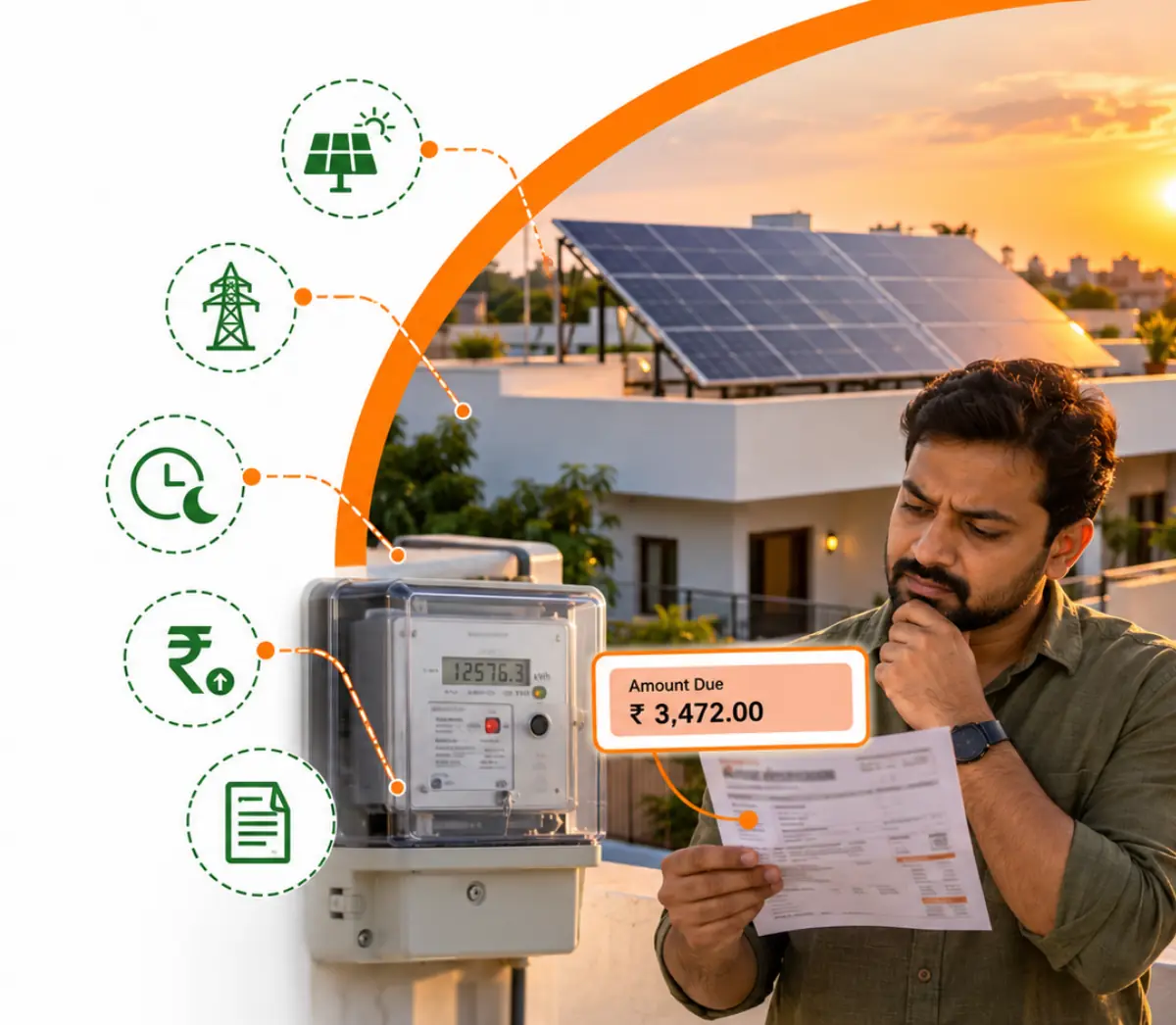
Then the electricity bill arrives and it is not zero.
For many homeowners, this immediately raises a question: Is my residential solar system underperforming?
Not necessarily.
A rooftop solar system reduces the electricity you purchase from the grid, but your final bill depends on several other factors: how much electricity your home consumes, when it consumes it, how much solar the system generates, the applicable metering mechanism, fixed charges, seasonal generation and the way your DISCOM settles imported and exported electricity.
In fact, the Ministry of New and Renewable Energy’s rooftop solar FAQ explicitly says a completely zero monthly bill is possible only in rare cases because consumers may still have to pay minimum or fixed charges even when their energy consumption is fully offset by solar.
Understanding this difference can prevent a perfectly healthy solar system from being mistaken for a poorly performing one.
First, Understand What “Zero Bill” Actually Means
There are two different numbers on an electricity bill:
Energy charges relate to the units of electricity you purchase.
Then there can be fixed, minimum or other applicable charges that do not disappear simply because you have installed residential rooftop solar panels.
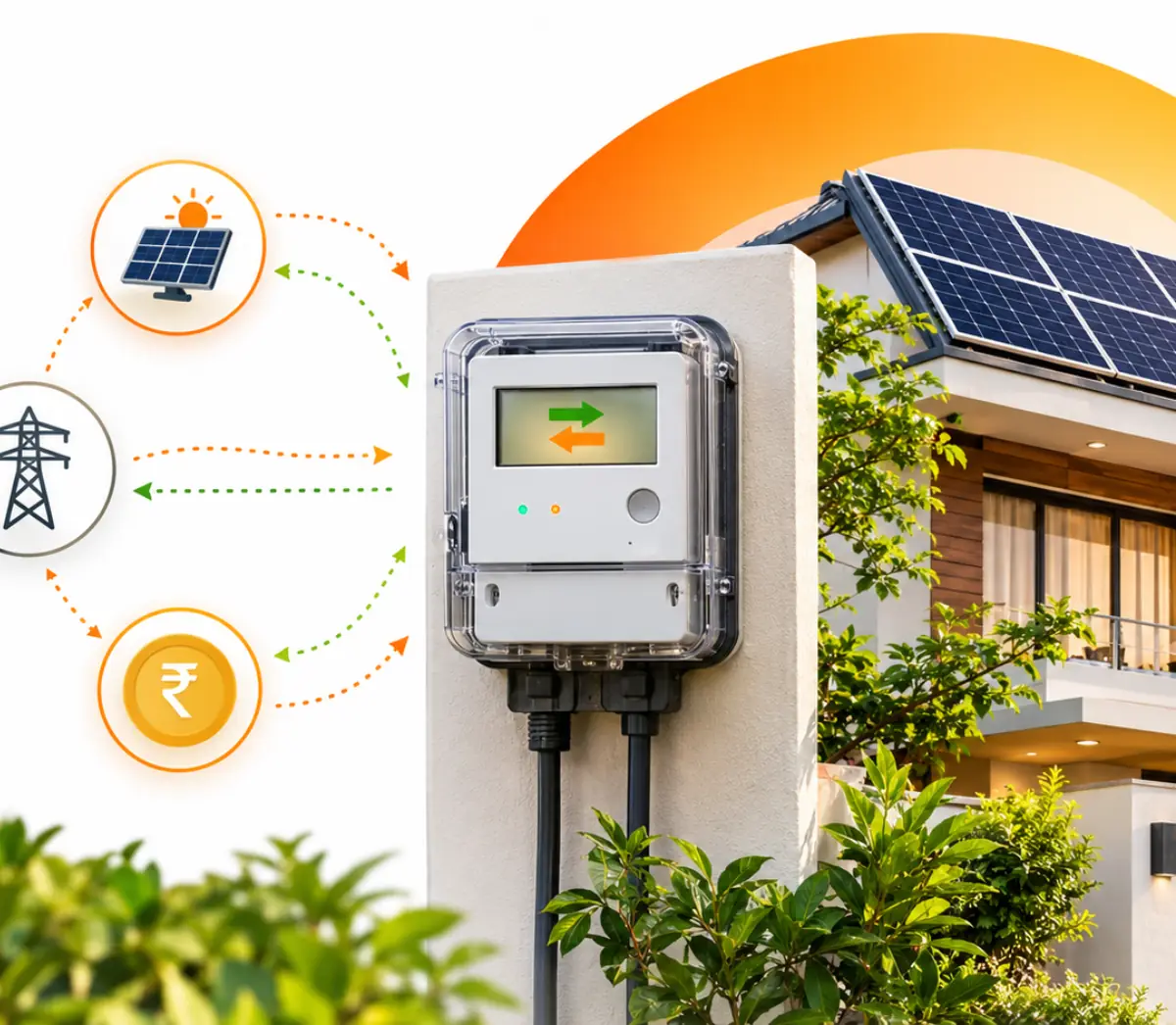
Under net metering, a bidirectional meter records electricity flowing both ways. Solar electricity is first available for consumption at the premises; surplus can be exported to the grid, while electricity is imported when solar generation is insufficient. At the end of the billing period, settlement takes place according to the applicable rules.
So the better expectation is not:
“Solar = ₹0 bill every month.”
It is:
“How much grid electricity can my solar system realistically offset over the year?”
That is a far more useful way to judge the benefits of residential solar panels.
1. Your Solar System May Be Smaller Than Your Electricity Requirement
Consider a simple example.
Suppose a household consumes:
600 units/month × 12 = 7,200 units/year
Now assume its rooftop system generates approximately:
5,400 units/year
The annual gap is still:
7,200 − 5,400 = 1,800 units
Those 1,800 units must come from somewhere typically the grid.
This is why choosing the best residential solar system does not mean fitting as many panels as possible. The system needs to be sized against actual consumption.
MNRE guidance provides a useful starting framework: households consuming 0–150 units a month may consider 1–2 kW, those consuming 150–300 units may consider 2–3 kW, while consumption above 300 units points toward capacity above 3 kW. Actual design still needs site-specific assessment. National Green House Mission
Illustrative Annual Energy Balance
| Item | Annual Units |
|---|---|
| Household consumption | 7,200 |
| Solar generation | 5,400 |
| Remaining energy requirement | 1,800 |
The practical lesson: compare annual consumption with expected annual generation before approving the system size.
2. Generation and Consumption Don't Happen at the Same Time
This is one of the most misunderstood parts of residential solar.
Your panels may generate strongly between late morning and afternoon, but your home's largest electricity consumption could occur in the evening.
Imagine this daily pattern:
| Time | Household Demand | Solar Availability |
|---|---|---|
| 6–9 AM | Medium | Low |
| 9 AM–4 PM | Medium | High |
| 4–7 PM | Rising | Falling |
| 7–11 PM | High | None |
| Overnight | Low | None |
Your air conditioners, kitchen appliances, television, lighting and other loads do not stop consuming electricity just because solar generation has stopped.
Under net metering, exports and imports are accounted for according to the applicable framework. But rooftop solar should still be understood as an energy balance, not as a system that physically powers the home with sunlight 24 hours a day.
Not Sure Why Your Solar Bill Isn't Zero?
Talk to Enersol's engineers about right-sizing your residential solar system around your actual consumption.
3. Your Electricity Bill Contains More Than Energy Charges
This explains why someone can achieve a very high solar offset and still receive a bill.
MNRE's FAQ specifically notes that consumers may continue paying charges such as fixed charges even when consumed energy is fully self-generated. Solar Rooftop
State regulations matter too.
For example, Gujarat's rooftop solar framework states that applicable fixed/demand charges and other charges remain payable even where surplus generation is compensated. Gercin
That distinction matters.
Suppose your monthly bill before solar was:
₹6,000
After a well-designed residential solar installation, energy-related charges could fall dramatically, but an amount may remain because not every component of the bill is linked directly to net electricity consumption.
Always compare the individual line items, not only the final amount.
4. A 5 kW System Does Not Generate Exactly the Same Amount Every Month
Solar generation changes throughout the year.
Cloud cover, monsoon conditions, temperature, shading, dust and the number of effective sunshine hours all affect production.
That means expecting:
Annual generation ÷ 12 = identical monthly generation
is unrealistic.
A system might perform strongly during one period and generate noticeably less during prolonged cloudy weather.
This is why homeowners should assess their residential solar panels over a meaningful period rather than panicking over one weak month.
Better Performance Check
Instead of asking:
“Why was my bill higher this month?”
Check these four numbers:
1. Solar generation this month
2. Grid import
3. Solar/grid export
4. Total household consumption
Together, they tell the real story.
5. Your Electricity Consumption May Have Increased After Installing Solar
This happens more often than homeowners expect.
Imagine this situation:
Before Solar
Consumption: 500 units/month
After Solar
Solar generation: 450 units/month
But household consumption has increased to:
650 units/month
Perhaps another air conditioner was installed. Someone started working from home. An EV was purchased. A water heater is being used more frequently.
The homeowner may think:
“My solar isn't reducing the bill enough.”
But the system could actually be performing correctly.
The consumption baseline changed.
What the Numbers Show
Without solar at 650 units, the household would purchase approximately 650 units from the grid.
With 450 units of solar generation, the system is still creating substantial value even if the final bill has not fallen to the amount originally imagined.
This is why good residential solar solutions begin with electricity data, not just available rooftop area.
6. Installation Quality Can Affect the Result
A correctly sized system can still produce less than expected if the physical design is poor.
Common causes include:
- Partial shading
- Poor panel orientation
- Excessive dirt accumulation
- Inverter issues
- Loose electrical connections
- Incorrect string design
- Unexpected rooftop obstructions
- Extended system downtime
This is where the difference between simply purchasing panels and getting a professionally engineered residential solar installation becomes important.
If expected annual generation was 7,500 units, even a 10% performance gap represents:
750 units/year
At an illustrative electricity value of ₹8/unit, that represents:
₹6,000/year of energy value.
How a generation gap affects annual solar value
Illustrative 7,500-unit annual generation target at an assumed electricity value of ₹8/unit.
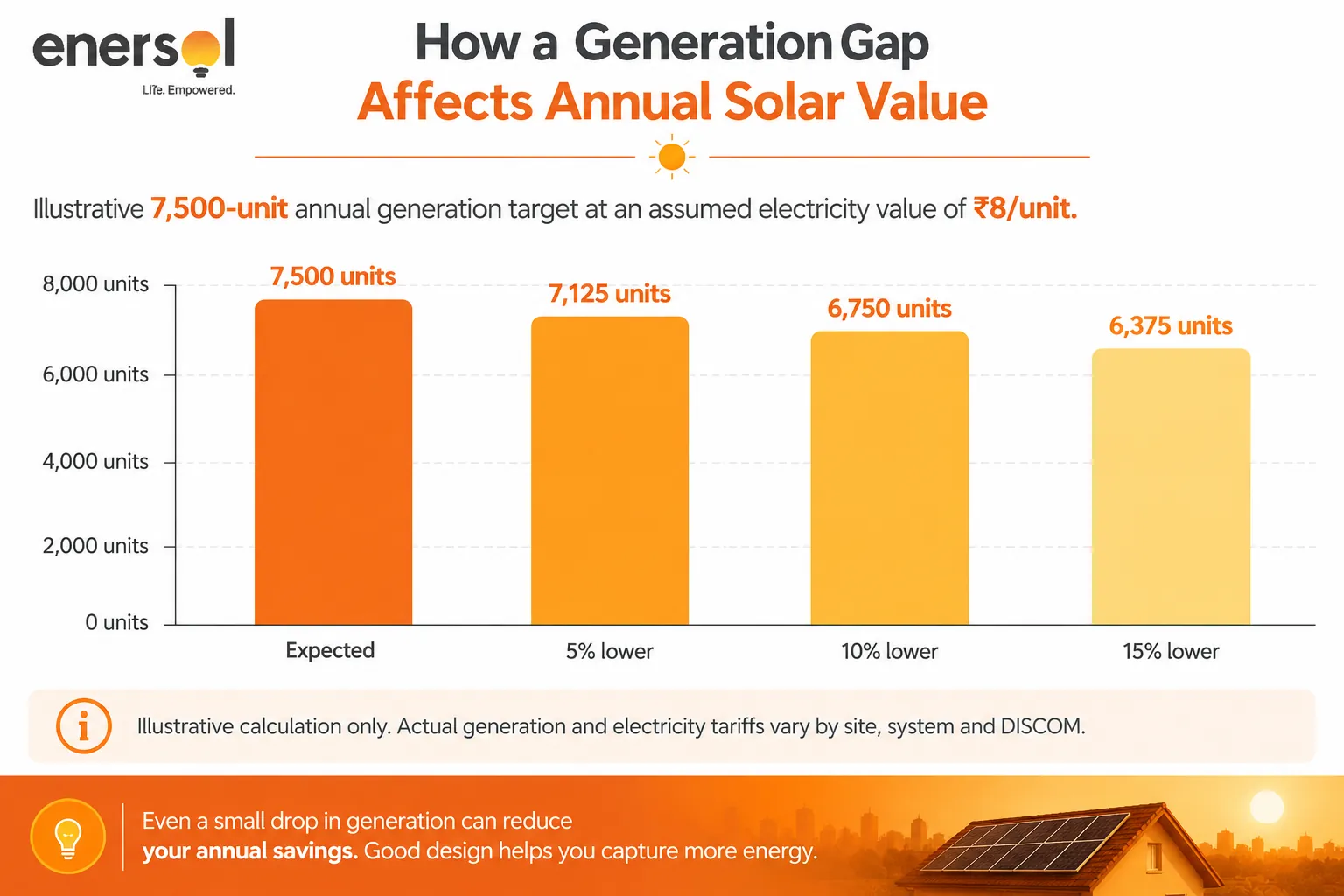
At the same assumed ₹8/unit, the illustrative annual value difference is ₹3,000 at 5%, ₹6,000 at 10%, and ₹9,000 at 15%.
The point isn't that every system loses 5–15%. It is that performance differences become meaningful when translated into units and rupees.
What Recent Indian Data Tells Us
Residential rooftop solar is no longer a niche market in India.
A June 2026 study by the Council on Energy, Environment and Water surveyed 17,094 households across 22 states and Union Territories. CEEW reported that more than 4 million households had been solarised as of May 2026, while the growth rate of India's residential rooftop solar sector had risen sharply following the launch of PM Surya Ghar
Government data also shows the scale of the transition: during 2025 alone, nearly 14.43 lakh rooftop systems were installed under PM Surya Ghar, benefiting more than 18.14 lakh households. National Green House Mission
The takeaway for homeowners is important: rooftop solar is scaling rapidly, but a subsidy or installation alone does not guarantee a particular electricity bill. System sizing, household consumption, engineering and the applicable billing mechanism still determine the outcome.
Your 5-Minute Solar Bill Check
If your electricity bill is higher than expected after installing solar, don't immediately assume something is wrong.
Take your last electricity bill and solar monitoring report and write down:
A. Solar generation: _____ units
B. Grid import: _____ units
C. Grid export: _____ units
D. Total household consumption: _____ units
E. Fixed/other charges: ₹_____
Then compare the same period with the previous year.
If generation is close to the system's expected output but consumption has increased, the problem probably isn't the panels.
If generation is materially below the design estimate, investigate system performance.
If energy charges are very low but the bill still exists, inspect the fixed and other applicable charges.
That simple exercise is more useful than judging solar from the final bill amount alone.
Final Thoughts
The real purpose of residential rooftop solar panels is not to magically erase every line from an electricity bill. It is to reduce the amount of grid electricity your home needs to purchase and improve the economics of your household energy consumption over the system's life.
A good residential solar project therefore starts with three numbers:
How much electricity does your home use?
How much can the proposed system realistically generate?
How will imported and exported electricity be settled?
Then come the engineering questions: shading, orientation, inverter sizing, mounting, electrical safety and monitoring.
The best residential solar system is not necessarily the largest system or the system promising a “zero bill.” It is the one designed around your actual energy profile, rooftop conditions and local electricity rules.
Before choosing among residential solar solutions, ask your installer for an estimated annual generation figure in units and compare that directly with your last 12 months of electricity consumption.
That one comparison can tell you far more than a promise of “zero electricity bills.”
Useful official resources: PM Surya Ghar / National Rooftop Solar Portal and CEEW's 2026 household rooftop-solar study