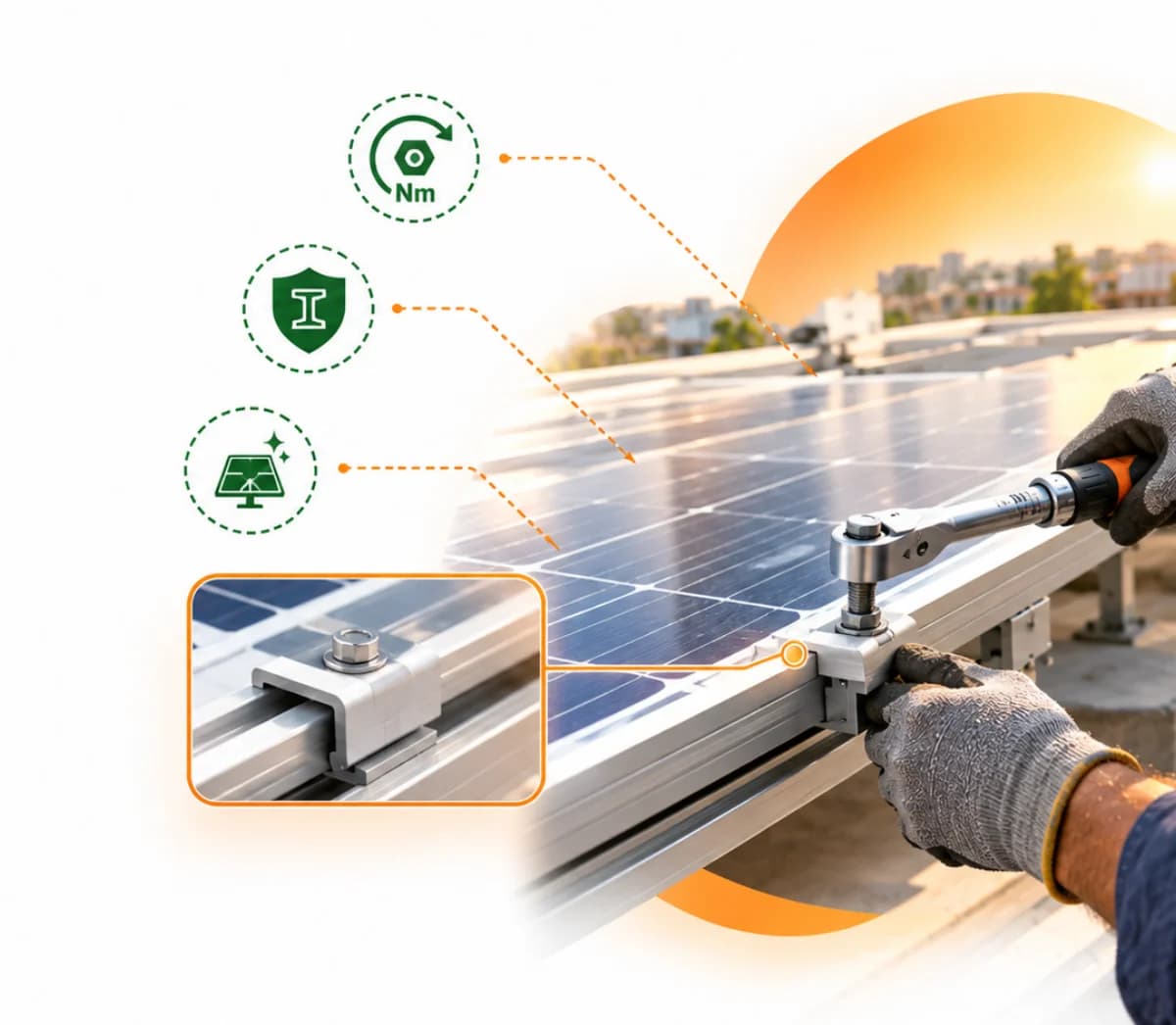
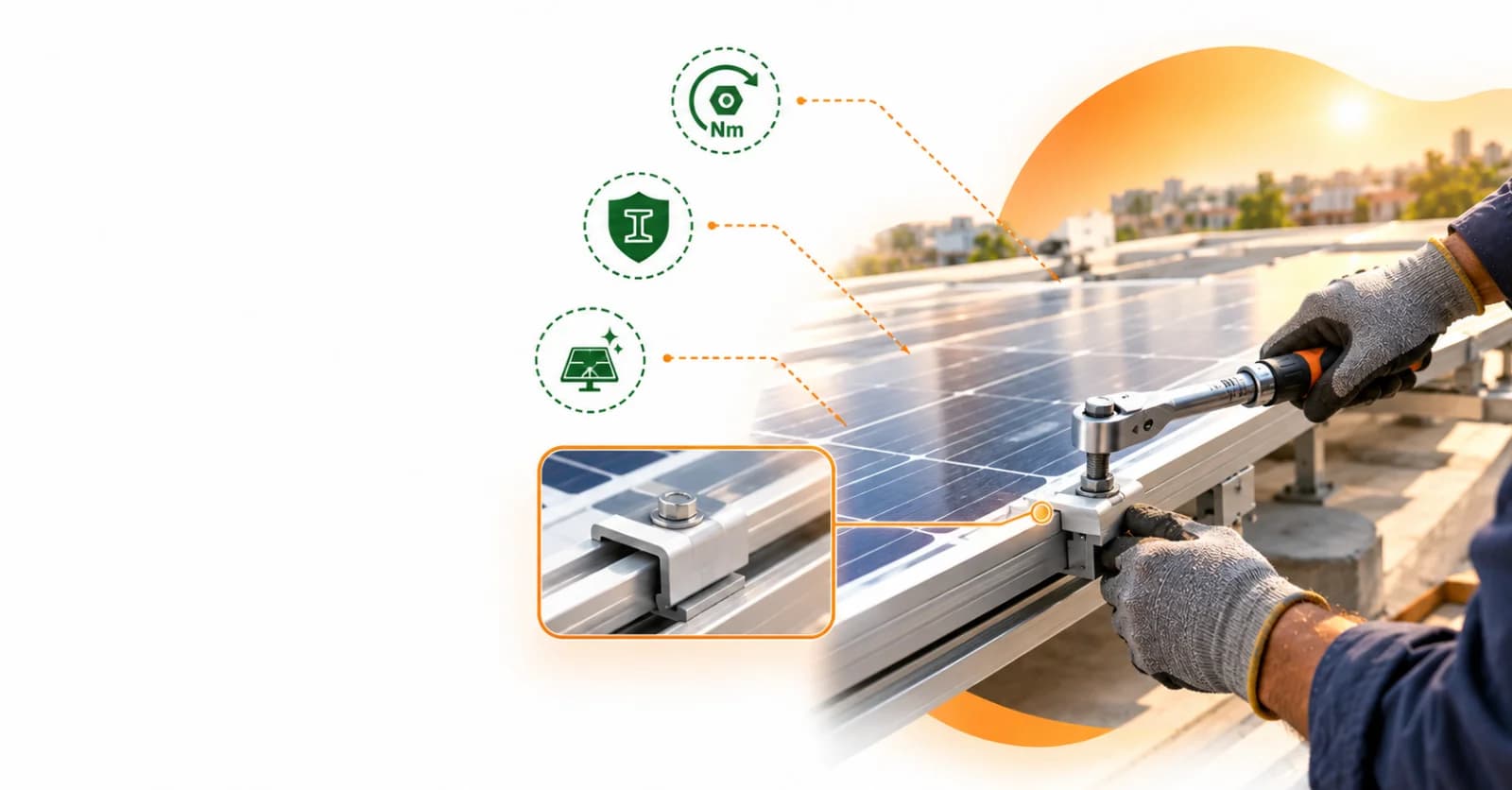
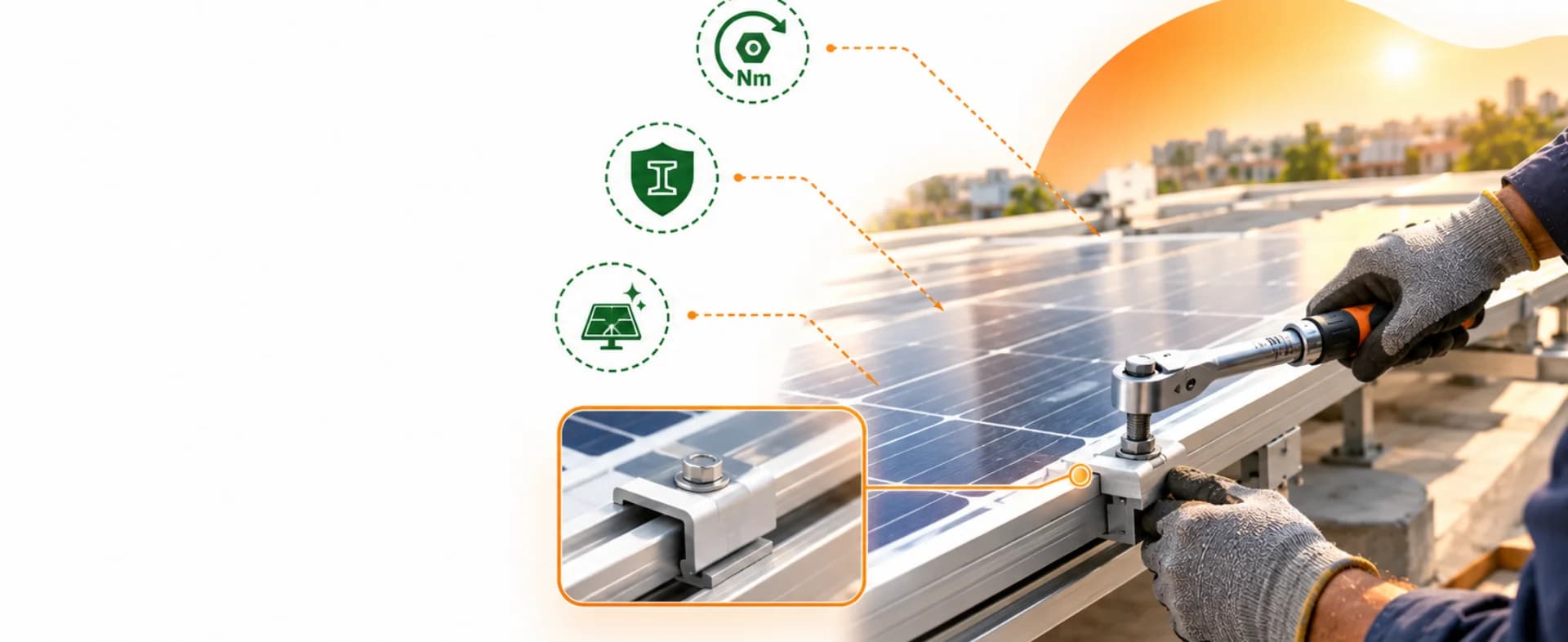
Learn why correct solar panel fastener torque protects the best household solar panels, prevents frame damage, and extends the life of top rated solar panels for home.
Quick Summary
Choosing the best household solar panels is only half the job. The way each module is secured to its mounting structure can directly affect its long-term mechanical reliability.
Solar module manufacturers specify where clamps can be positioned and the tightening torque required for the approved mounting hardware. The installer should follow those values rather than tightening bolts by feel.
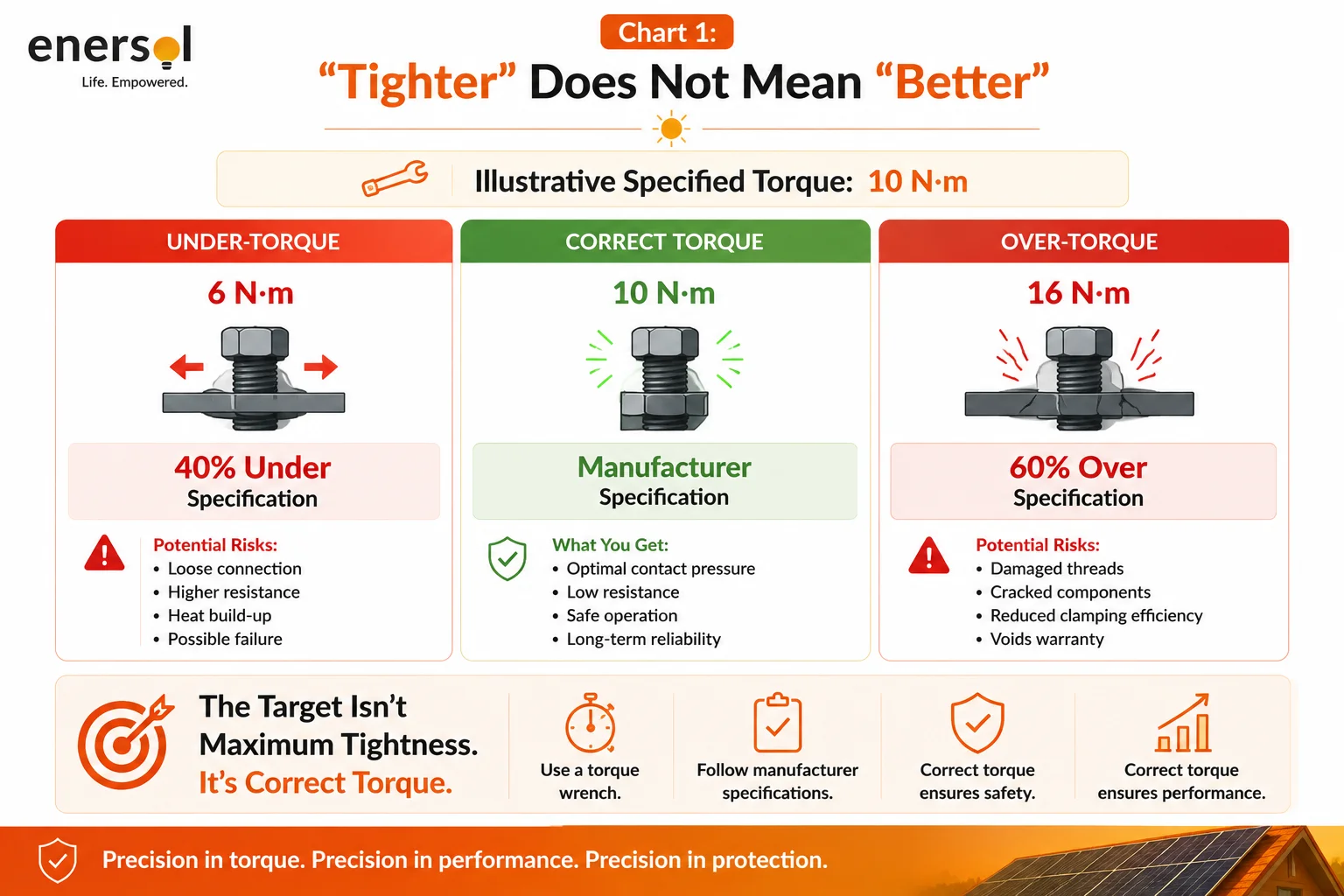
Consider an illustrative mounting bolt with a specified torque of 10 N·m. Applying 6 N·m because it “feels tight enough” means the connection has not been tightened to the specified value. Applying 16 N·m because “tighter is safer” exceeds it by 60%.
Neither approach is professional installation.
The actual solar panel fastener torque must always come from the relevant module, clamp and mounting-system manufacturer's instructions.
For homeowners, the actionable question is simple:
Don't ask whether the bolts are tight. Ask whether they were tightened to the specified torque using a calibrated torque tool.
A Premium Solar Panel Still Depends on a Small Fastener
Most homeowners spend considerable time comparing:
- Panel efficiency
- Module technology
- Warranty
- Inverter brand
- System capacity
- Installation cost
Very few ask:
“What torque will you use on the module clamps?”
Yet a solar array expected to remain outdoors for more than two decades relies on numerous mechanical connections.
Every module is connected to the mounting structure through clamps and fasteners.
Those connections must achieve two things simultaneously:
Hold the module securely
and
Avoid applying inappropriate mechanical stress to its frame.
That's why installing the latest technology in solar panels still requires precise workmanship.
What Exactly Is Fastener Torque?
Torque is the turning effect applied when tightening a fastener.
It is commonly expressed in newton-metres (N·m).
A simplified relationship is:
Torque = Force × Lever Arm
For example, applying a force of 50 newtons at the end of a 0.2-metre lever arm produces:
50 × 0.2 = 10 N·m
This doesn't mean installers should calculate torque manually while working.
Professional installers use an appropriate torque wrench or torque-controlled tool to achieve the specified value.
The example simply explains what the number means.
Is Your Home Ready for Solar?
Reduce your monthly electricity bills and build long-term energy independence with Enersol's rooftop solar solutions.
Tight Is Not a Technical Specification
Imagine a mounting specification requires an illustrative tightening torque of:
10 N·m
Now compare three installations:
| Installation | Applied Torque | Difference from Specified Value |
|---|---|---|
| A | 6 N·m | 40% below |
| B | 10 N·m | Correct |
| C | 16 N·m | 60% above |
Installation B follows the stated specification.
Installation A and C do not.
Importantly, 10 N·m is only an illustrative value here. Different modules, clamps, bolts and mounting systems can require different torque values.
This is precisely why installers should not rely on memory or experience alone.
They should check the applicable technical documentation.
Chart 1: “Tighter” Does Not Mean “Better”
A simple graphic can make this extremely clear.
Illustrative Specified Torque: 10 N·m
6 N·m → 40% Under Specification
10 N·m → Manufacturer Specification
16 N·m → 60% Over Specification
Headline:
The Target Isn't Maximum Tightness. It's Correct Torque.
This gives homeowners a concrete takeaway instead of simply telling them installation precision matters.
Why Can Too Little Torque Become a Problem?
The fastener and clamp system is intended to keep the module securely connected to its mounting structure.
If a fastener is inadequately tightened, the connection may not perform as designed.
Potential concerns can include:
- Movement at the connection
- Clamp displacement
- Vibration
- Reduced connection stability
- Need for corrective maintenance
The actual behaviour depends on the mounting system, module, hardware and environmental loads.
The important point is that under-tightening isn't simply a workmanship issue—it changes the mechanical condition of the connection.
Why Can Too Much Torque Become a Problem?
The opposite assumption is equally problematic:
“If 10 N·m is good, 15 N·m must be stronger.”
Not necessarily.
Fasteners, clamps, threads and module frames are engineered components.
Excessive tightening can place unnecessary mechanical stress on the components involved.
Depending on the mounting system, incorrect installation may contribute to:
- Frame deformation
- Clamp damage
- Thread damage
- Uneven loading
- Mechanical stress around the clamped area
This is why the correct solar panel fastener torque isn't a minimum suggestion.
The applicable manufacturer specification should be followed.
Clamp Position Matters Just as Much as Torque
Correct torque applied in the wrong place does not automatically create a correct installation.
Module manufacturers typically define approved mounting or clamping zones.
These positions are selected because the module has been designed and tested around specific mechanical support conditions.
The installation therefore needs to get both variables right:
Variable 1 — Clamp Location
Is the clamp positioned within the module manufacturer's permitted mounting zone?
Variable 2 — Fastener Torque
Has the mounting hardware been tightened according to the applicable specification?
Think of it as:
Correct Clamp Position + Correct Hardware + Correct Torque = Proper Mechanical Connection
What Should an Installer Check Before Tightening?
Before a torque tool is even used, several details should already be correct.
These can include:
- Correct module model
- Compatible mounting system
- Correct clamp type
- Correct fastener
- Approved clamp location
- Proper rail alignment
- Correct installation sequence
- Clean and undamaged components
Torque is therefore one part of a complete installation process not a shortcut for correcting poor alignment or unsuitable hardware.
Heat and Temperature Cycling Matter Over Time
Solar panels operate outdoors through repeated temperature changes.
During the day, modules and mounting components heat up.
At night, they cool.
Different materials can expand and contract differently as temperatures change.
Over a 25-year operating period, that represents thousands of daily heating and cooling cycles.
Consider the scale:
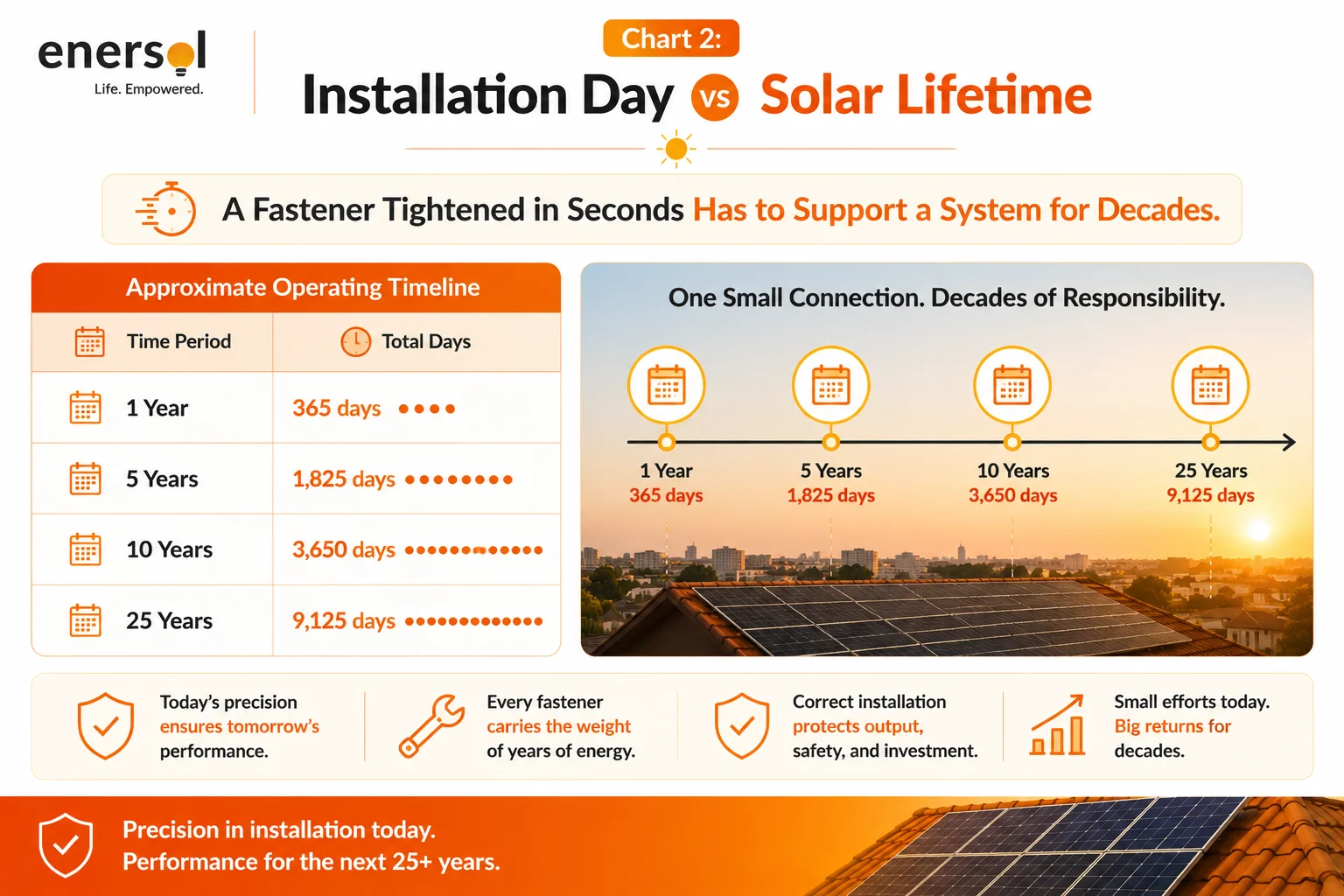
365 days × 25 years = 9,125 days
That doesn't mean every day produces one identical mechanical cycle, but it illustrates how long the connection is expected to remain reliable.
Installation quality therefore needs to be judged over decades not simply on whether the panel feels secure on installation day.
Chart 2: Installation Day vs Solar Lifetime
Approximate Operating Timeline
1 Year → 365 days
5 Years → 1,825 days
10 Years → 3,650 days
25 Years → 9,125 days
Suggested headline:
A Fastener Tightened in Seconds Has to Support a System for Decades.
This makes the long-term importance of installation precision much easier for a homeowner to understand.
Why Panel Frames Matter
The aluminium frame around a module is not decorative.
It contributes to the module's mechanical structure and provides defined locations for mounting.
The frame works together with:
- Glass
- Encapsulated solar cells
- Backsheet or rear glass
- Mounting clamps
- Supporting rails
This is why a module's mounting instructions should be treated as engineering requirements rather than optional installation advice.
Even top rated solar panels for home need to be installed according to the manufacturer's specified mounting conditions.
Latest Solar Technology Doesn't Eliminate Installation Risk
Today's solar panel new technology has improved substantially.
Modern modules may offer:
- Higher power density
- Improved cell architectures
- Better temperature performance
- Bifacial designs
- Advanced glass configurations
- Improved mechanical design
But technology and workmanship solve different problems.
A more advanced panel may improve energy performance.
It doesn't make incorrect clamp positioning or inappropriate fastener torque acceptable.
The latest technology in solar panels still depends on correct field installation.
Put the Investment Into Perspective
Consider an illustrative residential solar installation costing:
₹3,00,000
Suppose the modules represent a significant portion of the equipment value.
The homeowner may spend hours comparing two panel brands over a small efficiency difference.
Yet the long-term mechanical installation of those modules may depend on relatively inexpensive components such as:
- Clamps
- Bolts
- Nuts
- Rails
- Fasteners
This creates an important purchasing lesson:
Don't protect a ₹3 lakh solar investment with an installation process that relies on “approximately tight.”
The precise project cost will vary, but the principle remains the same.
Quality workmanship protects valuable equipment.
What Should Homeowners Ask to See?
This is where the blog becomes genuinely actionable.
Before installation, ask your solar company for:
1. Module Installation Manual
Which mounting instructions apply to the exact panel model?
2. Approved Clamping Zone
Where can the module legally and mechanically be clamped according to its manufacturer?
3. Mounting-System Specification
Which rails, clamps and fasteners are being used?
4. Required Torque
What torque value is specified for the applicable mounting connection?
5. Torque Tool
Are installers using an appropriate calibrated torque wrench/tool?
6. Quality-Control Process
How is correct tightening verified before handover?
Those six questions reveal much more than asking:
“Do you use good-quality mounting material?”
Don't Accept “We Know From Experience”
Experience is extremely valuable in solar installation.
But experience should support technical specifications—not replace them.
Imagine an installer says:
“We've installed thousands of panels. We know how tight the bolt needs to be.”
A better process is:
“The applicable mounting specification requires X N·m for this connection, and our technicians use the appropriate torque tool to verify it.”
That is measurable.
That is repeatable.
And that can be audited.
What Could a Torque Quality-Control Record Look Like?
For a residential project, an installer can maintain a basic QC record such as:
| Check | Required Information | Verified |
|---|---|---|
| Module model | Exact model number | ✓ |
| Clamp type | Approved/compatible | ✓ |
| Clamp location | Within permitted zone | ✓ |
| Fastener specification | As per mounting system | ✓ |
| Required torque | Manufacturer value | ✓ |
| Torque tool | Appropriate/calibrated | ✓ |
| Visual inspection | Completed | ✓ |
| Final QC | Completed | ✓ |
For larger projects, quality-control documentation can be even more detailed.
The point is simple:
Installation quality should be documented, not assumed.
Correct vs Incorrect Installation
| Correct Installation | Poor Installation |
|---|---|
| Manufacturer instructions checked | Generic installation approach |
| Approved clamp zones followed | Clamp position selected by convenience |
| Compatible hardware used | Hardware compatibility unclear |
| Specified torque followed | Tightened by feel |
| Torque-controlled tool used | Ordinary tool without verification |
| QC inspection completed | Visual appearance considered sufficient |
| Installation documented | No installation record |
This gives homeowners a practical way to compare EPC companies beyond panel price.
How Should Two Solar Quotations Be Compared?
Suppose two companies both offer:
5 kW solar
Same panel brand
Same inverter
One quotation is cheaper.
Before choosing it, add these questions:
| Installation Parameter | Installer A | Installer B |
|---|---|---|
| Exact module model specified? | ? | ? |
| Mounting system specified? | ? | ? |
| Clamp model/type provided? | ? | ? |
| Manufacturer clamp zones followed? | ? | ? |
| Torque specification documented? | ? | ? |
| Torque-controlled tools used? | ? | ? |
| Structural QC included? | ? | ? |
| Installation records provided? | ? | ? |
| Workmanship warranty? | ? | ? |
Fill those question marks before comparing only the final price.
That is actionable procurement information.
Can Incorrect Torque Reduce Solar Generation?
Incorrect fastener torque does not automatically translate into a predictable percentage of energy loss.
That distinction is important.
It would be arbitrary to claim:
“Wrong torque causes 5% lower generation.”
The source material doesn't support such a fixed relationship.
The more direct concerns are mechanical reliability, module mounting integrity, frame stress and potential future maintenance.
If physical damage eventually affects a module, generation could also be affected but the impact would depend on the actual failure.
For this topic, the most meaningful numbers are therefore torque values, installation tolerances, hardware specifications and QC measurements, rather than inventing an ROI-loss percentage.
Installation Quality Is Part of Product Quality
Homeowners searching for the best household solar panels often focus almost entirely on the product datasheet.
But there are really two quality decisions:
Product Quality
What panel are you buying?
Installation Quality
How will that panel be installed?
Two homeowners can purchase identical top rated solar panels for home and still receive different installation quality.
That's why EPC selection matters alongside module selection.
What Should Be Checked During Final Inspection?
Before project handover, the installation team should verify applicable items such as:
- Module alignment
- Clamp positions
- Required torque
- Fastener condition
- Rail connections
- Mounting stability
- Cable clearance around mechanical components
- Visible module/frame condition
- Completion of QC documentation
Homeowners should not attempt to retighten module fasteners themselves.
Mechanical adjustments should be handled by qualified personnel following the applicable manufacturer instructions.
Four Numbers Worth Asking Your Installer For
If you don't want to get lost in technical terminology, ask for these four pieces of information:
1. Required Torque
_____ N·m
2. Actual Mounting Hardware
Clamp/Fastener Model: _____
3. Approved Clamp Position
Manufacturer-specified mounting zone: _____
4. Torque Tool Verification
Tool/QC confirmation: _____
If your installer can clearly provide these details, you're having a much more meaningful technical conversation.
What Should Homeowners Remember?
If you remember only five things from this article, remember these:
1. “Tight” and “correctly torqued” are not the same.
Correct installation follows a measurable specification.
2. More torque isn't automatically safer.
Over-tightening can be just as inappropriate as under-tightening.
3. Clamp position matters.
Correct torque cannot compensate for an incorrectly positioned clamp.
4. Ask for the exact manufacturer's instructions.
Different module and mounting combinations can require different specifications.
5. Ask how torque is verified.
A professional installation process should rely on suitable tools and quality control not feel alone.
Final Thoughts
Choosing the best household solar panels or investing in the latest technology in solar panels is only one part of creating a solar system designed to last.
Those modules still need to be installed correctly.
The right solar panel fastener torque helps the mounting connection perform as designed without relying on guesswork.
Our illustrative example makes the difference clear.
If a connection requires 10 N·m:
6 N·m is 40% below the specified value.
10 N·m meets the specification.
16 N·m is 60% above it.
The actual torque for your installation may be completely different, which is precisely the point.
The installer should use the value specified for the actual equipment being installed.
When comparing top rated solar panels for home or evaluating solar panel new technology, don't stop at efficiency and warranty.
Ask:
Where will the modules be clamped?
What torque is required?
Which tool will verify it?
Will the installation be quality checked?
At Enersol Solar, precision at installation should receive the same attention as technology selection because a solar system expected to perform for decades deserves engineering accuracy down to the fasteners holding each module in place.