
Is the Gujarat solar subsidy ending soon? Check the PM Surya Ghar timeline, ₹78,000 subsidy, online application steps, solar loans and EMI options.
Quick Summary: Is the Solar Subsidy Still Available in Gujarat?
You've probably seen advertisements saying, "Apply for solar now before the subsidy ends!"
But when is the actual last date?
As of November 2026, the PM Surya Ghar: Muft Bijli Yojana remains the main central government subsidy programme for eligible residential rooftop solar installations in Gujarat.
The scheme was approved for implementation through the financial year 2026–27, which ends on March 31, 2027.
However, March 31, 2027 should not automatically be treated as the final date for every homeowner to submit an application. The scheme's implementation period and any officially notified registration or completion deadline are not necessarily the same.
Homeowners should check the National Portal for the latest instructions rather than relying on promotional countdowns.
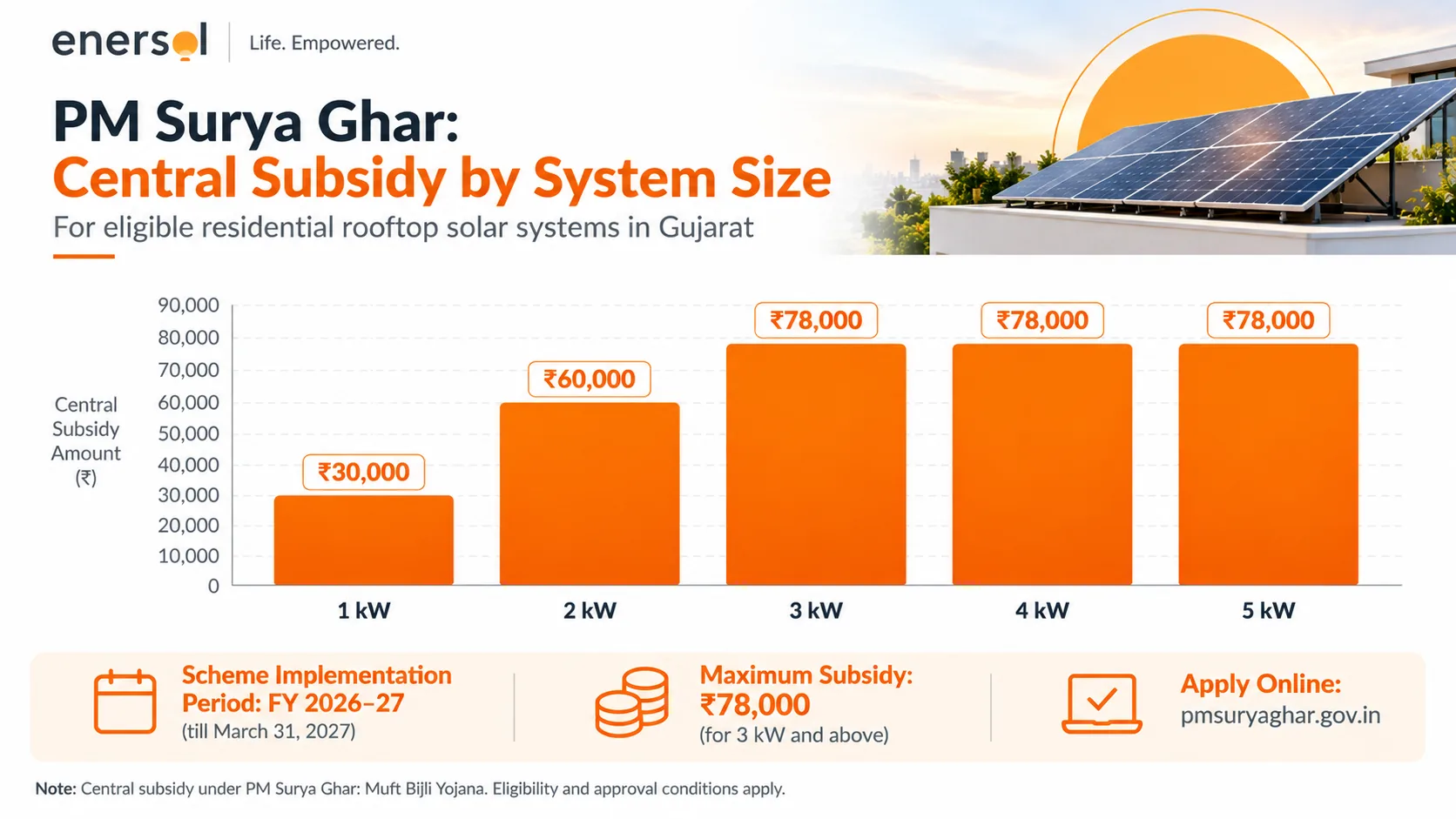
The standard central subsidy is:
| Rooftop Solar Capacity | Central Subsidy |
|---|---|
| 1 kW | ₹30,000 |
| 2 kW | ₹60,000 |
| 3 kW | ₹78,000 |
| 4 kW | ₹78,000 |
| 5 kW | ₹78,000 |
The standard subsidy is capped at ₹78,000 for systems of 3 kW or above, subject to eligibility.
And if you're worried about paying the entire installation cost upfront, eligible households can explore a loan for solar rooftop installation through participating banks.
1. What Is the Last Date for Solar Panel Subsidy in Gujarat?
This is the question many homeowners want answered before anything else.
The PM Surya Ghar scheme was approved in February 2024 with a total central outlay of ₹75,021 crore.
Its announced implementation period extends through FY 2026–27.
That financial year ends on March 31, 2027.
But this does not mean every residential applicant has an independently guaranteed right to register or complete installation until that date.
Application deadlines, programme instructions and processing requirements may be updated by the authorities.
Should You Wait Until March 2027?
Not necessarily.
Installing rooftop solar involves several steps beyond submitting an online form.
Your roof must be assessed, a vendor selected, equipment installed and the necessary DISCOM procedures completed.
Waiting until the end of a programme period may leave insufficient time for installation or corrections.
The better approach is to verify current eligibility and begin planning when your roof and finances are ready.
Where to check: https://pmsuryaghar.gov.in/
2. How Much Solar Subsidy Is Available in Gujarat?
Under PM Surya Ghar, eligible residential consumers can receive Central Financial Assistance for rooftop solar.
The standard subsidy calculation is:
- ₹30,000 per kW for the first 2 kW.
- ₹18,000 for the additional capacity from 2 kW to 3 kW.
- No additional standard central subsidy beyond 3 kW.
Example: A 3 kW System
Suppose your installed rooftop solar system costs ₹1,80,000.
If you qualify for ₹78,000 in central subsidy:
₹1,80,000 − ₹78,000 = ₹1,02,000
Your effective investment would be ₹1.02 lakh.
This is an illustrative calculation, not an actual Enersol quotation or guaranteed subsidy approval.
Is There an Additional Gujarat Government Subsidy?
Do not assume there is a separate Gujarat state subsidy simply because an advertisement mentions a larger benefit.
For a standard residential installation, use the central PM Surya Ghar amount as the starting point.
If a state-specific incentive is available for your consumer category, verify its official notification, eligibility and whether it can be combined with central assistance.
Planning to Apply for the Solar Subsidy?
Enersol can assess your roof and guide you through the PM Surya Ghar application.
3. Who Can Apply for the Rooftop Solar Subsidy?
The scheme is designed for eligible residential electricity consumers.
Applicants generally need to satisfy conditions such as:
| Requirement | What It Means |
|---|---|
| Indian citizenship | The applicant must meet the scheme's citizenship criteria |
| Residential property | The rooftop must be suitable for installation |
| Electricity connection | A valid residential electricity connection is required |
| Previous subsidy | The household must satisfy restrictions on earlier solar subsidies |
| Registered vendor | Installation must be through an eligible registered vendor |
| Approved equipment | Modules and other equipment must meet applicable scheme requirements |
For subsidy-supported installations, Domestic Content Requirement (DCR) compliance is important.
The solar cells and modules must meet the applicable Indian manufacturing requirements.
A panel being assembled in India does not automatically establish DCR compliance.
Your installer should confirm the relevant module documentation before installation.
4. How to Apply for Rooftop Solar Subsidy in Gujarat: Step by Step
You can begin the application online through the official PM Surya Ghar portal.
Step 1: Visit the National Portal
Open https://pmsuryaghar.gov.in/.
Use the official portal rather than an unfamiliar website requesting payment for registration.
Step 2: Register Your Electricity Connection
Select Gujarat and your electricity distribution company.
Enter the required details, including your consumer number and mobile number.
Use the information printed on your electricity bill.
Step 3: Submit the Rooftop Solar Application
Log in and complete the residential rooftop solar application.
Provide the requested information and follow the portal's instructions.
Step 4: Select a Registered Solar Vendor
Choose an eligible vendor listed for your DISCOM or application.
Before finalising, request a site assessment and compare the proposed system capacity, equipment, price and service commitments.
Step 5: Complete the Required Approvals
Follow the applicable DISCOM and portal procedures.
Some rooftop systems may qualify for simplified or deemed technical-feasibility acceptance, while other cases can require additional processing.
Follow the instructions shown for your application rather than assuming every consumer has the same approval process.
Step 6: Install the Rooftop Solar System
The registered vendor installs the system using compliant equipment.
The installation should include appropriate electrical protection, mounting, testing and documentation.
Step 7: Complete Inspection and Metering
Submit installation details and complete the required net-metering, inspection and commissioning procedures.
The DISCOM verifies the installation according to applicable requirements.
Step 8: Submit Subsidy Payment Details
After the required commissioning and approval steps, complete the subsidy request through the portal.
Provide the required bank or loan-account information.
The subsidy is processed after official verification.
Do not assume the subsidy will be credited immediately after installation.
5. Which Documents Do You Need?
Prepare the following before starting.
| Document or Detail | Why It May Be Needed |
|---|---|
| Latest electricity bill | Consumer number and DISCOM information |
| Mobile number | Registration and verification |
| Applicant identity details | Eligibility and application verification |
| Bank account information | Subsidy payment |
| Cancelled cheque or equivalent bank proof | Account verification where required |
| Property or roof-related documents | If requested for the installation or approval |
| Vendor quotation and agreement | Installation scope and cost |
| Installation and commissioning records | Final verification |
The exact documents can vary by application stage, financing arrangement and DISCOM requirements.
Check the portal's current document list before submitting.
6. How Much Does Rooftop Solar Cost After Subsidy?
The installed price depends on system size, panel technology, inverter, mounting structure, electrical materials and roof conditions.
For example:
| System Capacity | Illustrative Installed Cost | Eligible Central Subsidy | Effective Cost |
|---|---|---|---|
| 1 kW | ₹65,000 | ₹30,000 | ₹35,000 |
| 2 kW | ₹1,20,000 | ₹60,000 | ₹60,000 |
| 3 kW | ₹1,80,000 | ₹78,000 | ₹1,02,000 |
| 5 kW | ₹2,75,000 | ₹78,000 | ₹1,97,000 |
These are hypothetical price examples, not verified November 2026 market rates or Enersol quotations.
The subsidy reduces the effective investment for an eligible consumer.
However, depending on the vendor payment schedule and loan arrangement, you may need to finance the installation before receiving the subsidy.
That is where solar loans and EMI plans become relevant.
7. Can You Install Solar Panels on EMI in Gujarat?
Yes. Residential rooftop solar can be financed through participating banks, subject to eligibility and lender approval.
The Government of India introduced access to collateral-free, low-interest loan products for eligible residential rooftop systems up to 3 kW.
Banks may offer different interest rates, tenures, borrower contributions and documentation requirements.
The JanSamarth portal can help eligible applicants access participating loan products.
What Does a Solar EMI Look Like?
Consider a hypothetical homeowner taking a ₹1,20,000 loan.
Assume:
- Loan amount: ₹1,20,000
- Annual interest rate: 7%
- Repayment period: 5 years
- Monthly repayment structure: Standard reducing-balance EMI
The approximate EMI would be ₹2,376 per month.
Over five years, the total repayment would be approximately ₹1.43 lakh.
The actual amount depends on the lender's interest rate, disbursement date, fees and repayment terms.
If a subsidy is credited to the loan account, the outstanding principal may reduce. The effect on EMI or tenure depends on the lender's process.
Compare More Than the Monthly EMI
Before choosing solar financing for residence use, ask:
- What is the effective annual interest rate?
- Is the rate fixed or floating?
- Is a down payment required?
- Are processing fees or insurance charges applicable?
- Will the subsidy reduce the loan principal?
- Are there prepayment penalties?
- What happens if subsidy processing takes longer than expected?
A lower monthly EMI may simply mean a longer loan tenure and greater total interest.
8. Is “Free Solar EMI for Residence” Really Free?
Searches for free solar EMI for residence often lead to offers promising solar installation without a large upfront payment.
But the word “free” can mean different things.
Zero Down Payment
You may be able to start with little or no upfront contribution under a particular financing offer.
That doesn't mean the equipment itself is free.
No-Cost EMI
Some sellers advertise no-cost EMI arrangements.
You still need to check whether the equipment price, discounts or financing charges differ from a cash purchase.
Subsidy-Adjusted Financing
Some financing arrangements account for the expected government subsidy.
But the subsidy is not automatically approved, and its timing can affect the outstanding loan balance.
The Real Comparison
Suppose a homeowner expects to save ₹2,000 per month on electricity purchases.
Their solar loan EMI is ₹2,400.
For that period, the combined monthly cash-flow effect is approximately ₹400 more than their previous electricity spending, before accounting for any remaining bill charges or other costs.
That doesn't automatically make the investment unattractive.
It simply means the homeowner should distinguish between long-term savings and immediate monthly cash flow.
Solar savings and loan repayments are two separate calculations.
9. Ahmedabad and Gandhinagar Example: Choosing Between Cash and EMI
Consider a hypothetical family in Gandhinagar.
Their average monthly electricity consumption is 320 units.
They have a suitable rooftop and are considering a 3 kW solar system.
After receiving a quotation, they compare two payment options.
Option A: Pay the installation cost upfront.
The family pays the vendor according to the agreed schedule and later receives the approved subsidy, if eligible.
Option B: Use a solar loan.
The family finances part of the installation and repays the bank over an agreed period.
If the subsidy is credited to the loan account, the outstanding balance can be adjusted according to lender rules.
Which option is better?
That depends on the family's available savings, borrowing rate, expected electricity savings and comfort with monthly repayments.
For homeowners considering solar in Gandhinagar or Ahmedabad, the installation process is broadly similar under the national scheme, but the applicable DISCOM and connection details must be checked.
10. Common Mistakes That Can Delay Your Solar Subsidy
Mistake 1: Choosing Panels Without Checking DCR Compliance
Subsidy-linked installations must satisfy applicable domestic-content requirements.
Mistake 2: Installing Through an Ineligible Vendor
Confirm the vendor's registration status on the National Portal.
Mistake 3: Entering Incorrect Consumer Details
A mismatch between the electricity bill and application details may require correction.
Mistake 4: Assuming the Subsidy Is an Upfront Discount
The subsidy is generally processed after installation, inspection and commissioning requirements are completed.
Mistake 5: Believing an Unverified Deadline
A social media advertisement is not an official government notification.
Mistake 6: Signing a Loan Without Reading the Terms
Understand interest, borrower contribution, subsidy adjustment and total repayment before committing.
12. Final Recommendation: Apply With the Right Information, Not Deadline Pressure
A rooftop solar subsidy can make a meaningful difference to the initial investment.
But homeowners should not rush into an unsuitable installation because of an unverified last-date claim.
Start by checking the current scheme status.
Review your electricity consumption.
Get your rooftop assessed.
Choose a registered vendor and verify the proposed equipment.
If you're considering EMI, calculate the full loan repayment—not just the monthly instalment.
At Enersol Solutions, residential solar services include system planning, installation and assistance with applicable subsidy and approval processes.
Planning rooftop solar in Ahmedabad, Gandhinagar or elsewhere in Gujarat?
Start with your electricity bill and a site assessment, then compare the total project cost and available financing options.
Residential Solar: https://www.enersol.co.in/solutions/rooftop-solar/residential-solar