

Why do two 3 kW solar systems have different prices? Understand solar cost per watt, panels, inverters, rooftop work, subsidies and hidden charges in Gujarat.
Quick Summary
You ask two solar companies for a 3 kW rooftop system. One quotes ₹1.65 lakh. The other quotes ₹2.10 lakh.
Both are offering 3 kW solar. So why is there a ₹45,000 difference?
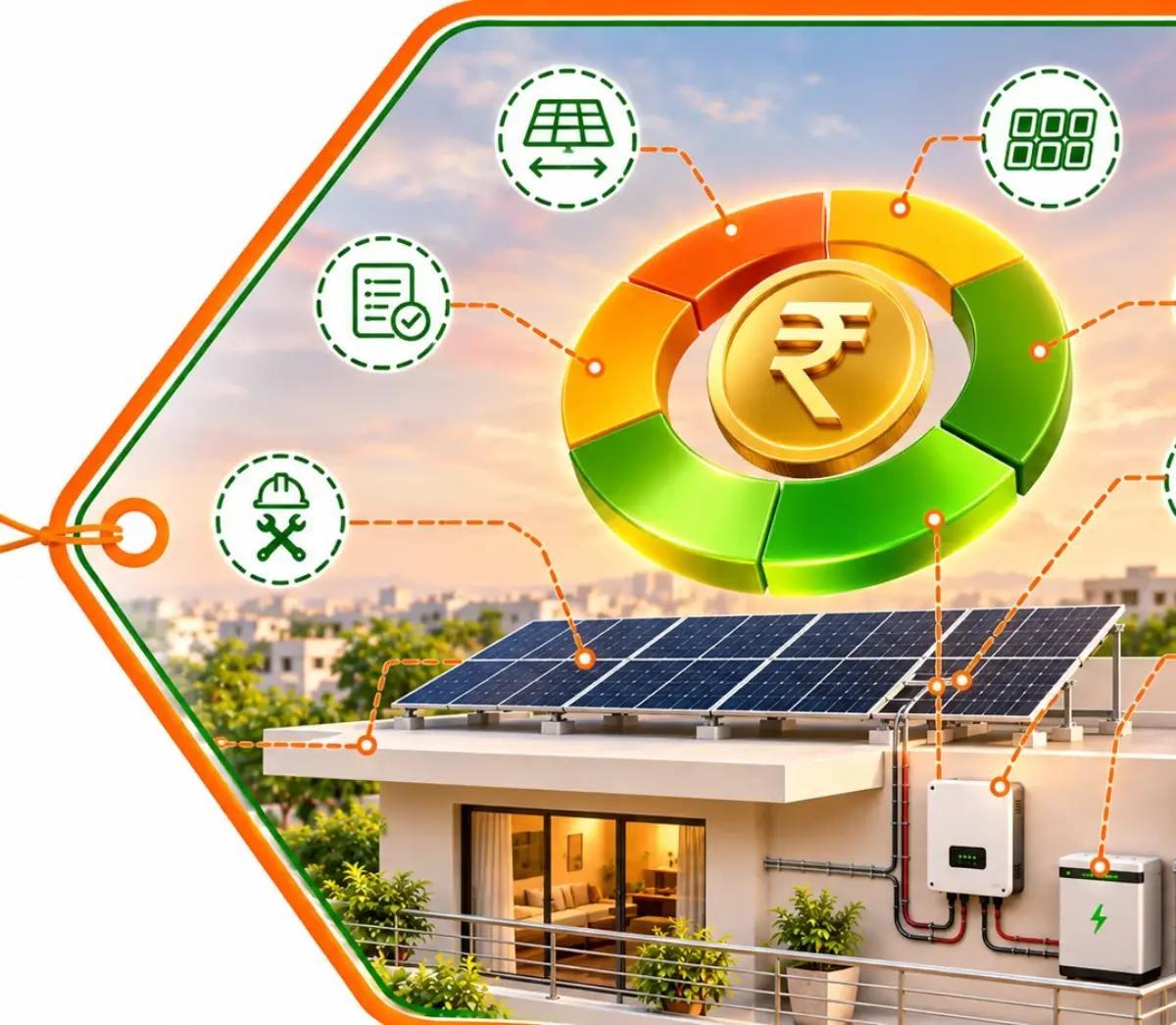
Because you're not buying just solar panels. You're paying for a complete system that includes an inverter, mounting structure, wiring, safety equipment, installation and ongoing support.
In Gujarat, the price of a rooftop solar system depends mainly on its capacity, equipment quality, roof conditions, installation requirements and service package.
Here is a quick overview.
| Factor | How It Affects the Price |
|---|---|
| System capacity | Larger systems cost more overall, but may cost less per kW |
| Solar panel technology | Different technologies and manufacturers have different prices |
| Inverter | Brand, capacity, features and warranty affect cost |
| Mounting structure | Elevated or customised structures generally cost more |
| Roof condition | Repairs, access and structural work may increase expenses |
| Wiring and safety | Longer cable runs and additional protection add cost |
| Battery storage | Increases upfront investment |
| Installation and approvals | Labour, logistics and applicable fees vary |
| Warranty and service | Longer or more comprehensive support may affect pricing |
The important question isn't simply, "What's the cheapest solar system?"
It's "What exactly am I getting for the price?"
1. What Is the Rooftop Solar System Cost per kW in Gujarat?
Solar companies usually quote residential installations based on system capacity.
One kilowatt (kW) equals 1,000 watts (W).
A 3 kW system therefore has approximately 3,000 watts of rated solar-panel capacity.
Based on published Gujarat installer prices in 2026, a standard residential on-grid rooftop solar system may cost approximately ₹50,000–₹65,000 per kW before subsidy, although premium packages and difficult installations can cost more.
For a rough comparison:
| System Size | Illustrative Installed Cost Before Subsidy |
|---|---|
| 1 kW | ₹55,000–₹70,000 |
| 2 kW | ₹1.05–₹1.35 lakh |
| 3 kW | ₹1.50–₹1.95 lakh |
| 5 kW | ₹2.50–₹3.25 lakh |
| 7 kW | ₹3.50–₹4.55 lakh |
These are broad, indicative budgeting ranges for conventional on-grid residential systems in Gujarat not Enersol quotations or guaranteed market prices. Equipment, taxes, installation scope and local charges must be confirmed in a written proposal.
Notice that a 5 kW system costs more than a 3 kW system, but its price per kW may be lower.
That's because some installation expenses don't increase proportionately with capacity.
For example, site visits, system design, transportation and paperwork may involve similar work for both installations.
2. How Is Rooftop Solar Cost per Watt Calculated?
Cost per watt is one of the easiest ways to compare solar quotations.
The calculation is:
Cost per watt = Total installed system cost ÷ Installed solar capacity in watts
Suppose an installer quotes ₹1,80,000 for a 3 kW system.
₹1,80,000 ÷ 3,000 W = ₹60 per watt
Now suppose another installer quotes ₹2,75,000 for a 5 kW system.
₹2,75,000 ÷ 5,000 W = ₹55 per watt
| System | Total Price | Price per Watt |
|---|---|---|
| 3 kW | ₹1,80,000 | ₹60/W |
| 5 kW | ₹2,75,000 | ₹55/W |
These are hypothetical calculations.
The 5 kW system has a lower price per watt, but that doesn't automatically make it the better choice.
If your home only needs 3 kW, installing 5 kW without evaluating consumption and export compensation could mean spending more than necessary.
Compare price per watt before subsidy, using the same scope of work. Then calculate the final amount payable after any eligible subsidy.
Also confirm whether the stated capacity is the solar panels' DC capacity or the inverter's AC capacity.
Want to Understand Your Solar Quote?
Get an itemised quotation with the price before subsidy and the amount payable after subsidy.
3. Why System Capacity Changes the Total Price
Imagine a family living in Prahlad Nagar, Ahmedabad.
Their electricity consumption averages 250 units per month.
A 3 kW rooftop solar system might be worth evaluating, depending on the roof and expected generation.
Now consider another family in Bopal using 600 units monthly.
Their requirement may be closer to 5–6 kW.
The second household needs more panels, a suitable inverter, a larger mounting arrangement and additional electrical materials.
Naturally, the total installation cost will be higher.
But system sizing should be based on actual electricity consumption, not simply the size of the house.
A large bungalow with modest electricity use may need less solar capacity than a smaller home with multiple air conditioners.
Before calculating the cost to install solar panels at home, review at least 12 months of electricity bills.
This helps account for summer demand and seasonal changes.
4. Solar Panel Technology and Brand Affect the Price
Not every solar panel is identical.
Different manufacturers offer different cell technologies, efficiency levels, product warranties and performance guarantees.
For example, you may receive quotations featuring Mono PERC or newer n-type TOPCon panels.
A higher-efficiency module can generate more rated power from a similar panel area, which can be useful when rooftop space is limited.
However, a higher wattage or newer technology does not automatically guarantee better value.
Compare:
- Module brand and exact model
- Rated wattage and efficiency
- Product warranty
- Performance warranty and degradation terms
- Applicable certifications and subsidy eligibility
The price of a solar panel for home use should always be evaluated alongside its specifications and the complete installed system.
A cheaper panel with an unclear warranty may not offer the same long-term value as a well-supported alternative.
5. Why the Solar Inverter Makes a Difference
Your solar panels generate direct-current electricity.
The inverter converts it into alternating-current electricity that can be used by your household and, where permitted, exported to the grid.
An inverter is a significant part of your installation cost.
Its price depends on capacity, brand, efficiency, monitoring features, protection ratings and warranty.
On-Grid, Hybrid and Off-Grid Systems
| System Type | Main Purpose | General Cost Impact |
|---|---|---|
| On-grid | Works with the electricity grid | Usually the most economical option without storage |
| Hybrid | Integrates solar with compatible battery storage and grid supply | Higher cost |
| Off-grid | Supplies electricity independently of the grid using storage | Typically requires substantial battery investment |
For a home with a reliable grid connection, a conventional on-grid system is often the starting point.
If backup power is important, the system needs additional planning.
An ordinary on-grid solar system does not provide electricity during a grid outage. Backup requires appropriate equipment and configuration.
Don't compare the price of an on-grid system with a hybrid system without accounting for this difference.
6. Your Roof Can Change the Solar Installation Cost
Two neighbours could install the same 3 kW capacity and still receive different quotations.
Why?
Because their rooftops may require different mounting arrangements.
Consider a house in Thaltej with an open, accessible concrete terrace.
The installer may be able to use a straightforward mounting design.
Now consider another house with multiple water tanks, a narrow access staircase and a requirement to elevate panels so the terrace remains usable.
The second installation may need additional structural material, engineering and labour.
Other cost factors include roof height, waterproofing requirements, cable distance and access for transporting equipment.
A Commonly Overlooked Cost: The Mounting Structure
The mounting structure must safely support the panels under local wind and weather conditions.
Material specifications, corrosion protection, fasteners and anchoring methods matter.
Choosing a cheaper structure without understanding its engineering can create long-term maintenance and safety concerns.
Ask your installer for the mounting specifications rather than accepting a vague description such as "standard structure."
7. What Additional Costs Should You Check?
When comparing solar panel installation for home cost, look beyond the advertised headline price.
Some quotations include everything needed for commissioning. Others exclude specific items.
| Potential Cost | Question to Ask |
|---|---|
| Extra cable length | Is the complete cable route included? |
| Elevated mounting | Is the structure height specified? |
| Roof waterproofing | Are any repairs or sealing works excluded? |
| Earthing and surge protection | Which devices and tests are included? |
| Net-metering and utility charges | What is included and what is payable separately? |
| Transport and lifting | Are delivery and rooftop handling included? |
| Monitoring | Is the monitoring equipment and app access included? |
| Maintenance | What service is covered and for how long? |
| Taxes | Is the quotation inclusive of all applicable taxes? |
A good quotation should make these costs clear before you pay an advance.
Also ask for the payment schedule and whether the final price can change after the site survey.
8. How Government Subsidy Changes Your Final Investment
For eligible residential installations, PM Surya Ghar: Muft Bijli Yojana offers central financial assistance.
The standard central subsidy structure is:
| Installed Capacity | Central Subsidy |
|---|---|
| 1 kW | ₹30,000 |
| 2 kW | ₹60,000 |
| 3 kW and above | ₹78,000 maximum |
For example, suppose a 3 kW rooftop solar installation costs ₹1,80,000.
If the household qualifies for the full ₹78,000 central subsidy:
₹1,80,000 − ₹78,000 = ₹1,02,000
The effective investment would be ₹1.02 lakh, assuming no additional charges or incentives.
This is an illustrative calculation, not a quotation.
Remember that subsidy approval and disbursement depend on official eligibility, equipment requirements, vendor registration and completion of the prescribed process.
Gujarat may also have additional assistance for certain eligible households or capacity categories. Confirm current state-specific eligibility and whether benefits can be combined before calculating your final cost.
A subsidy should be treated as a separate financial benefit not as a reason to overlook equipment quality or installation safety.
9. Ahmedabad Example: Same 3 kW Capacity, Different Prices
Consider a hypothetical homeowner in Chandkheda, Ahmedabad.
They receive two quotations for a 3 kW on-grid solar system.
| Quotation Detail | Installer A | Installer B |
|---|---|---|
| System capacity | 3 kW | 3 kW |
| Total quoted price | ₹1,65,000 | ₹1,90,000 |
| Panel model | Specified | Specified |
| Inverter model | Basic model | Higher-specification model |
| Mounting structure | Standard | Elevated, customised |
| Monitoring | Basic | Detailed monitoring |
| Service agreement | Limited details | Written scope and duration |
The ₹25,000 difference may be justified by the equipment and additional work.
Or it may not be.
The homeowner needs to check the actual product specifications, structure design, warranties and service terms before deciding.
This is why comparing only the total price or rooftop solar cost per watt can be misleading.
The best-value system is the one that meets your electricity needs safely and reliably at a transparent price.
10. A Simple Checklist Before You Finalise Your Solar Quotation
Before signing an agreement, make sure you can answer these questions:
- Has the company reviewed my electricity bills and inspected my rooftop?
- Is the system capacity suitable for my present and expected electricity use?
- Are the exact solar panel and inverter models mentioned?
- Are the mounting structure, cables and safety components specified?
- Does the price include taxes, installation, commissioning and relevant approvals?
- Are warranty and maintenance responsibilities documented?
- Is the subsidy shown separately from the total installed price?
- What happens if the project requires additional work?
If a quotation leaves important details unanswered, ask for clarification before making a payment.
Final Takeaway: Understand the Price Before You Compare It
The price of a home solar system is not determined by panels alone.
System size, inverter selection, roof conditions, mounting structure, electrical safety, installation quality and after-sales support all affect the final amount.
A low quotation can be good value when the scope is complete.
A higher quotation can also be justified when it includes meaningful improvements in equipment, engineering or service.
What matters is understanding the difference.
At Enersol Solutions, residential rooftop solar planning begins with understanding the property's electricity requirements and installation conditions.
Planning rooftop solar for your home in Ahmedabad or elsewhere in Gujarat?
Start with your electricity bills and a professional rooftop assessment. Then compare detailed proposals, not just advertised prices.
Explore Residential Solar: https://www.enersol.co.in/solutions/rooftop-solar/residential-solar