
Considering 3.24, 3, 5 or 7 kW solar? Compare Gujarat installation costs, ₹78,000 subsidy, monthly generation and which capacity fits your home.
Quick Summary: Which Solar Capacity Should You Choose?
If you're planning rooftop solar for your home in Ahmedabad, you may receive quotations for 3 kW, 3.24 kW, 5 kW or even 7 kW systems.
At first, the decision may seem simple: a bigger solar system produces more electricity.
But does your home actually need that additional electricity?
A 3.24 kW system may be sufficient for a family with moderate consumption, while a 5 kW or 7 kW system may suit households with multiple air conditioners, larger living spaces or higher annual electricity demand.
Here's a starting comparison.
| Solar Capacity | Estimated Monthly Generation | Central Subsidy | Suitable Consumption Profile |
|---|---|---|---|
| 3 kW | 270–360 units | ₹78,000 | Moderate household consumption |
| 3.24 kW | 292–389 units | ₹78,000 | Moderate consumption with slightly more generation |
| 5 kW | 450–600 units | ₹78,000 | Higher-consumption households |
| 7 kW | 630–840 units | ₹78,000 | Large homes with substantial electricity demand |
Generation estimates use an illustrative range of 90–120 units per installed kW per month. Actual production depends on roof orientation, shading, temperature, weather and system design.
The important point: All four capacities reach the same maximum central subsidy under the standard PM Surya Ghar residential subsidy structure. Installing 7 kW instead of 3 kW does not automatically increase your central subsidy.
1. Why Solar Capacity Matters More Than the Number of Panels
Imagine two neighbouring homes in Bopal, Ahmedabad.
One family uses a single air conditioner, a refrigerator, fans, lights and everyday kitchen appliances.
The other has three air conditioners, a larger water pump, multiple refrigerators and an electric vehicle.
Both houses have similar rooftop areas.
Should they install the same solar system?
Not necessarily.
The second household may need considerably more electricity throughout the year.
Choosing solar capacity only because your neighbour installed 5 kW can leave you with an unnecessarily expensive system or one that doesn't cover enough of your consumption.
Before comparing solar rooftop systems for home use, check your annual electricity units and estimate how much solar energy your roof can realistically generate.
2. What Makes a 3.24 kW Solar System Different?
You might wonder why an installer recommends 3.24 kW instead of exactly 3 kW.
The answer often comes down to the rated wattage and number of solar panels.
For example, six panels rated at 540 W each provide:
6 × 540 W = 3,240 W, or 3.24 kW.
Similarly, six 500 W panels provide exactly 3 kW of rated DC panel capacity.
The 3.24 kW system has approximately 8% more rated panel capacity than the 3 kW system.
That doesn't guarantee 8% more usable electricity every month, because actual generation also depends on inverter performance, orientation, shading and weather.
When does 3.24 kW make sense?
When the selected modules, roof layout and inverter design make it a practical fit, and your annual consumption justifies the additional capacity.
Ask the installer to specify both the total DC panel capacity and the inverter's AC rating. These numbers are not always identical.
Planning a Bigger Home Solar System?
Get a site-specific comparison of capacity, generation and cost before you decide.
3. When Is a 3 kW Solar System Enough?
A 3 kW system is worth evaluating when your household consumes approximately 270–360 units per month under the generation assumptions used in this article.
For example, a family in Chandkheda with one air conditioner, a refrigerator, washing machine and other appliances might find that a properly designed 3 kW system offsets a meaningful portion of its annual electricity use.
But the family's actual bills matter more than the appliance list.
If the household consumes only 180 units per month, a 3 kW system could produce surplus electricity.
Whether that surplus provides attractive financial value depends on the applicable export and billing rules.
The cost of a 3kw rooftop solar system should therefore be compared with the savings the home can realistically achieve, rather than a generic claim of zero electricity bills.
4. Is a 5 kW Solar System Worth the Additional Investment?
Many homeowners searching for the 5 kW solar system price with subsidy are trying to answer one question:
"Will the extra investment give me enough additional savings?"
A 5 kW system may generate approximately 450–600 units per month under the assumptions used here.
That can make it relevant for households with higher annual electricity consumption, particularly larger families with regular air-conditioner usage.
However, if your home uses only 250 units per month, installing 5 kW solely because your roof has enough space may not be the most economical decision.
A larger system produces more electricity, but additional generation does not always translate into proportionally higher savings.
Consider 5 kW when: Your electricity bills show consistently high consumption, your roof supports the installation, and the financial calculation justifies the additional capacity.
5. Who Actually Needs a 7 kW Solar System?
A 7 kW home solar panel system is a significant residential installation.
Under the illustrative generation assumptions, it could produce approximately 630–840 units monthly.
This may be suitable for a large bungalow with multiple air conditioners, substantial household loads or a high annual electricity requirement.
For example, a family in Shela, Ahmedabad, with several cooling appliances and an electric vehicle may have greater electricity demand than a smaller apartment.
But a 7 kW installation should never be recommended only because the house is large.
A big house with low occupancy may use less electricity than a smaller home with several regularly used air conditioners.
Before selecting 7 kW, evaluate annual consumption, usable rooftop area, inverter configuration, grid interconnection requirements and expected financial returns.
6. Solar System Price in Ahmedabad: 3 kW vs. 3.24 kW vs. 5 kW vs. 7 kW
The 5kw solar panel price in Ahmedabad depends on equipment specifications, mounting requirements, inverter selection, installation complexity and service scope.
For preliminary budgeting, consider the following illustrative price ranges for residential on-grid installations.
| Solar Capacity | Indicative Cost Before Subsidy | Central Subsidy | Illustrative Cost After Subsidy |
|---|---|---|---|
| 3 kW | ₹1.50–₹1.90 lakh | ₹78,000 | ₹72,000–₹1.12 lakh |
| 3.24 kW | ₹1.60–₹2.00 lakh | ₹78,000 | ₹82,000–₹1.22 lakh |
| 5 kW | ₹2.50–₹3.25 lakh | ₹78,000 | ₹1.72–₹2.47 lakh |
| 7 kW | ₹3.50–₹4.55 lakh | ₹78,000 | ₹2.72–₹3.77 lakh |
These are illustrative budgeting ranges, not verified live Enersol quotations or guaranteed Ahmedabad market prices. Actual costs can differ substantially. Net costs assume full central subsidy eligibility and approval.
Why Does the Subsidy Stay the Same?
Under PM Surya Ghar: Muft Bijli Yojana, the standard central subsidy reaches ₹78,000 at 3 kW for eligible residential households.
That means a qualifying 3 kW system and a qualifying 5 kW system receive the same maximum central assistance.
So when comparing the 5 kW solar plant price with subsidy against a 3 kW installation, you need to evaluate the additional investment against the additional electricity your household can actually use or export economically.
What Should Be Included in the Quotation?
A useful quotation should clearly mention solar modules, inverter, mounting structure, electrical protection, wiring, earthing, installation, commissioning, approval assistance and warranty terms.
Ask whether elevated mounting structures, additional civil work or unusual cable routes will cost extra.
The cheapest quote is not necessarily the best value, but a higher price also needs a clear technical explanation.
7. Solar Generation Comparison: How Much More Can 5 kW or 7 kW Produce?
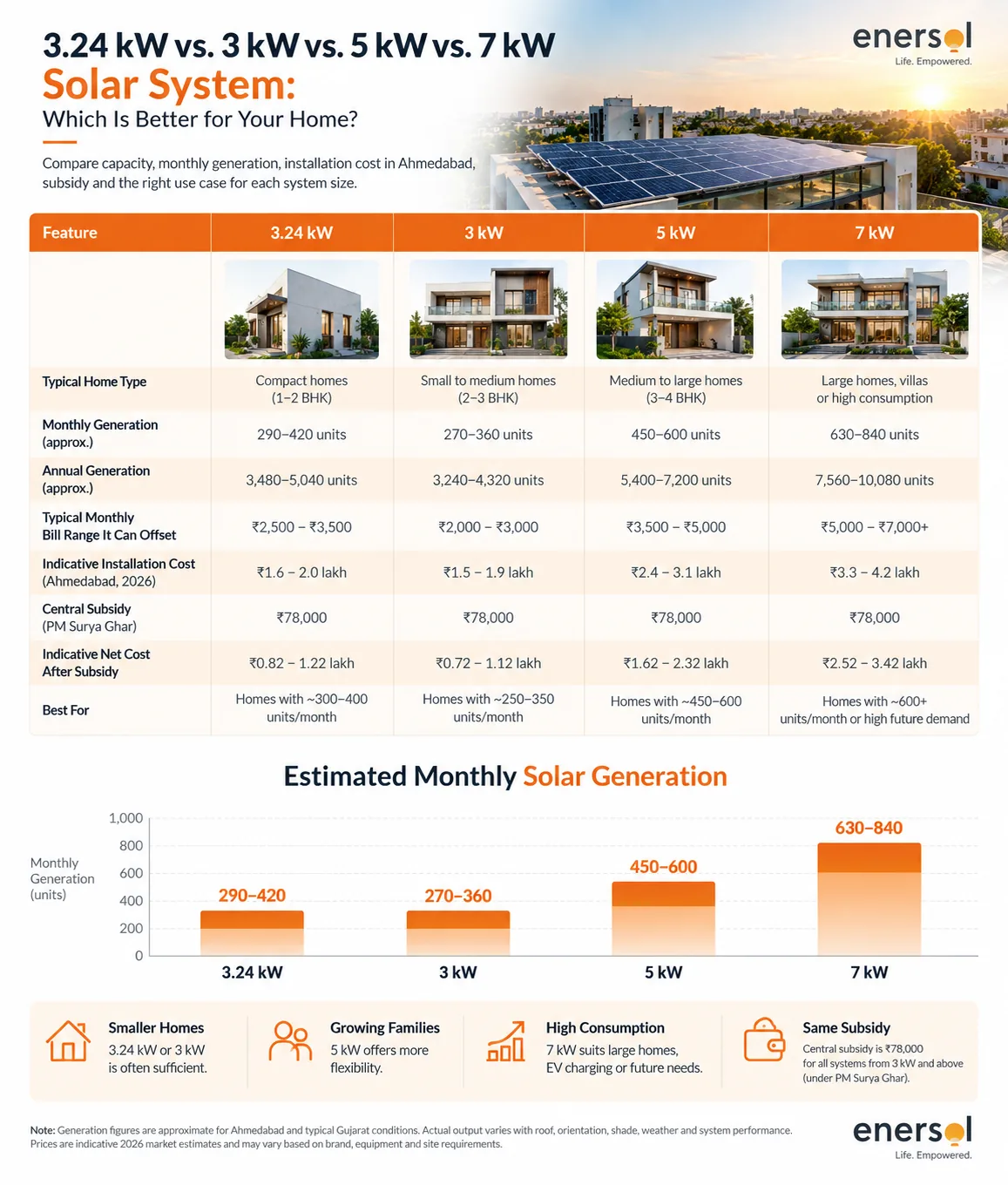
The chart below compares estimated monthly generation for all four capacities.
| Solar Capacity | Lower Estimate (Units/Month) | Upper Estimate (Units/Month) |
|---|---|---|
| 3 kW | 270 | 360 |
| 3.24 kW | 292 | 389 |
| 5 kW | 450 | 600 |
| 7 kW | 630 | 840 |
A 5 kW system has approximately 67% more rated panel capacity than a 3 kW system.
A 7 kW system has approximately 133% more rated capacity.
That doesn't mean either system will reduce your electricity bill by the same percentage.
The value of the additional generation depends on your household consumption, the timing of usage and the applicable DISCOM rules.
8. Ahmedabad Example: When 5 kW May Be Better Than 3.24 kW
Consider a hypothetical family living in a bungalow in Gota, Ahmedabad.
Their annual electricity consumption is 5,400 units, averaging 450 units per month.
Using a planning assumption of 110 units per kW per month:
- A 3.24 kW system could generate approximately 356 units monthly.
- A 5 kW system could generate approximately 550 units monthly.
The 3.24 kW system may offset a substantial portion of annual consumption, but it may not match the family's total electricity requirement.
A 5 kW system could generate more electricity than the family's average monthly use.
Which is better?
The answer depends on seasonal demand, export settlement, roof conditions and the price difference between the systems.
If the family expects electricity consumption to increase, 5 kW may deserve serious consideration.
If consumption is likely to remain stable and surplus exports receive limited financial value, a smaller system may offer a more attractive return.
The lesson: Compare the lifetime value of the additional solar capacity, not just the number of units it can produce.
9. Five Checks Before Selecting a Home Solar Panel System
Check 1: Review 12 Months of Electricity Consumption
A summer bill alone can exaggerate your average requirement. Review the complete year to understand seasonal demand.
Check 2: Ask for a Roof-Specific Generation Estimate
Shade from neighbouring buildings, water tanks and parapet walls can reduce output. A proper site assessment should account for these conditions.
Check 3: Confirm the DC and AC System Ratings
A quotation for 3.24 kW may describe the total rated capacity of the panels, while the inverter may have a different AC rating. Ask your installer to explain the configuration.
Check 4: Understand the Subsidy and Net-Metering Process
Confirm current PM Surya Ghar eligibility, equipment requirements, DISCOM approvals and export billing arrangements before making a payment.
Check 5: Compare Long-Term Value, Not Just Installation Price
Review equipment quality, workmanship, electrical safety, monitoring, maintenance requirements and warranty support.
Enersol's residential rooftop solar services include system design, installation, assistance with approvals and subsidies, and ongoing after-sales support.
11. Final Recommendation: Choose the Capacity Your Home Can Actually Benefit From
A 3 kW or 3.24 kW system may be suitable for moderate household electricity consumption.
A 5 kW system may make sense for families with higher annual demand.
A 7 kW installation may be appropriate for larger electricity requirements, provided the additional generation offers worthwhile value.
But the best choice isn't automatically the largest system.
At Enersol Solutions, the right starting point is a review of your electricity bills, rooftop conditions and expected energy requirements.
If you're planning a solar rooftop system for home use in Ahmedabad, Gandhinagar, Surat or elsewhere in Gujarat, request a property-specific assessment before deciding.
Residential Solar Enquiry: https://www.enersol.co.in/solutions/rooftop-solar/residential-solar