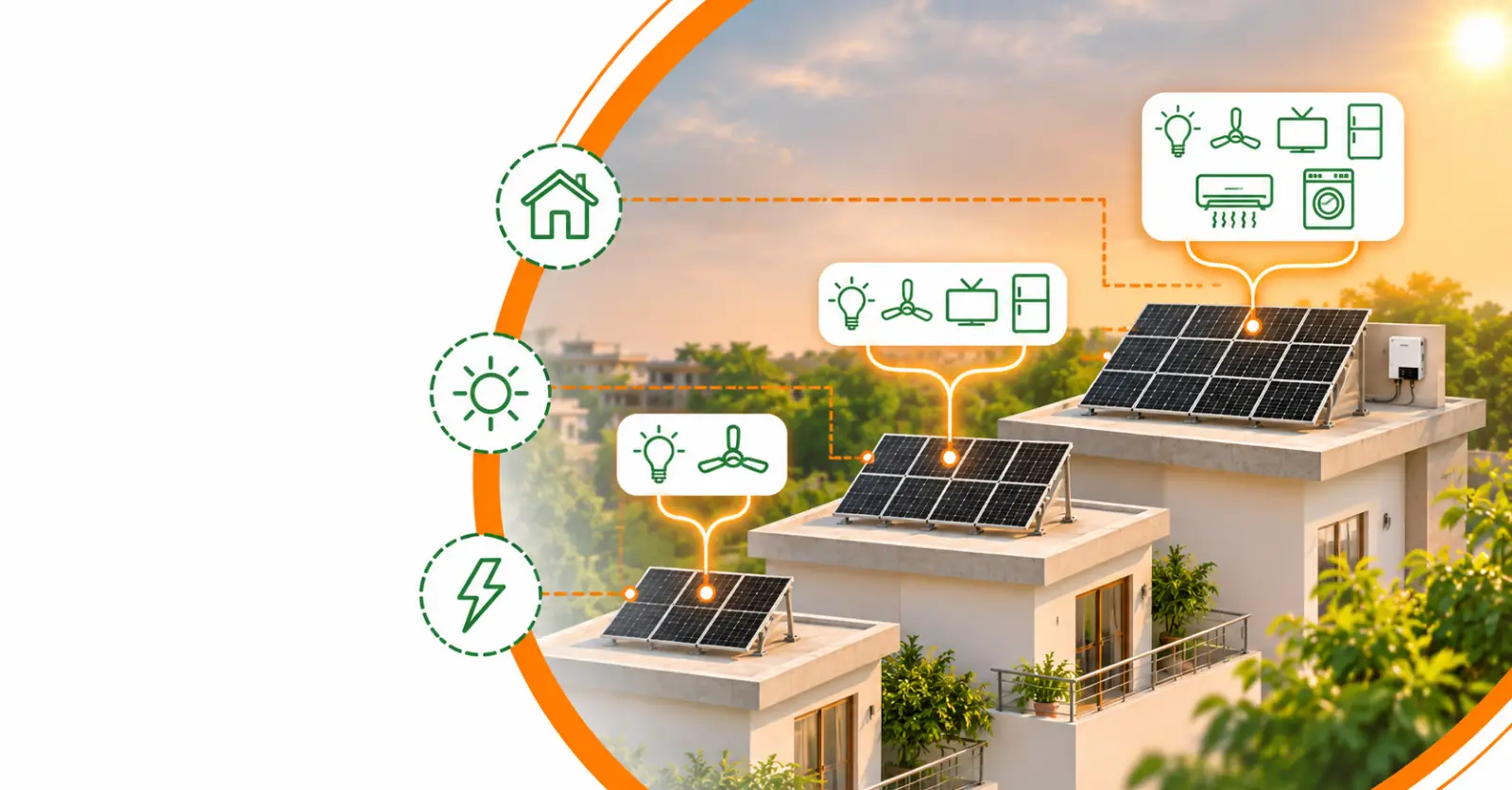

1 kW, 2 kW or 3 kW solar? Compare Ahmedabad installation prices, monthly electricity generation and subsidies before choosing the right system for your home.
Quick Summary: Which Solar System Should You Choose?
If you're planning rooftop solar for your home in Ahmedabad or elsewhere in Gujarat, you'll probably come across three popular options: 1 kW, 2 kW and 3 kW.
But how do you decide?
A 1 kW system can be suitable for modest electricity consumption. A 2 kW system offers more generation for a family with moderate usage. A 3 kW system may be worth considering if your home regularly uses air conditioning or consumes around 300 units a month.
Here's a quick comparison.
| Feature | 1 kW Solar | 2 kW Solar | 3 kW Solar |
|---|---|---|---|
| Monthly generation | 90–120 units | 180–240 units | 270–360 units |
| Annual generation | 1,080–1,440 units | 2,160–2,880 units | 3,240–4,320 units |
| Typical household | Low consumption | Moderate consumption | Moderate-to-high consumption |
| Central subsidy | ₹30,000 | ₹60,000 | ₹78,000 |
| Best reason to choose | Smaller electricity requirement | Balanced capacity | Higher annual demand |
Generation figures are approximate ranges published in Enersol's residential solar guidance. Actual output depends on site conditions.
The simplest rule: Choose solar capacity according to your electricity consumption, not just the number of bedrooms or your latest electricity bill.
1. Why Choosing the Right Solar Capacity Matters
Imagine a family living in a bungalow in South Bopal, Ahmedabad.
They want to install solar panels because their summer electricity bills keep increasing.
One installer recommends 2 kW. Another recommends 3 kW.
Naturally, the family wonders whether the bigger system is worth the extra money.
The answer depends on something neither recommendation should ignore: how much electricity the family actually uses throughout the year.
If their consumption is only 150 units a month, installing 3 kW may produce more electricity than they can use economically.
If their consumption is 320 units a month, a 1 kW system will offset only part of their requirement.
The goal isn't to install the most panels. It's to install the capacity that offers sensible long-term value.
2. What Can a 1 kW Solar System Do for Your Home?
A 1 kW residential solar system may generate approximately 90–120 electricity units per month.
It is worth considering for a smaller household with relatively low electricity consumption.
For example, a home using fans, lights, a refrigerator, television and basic kitchen appliances may find 1 kW useful.
However, it is important to understand that a 1 kW solar system does not supply 1 kW of electricity continuously, day and night.
Generation changes throughout the day and stops after sunset.
If your home uses air conditioning frequently, the solar system may still reduce grid consumption, but 1 kW is unlikely to offset all your electricity needs.
Consider 1 kW when: Your annual consumption is modest and your roof or investment budget is limited.
Which Solar Capacity Fits Your Home?
Compare 1 kW, 2 kW and 3 kW options with a site-specific generation and cost estimate.
3. When Does a 2 kW Solar System Make Sense?
A 2 kW solar system may generate around 180–240 units monthly under typical planning conditions.
For many households, it offers a middle ground between installation cost and electricity generation.
Consider a family in Chandkheda, Ahmedabad, consuming around 200 units per month.
A 2 kW system could be worth evaluating because its expected annual output is broadly comparable to the family's annual consumption.
But there's an important detail.
If the family consumes most of its electricity at night, the value of solar exports and grid imports will depend on the applicable net-metering rules.
That is why a solar proposal should estimate not only how much electricity the panels will generate but also how that generation will affect the household's bill.
Consider 2 kW when: Your annual electricity requirement is moderate and a site assessment supports the expected generation.
4. Is a 3 kW Solar System Worth Buying?
For homeowners comparing the 3 kW solar system price for home use, this is often the most important question.
A 3 kW system can generate approximately 270–360 units per month, based on Enersol's published estimates.
That makes it worth evaluating for households with higher electricity consumption.
For example, a family in Ahmedabad with one frequently used air conditioner, a refrigerator, washing machine, water pump and other everyday appliances might consume around 300 units monthly.
A 3 kW system could offset a substantial share of that consumption over the year, depending on sunlight, system performance and electricity billing rules.
What about the 3 kW on-grid solar system price?
An on-grid system connects to the electricity network and generally does not include battery storage.
It can be more economical than a battery-backed installation, but it will normally shut down during a grid outage for safety.
If you need backup power during electricity cuts, discuss a suitable hybrid or battery-backed design separately.
Consider 3 kW when: Your electricity records show higher annual demand, your roof has enough usable space, and the additional capacity offers worthwhile savings.
5. Solar System Price in Ahmedabad: 1 kW vs 2 kW vs 3 kW
The cost of residential solar systems varies by solar panel brand, inverter, mounting structure, cable routing, roof height, safety equipment and installation scope.
Published Ahmedabad market estimates for 2026 suggest the following broad budget ranges for installed on-grid systems.
| Capacity | Indicative Price Before Subsidy | Central Subsidy | Indicative Net Cost |
|---|---|---|---|
| 1 kW | ₹55,000–₹70,000 | ₹30,000 | ₹25,000–₹40,000 |
| 2 kW | ₹1,05,000–₹1,35,000 | ₹60,000 | ₹45,000–₹75,000 |
| 3 kW | ₹1,50,000–₹1,90,000 | ₹78,000 | ₹72,000–₹1,12,000 |
Indicative market estimates, not Enersol quotations. Figures assume eligibility for the stated central subsidy and do not guarantee that every installation can be completed within these ranges. Premium equipment, elevated structures or unusual site conditions may increase costs.
Why Do 3 kW Solar Prices Differ So Much?
Suppose one company quotes ₹1.55 lakh for a 3 kW system and another quotes ₹1.85 lakh.
The ₹30,000 difference deserves investigation.
Check whether both quotations include the same panel specifications, inverter quality, mounting structure, earthing, surge protection, installation workmanship, approval assistance and after-sales service.
A lower quote may be perfectly reasonable. But you need to know exactly what is included before deciding.
Also remember that the PM Surya Ghar central subsidy reaches its maximum of ₹78,000 at 3 kW. Installing additional capacity does not increase that central subsidy.
6. Solar Generation Comparison: 1 kW, 2 kW and 3 kW
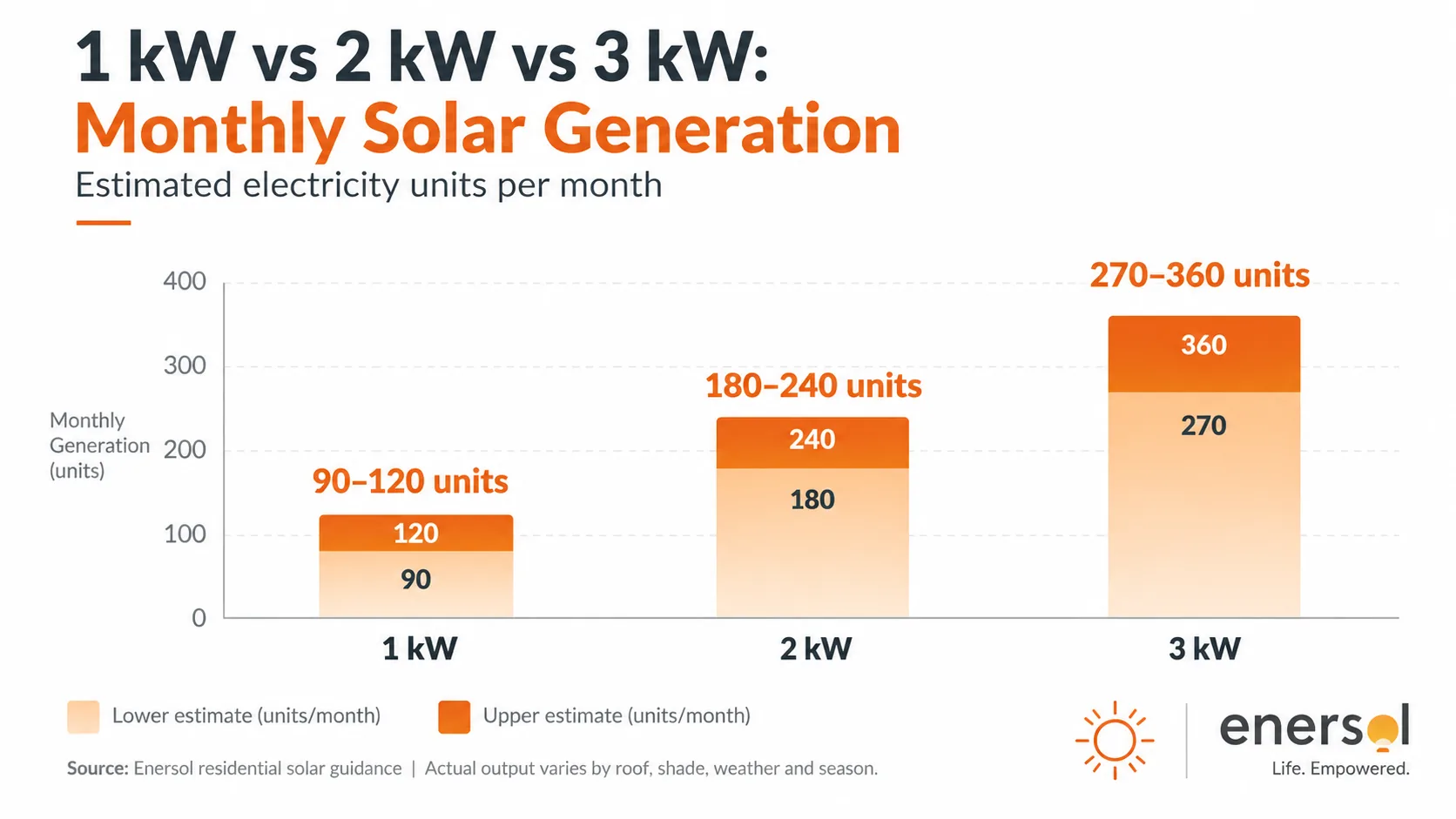
The following chart uses Enersol's published monthly generation ranges.
| Solar Capacity | Minimum Monthly Generation | Maximum Monthly Generation |
|---|---|---|
| 1 kW | 90 units | 120 units |
| 2 kW | 180 units | 240 units |
| 3 kW | 270 units | 360 units |
These are planning estimates rather than guaranteed production. Summer heat, monsoon cloud cover, dust and shade can all influence output.
For example, a solar system installed on an open, well-oriented roof in Ahmedabad may perform differently from the same system installed near a tall neighbouring building.
This is why a site-specific generation forecast is more valuable than a generic promise of monthly savings.
7. How to Calculate the Solar Capacity Your Home Needs
Here's a simple calculation.
Suppose your home consumes 3,000 electricity units in one year.
Your average monthly consumption is:
3,000 ÷ 12 = 250 units.
Now assume your roof can generate an average of 110 units per month for every installed kW.
Estimated capacity:
250 ÷ 110 = 2.27 kW.
This suggests that comparing 2 kW and 3 kW would be sensible.
However, the final choice depends on your seasonal consumption, projected generation, export compensation, available roof area and total installation cost.
Practical advice: Keep the last 12 months of electricity bills ready before requesting a solar quotation. If your electricity bills are issued every two months, collect the last six bills.
8. What Should You Check Before Installing Solar?
Roof Condition and Available Space
A rooftop must be structurally suitable for solar panels and their mounting structure. Roof area alone is not enough; water tanks, access pathways, parapet walls and shade can reduce usable space.
Panel and Inverter Specifications
Compare the actual rated capacity of the modules, inverter compatibility, product warranties and service support. Six 500 W panels, for example, provide 3,000 W of rated DC panel capacity.
Subsidy Eligibility
Under PM Surya Ghar, eligible residential installations may qualify for central financial assistance of ₹30,000 for 1 kW, ₹60,000 for 2 kW and ₹78,000 for 3 kW or higher.
Confirm eligibility and applicable equipment requirements before installation.
Net Metering and DISCOM Approval
Your solar installer should explain how grid imports, solar exports and electricity billing will work under your local distribution company's rules.
Long-Term Maintenance
Panels need periodic cleaning and inspection. Electrical connections, inverter performance, mounting hardware and system monitoring also deserve attention.
Enersol's residential solar offering covers system design, installation, subsidy and net-metering assistance, and ongoing support.
10. Final Recommendation: The Best Solar System Is the One That Fits Your Home
A 1 kW system may be enough for a household with modest electricity requirements.
A 2 kW system may be a practical option for moderate consumption.
A 3 kW system may make sense when electricity demand is higher and the roof can support sufficient generation.
But none of these choices should be based only on the system price or subsidy amount.
At Enersol Solutions, residential solar planning focuses on understanding your electricity consumption, evaluating the rooftop and designing a suitable system with support through installation, approvals and long-term maintenance.
Thinking about rooftop solar in Ahmedabad, Gandhinagar, Surat or elsewhere in Gujarat?
Start with your electricity bills and a proper rooftop assessment.
Request a residential solar assessment: https://www.enersol.co.in/solutions/rooftop-solar/residential-solar