
₹2,000 electricity bill every month? See whether 2 kW or 3 kW solar makes sense, how much it may cost in Gujarat, and what subsidy you could receive.
Quick Summary: Which Solar System Is Right for Your Electricity Bill?
If your monthly electricity bill is ₹1,000, ₹2,000 or ₹3,000, you're probably wondering how many solar panels your home needs and whether the investment will actually reduce your expenses.
Here's a practical starting point.
| Average Monthly Electricity Bill | Solar Capacity Worth Evaluating | What to Check |
|---|---|---|
| ₹1,000 | 1–2 kW | Basic appliances, actual units consumed |
| ₹2,000 | 2–3 kW | AC usage, seasonal consumption, daytime load |
| ₹3,000 | 3–4 kW | Multiple ACs, annual demand, future appliances |
Important: These are broad planning ranges, not guaranteed system recommendations. Two households paying ₹2,000 can require different solar capacities because their electricity tariffs and consumption patterns may differ.
The most useful number is not your bill amount. It is the number of electricity units your family consumes.
1. Why a ₹2,000 Electricity Bill Doesn't Always Mean a 2 kW Solar System
Imagine two families living in Ahmedabad.
The first family lives in a two-bedroom apartment. They use fans, a refrigerator, a washing machine and one air conditioner occasionally.
The second family lives in a bungalow. They use similar appliances but run two air conditioners regularly.
Both receive an electricity bill of around ₹2,000 during a particular month.
Does that mean both need the same home solar system?
Not necessarily.
Their electricity usage may change considerably between summer and winter. They may also be billed under different tariff categories or slabs.
A family in Ahmedabad served by Torrent Power may have a different billing structure from a household in another part of Gujarat served by a state DISCOM.
That's why choosing solar panels for home based on a single electricity bill can lead to an undersized or oversized installation.
The better approach: Check your electricity consumption over 12 months before deciding on capacity.
2. How to Calculate the Right Solar Capacity for Your Home
You don't need to be an electrical engineer to understand the basic calculation.
Open your electricity bill and find the section showing units consumed (kWh).
Suppose your household consumes 300 units every month on average.
That means your approximate annual electricity consumption is:
300 × 12 = 3,600 units.
Now estimate how much electricity a solar system of different capacities could generate at your property.
For illustration, assume your roof can generate an average of 110 units per installed kW each month.
Estimated solar capacity:
300 ÷ 110 = 2.73 kW.
A 3 kW system becomes a reasonable option to evaluate.
But this is not the final installation recommendation.
Your installer should also check rooftop shade, panel orientation, available space, inverter suitability, seasonal generation and the local net-metering arrangement.
Practical tip: If you have a bi-monthly electricity bill, divide the units by two to estimate monthly consumption. For annual planning, add the units from all six bills rather than relying on just one.
Not Sure How Much Solar Your Home Needs?
Get a site-specific capacity and savings estimate based on your yearly electricity units.
3. Solar Capacity for ₹1,000, ₹2,000 and ₹3,000 Electricity Bills
₹1,000 Electricity Bill: Is 1 kW Solar Enough?
For a relatively small household, a 1 kW solar system may be worth considering.
It could be suitable for homes with modest electricity requirements, such as lights, fans, a refrigerator, television and occasional appliance usage.
However, if your household regularly uses an air conditioner or electric water heater, 1 kW may not cover a large share of your consumption.
A 1–2 kW system is a sensible starting range to assess, provided the annual units support it.
₹2,000 Electricity Bill: Should You Install 2 kW or 3 kW?
This is where many homeowners get confused.
When searching for a solar system for 2000 rs electricity bill price, you may find recommendations for 2 kW or 3 kW systems.
The difference matters.
A 2 kW system costs less initially and may suit moderate consumption.
A 3 kW system offers greater generation potential and may be useful if your household consumes more electricity during summer or plans to add appliances.
For example, if your annual consumption is approximately 3,300 units, a 2 kW system generating around 2,640 units annually under an illustrative 110-unit-per-kW monthly assumption may not fully match your yearly usage.
A 3 kW system generating approximately 3,960 units under the same assumption could be worth assessing.
That doesn't automatically mean 3 kW will save more money in every situation. Export compensation, seasonal demand and installation costs also matter.
₹3,000 Electricity Bill: Is 3 kW Solar Sufficient?
For a household paying around ₹3,000 monthly, 3–4 kW may be an appropriate initial comparison.
But consider your future requirements.
Are you planning to install another air conditioner? Will your parents move in? Are you considering an electric vehicle?
These changes can increase electricity consumption.
A properly sized solar setup for home should consider reasonable future demand without unnecessarily increasing the investment.
4. How Much Electricity Does a Home Solar System Generate?
Solar panels generate electricity when sunlight reaches them. Their actual output depends on temperature, weather, dust, shading, orientation and system efficiency.
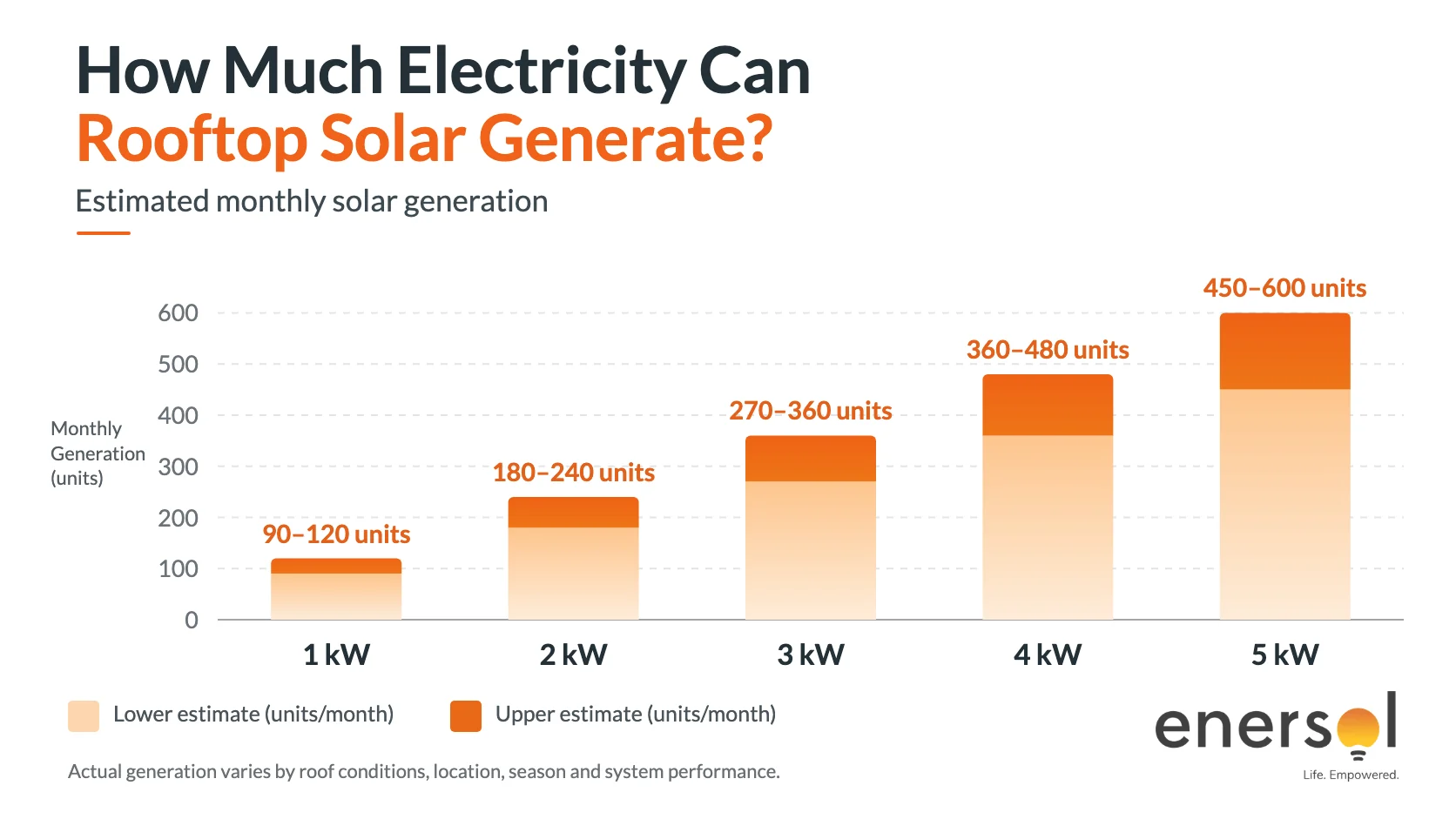
The following table uses an illustrative planning assumption of 90–120 units per month for each installed kW.
| Solar System Capacity | Estimated Monthly Generation | Estimated Annual Generation |
|---|---|---|
| 1 kW | 90–120 units | 1,080–1,440 units |
| 2 kW | 180–240 units | 2,160–2,880 units |
| 3 kW | 270–360 units | 3,240–4,320 units |
| 4 kW | 360–480 units | 4,320–5,760 units |
| 5 kW | 450–600 units | 5,400–7,200 units |
These are illustrative estimates, not guaranteed Enersol production figures. A site-specific solar generation assessment is necessary.
Chart: Estimated Monthly Solar Generation
| Solar Capacity | Lower Estimate (Units/Month) | Upper Estimate (Units/Month) |
|---|---|---|
| 1 kW | 90 | 120 |
| 2 kW | 180 | 240 |
| 3 kW | 270 | 360 |
| 4 kW | 360 | 480 |
| 5 kW | 450 | 600 |
5. Solar for Home Cost and Government Subsidy in Gujarat
One of the biggest questions homeowners ask is: "How much money will I need to install solar?"
The answer depends on the capacity, solar module brand, inverter, mounting structure, wiring, installation requirements and other project components.
Instead of trusting an advertised starting price, request a detailed quotation that clearly separates the equipment, installation scope, applicable taxes and any additional work.
PM Surya Ghar Subsidy for Residential Solar
Eligible residential households can receive central financial assistance under PM Surya Ghar: Muft Bijli Yojana.
| Residential Solar Capacity | Maximum Central Subsidy |
|---|---|
| 1 kW | ₹30,000 |
| 2 kW | ₹60,000 |
| 3 kW | ₹78,000 |
| 4 kW | ₹78,000 |
| 5 kW | ₹78,000 |
Subsidy figures are subject to current scheme eligibility, installation requirements and approval. Additional state assistance, if available, must be verified separately.
Example: Calculating Your Net Solar Investment
Suppose an eligible homeowner receives an itemised 3 kW installation quotation of ₹1,80,000.
| Particulars | Amount |
|---|---|
| Illustrative installation cost | ₹1,80,000 |
| Eligible central subsidy | ₹78,000 |
| Effective cost after subsidy | ₹1,02,000 |
This example is for understanding the calculation. It is not an Enersol price quotation.
Before paying an advance, confirm the proposed equipment, warranty terms, subsidy process, DISCOM requirements and whether the quotation includes all necessary installation work.
6. An Ahmedabad Family's Solar Calculation
Consider a hypothetical family living in South Bopal, Ahmedabad.
Their monthly electricity bill is usually around ₹2,000, but during April, May and June, it increases because the air conditioner runs longer.
Instead of choosing a system based on their average bill, they collect their last six bi-monthly electricity bills.
Their annual consumption comes to 3,600 units.
That gives an average of 300 units per month.
Using an illustrative solar generation estimate of 110 units per kW per month, their calculated requirement is approximately 2.73 kW.
A 3 kW rooftop solar system is therefore worth evaluating.
However, during a roof inspection, the installer notices that a neighbouring building shades part of the terrace in the afternoon.
This changes the design decision.
The family now needs a realistic generation estimate based on usable roof area, shade and panel positioning not simply a standard 3 kW package.
The takeaway: Good solar planning begins with your electricity bills, but it should always end with a proper rooftop assessment.
7. Five Mistakes to Avoid Before Installing Solar Panels for Home
Mistake 1: Choosing solar capacity from one electricity bill.
Summer and winter consumption can be very different. Review a full year wherever possible.
Mistake 2: Assuming solar means a zero electricity bill.
Grid-connected households may still pay fixed charges and other applicable billing components. Electricity imported from the grid can also affect the final bill.
Mistake 3: Ignoring shade from nearby buildings and water tanks.
Even partial shade can reduce output. Ask your installer to evaluate shading before finalising panel placement.
Mistake 4: Comparing only the lowest solar quotation.
Check module specifications, inverter quality, mounting structures, safety components, warranties and after-sales support.
Mistake 5: Assuming regular rooftop solar works during a power cut.
A conventional grid-tied solar system generally shuts down when the grid fails for safety reasons. Backup power requires an appropriately designed battery or hybrid arrangement.
9. Final Takeaway: Don't Buy More Solar Than You Need. Don't Install Less Than You Use.
Installing solar is a long-term decision, so the right capacity matters more than choosing the biggest available package.
A ₹1,000 electricity bill may justify evaluating 1–2 kW. A ₹2,000 bill may point toward 2–3 kW. A ₹3,000 bill may call for 3–4 kW.
But these ranges only help you begin the conversation.
Your annual electricity consumption, roof conditions, local billing rules and future requirements should determine the final recommendation.
At Enersol Solutions, the focus is on helping homeowners choose a properly designed rooftop solar system, with support for installation, approvals, subsidy documentation and ongoing performance.
Planning solar for your home in Ahmedabad or Gujarat?
Keep your last 12 months of electricity bills ready and ask Enersol for a home solar assessment.
Website: https://www.enersol.co.in/
Sources and References
- PM Surya Ghar: Muft Bijli Yojana — Government of India: https://pmsuryaghar.gov.in/
- Ministry of New and Renewable Energy: https://mnre.gov.in/
- Gujarat Electricity Regulatory Commission — Tariffs and Regulations: https://gercin.org/
- Enersol Solutions — Residential Rooftop Solar: https://www.enersol.co.in/solutions/rooftop-solar/residential-solar
Editorial note: The Ahmedabad family is a hypothetical example. Generation and pricing calculations are illustrative. Final recommendations should use current electricity bills, site-specific engineering estimates, applicable tariffs and confirmed subsidy eligibility.