
Discover the 4 kW solar panel price in India in 2026, including ₹78,000 subsidy, installation costs, electricity generation, EMI options and savings for Gujarat homes.
Quick Summary: How Much Does a 4 kW Solar System Cost After Subsidy?
Your electricity bill has been crossing ₹3,000 for months. You've started researching rooftop solar, and almost every installer seems to recommend a different system size.
Some suggest 3 kW. Others recommend 5 kW.
But what about 4 kW?
For many households, a 4 kW rooftop solar system can offer a useful middle ground between installation cost and electricity generation.
The bigger question is: How much will you actually pay after the government subsidy?
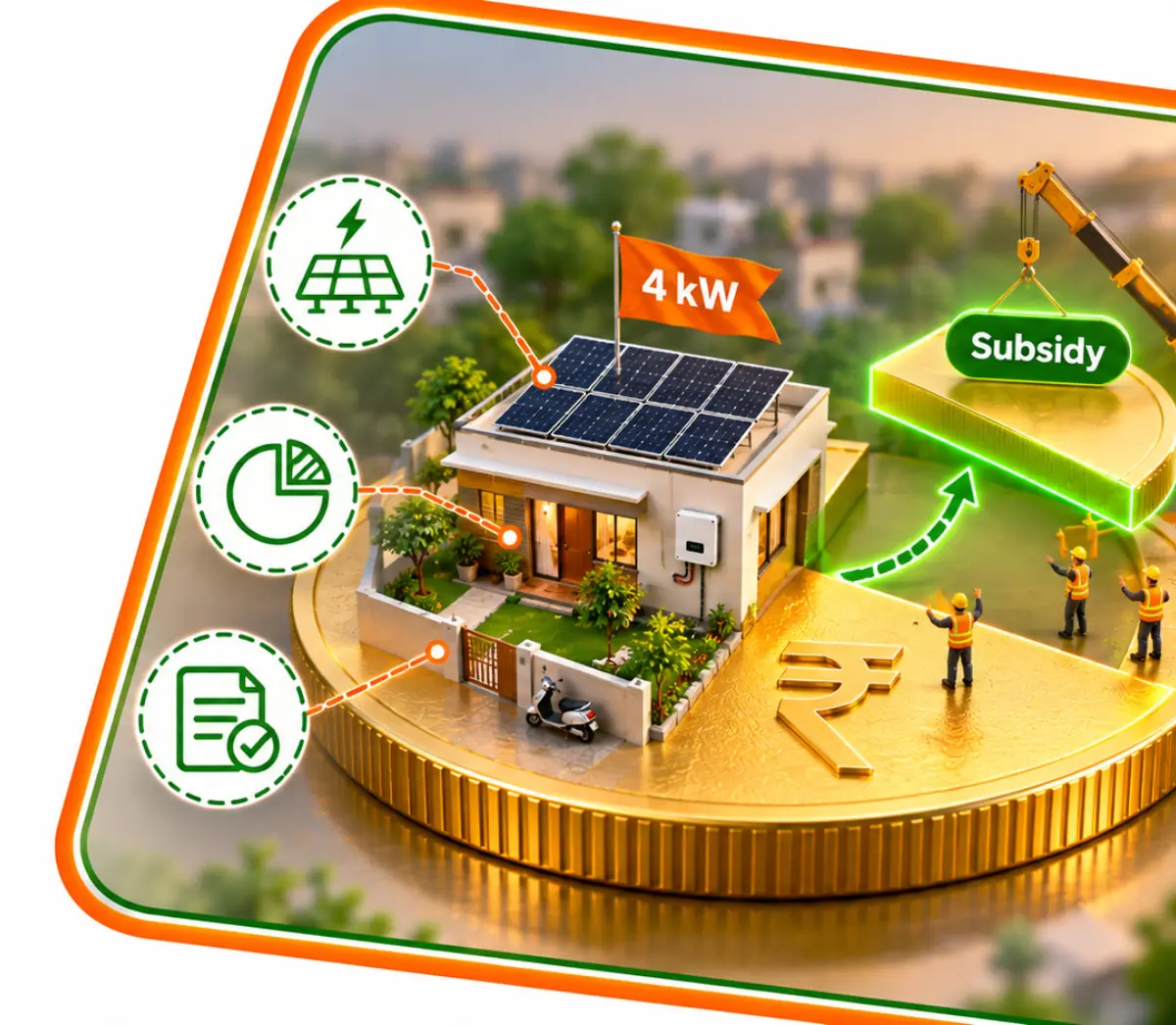
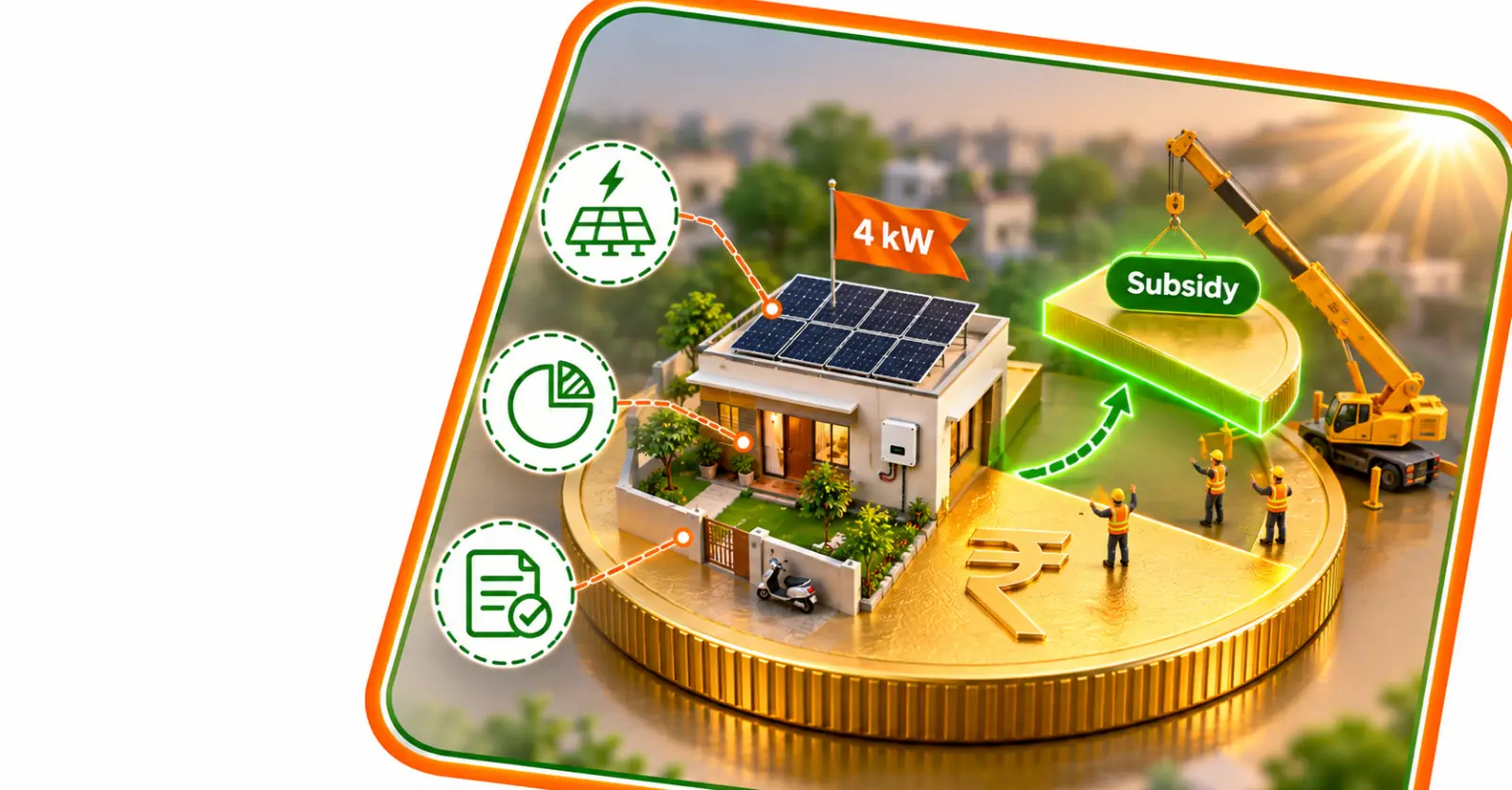
Under PM Surya Ghar: Muft Bijli Yojana, an eligible residential 4 kW system can receive the standard maximum central subsidy of ₹78,000.
Here's a simple illustration.
<text color="secondary" size="xs">Illustrative cost calculation — not a verified November 2026 market quotation</text>
| Cost Component | Amount |
|---|---|
| Example 4 kW installed system price | ₹2,20,000 |
| Eligible central subsidy | ₹78,000 |
| Effective cost after subsidy | ₹1,42,000 |
| Example cost per watt before subsidy | ₹55 |
The actual price depends on the panels, inverter, mounting structure, roof conditions, installation scope and applicable taxes.
And remember: the subsidy is subject to eligibility, installation compliance and approval. It should not automatically be treated as an upfront discount.
1. What Is a 4 kW Solar System?
A 4 kW rooftop solar system has approximately 4,000 watts of rated solar generating capacity.
The system typically includes photovoltaic panels, an inverter, mounting structures, wiring, electrical protection and monitoring equipment.
During daylight hours, the panels convert sunlight into DC electricity. The inverter converts it into AC electricity that can be used by household appliances.
In a standard grid-connected system, electricity generation varies throughout the day.
Excess electricity may be exported to the grid, with credits determined by the applicable DISCOM rules.
How Many Panels Does a 4 kW System Need?
That depends on the wattage of each panel.
| Panel Wattage | Number of Panels | Total DC Capacity |
|---|---|---|
| 500 W | 8 | 4.00 kWp |
| 540 W | 8 | 4.32 kWp |
| 550 W | 7 | 3.85 kWp |
| 575 W | 7 | 4.025 kWp |
These are examples of module combinations, not interchangeable system designs.
The final capacity must be matched with inverter specifications, roof layout and applicable approval requirements.
A system marketed as 4 kW may refer to the inverter's AC capacity or the panels' DC capacity. Always ask the installer which measurement is being quoted.
2. 4 kW Solar Panel Price in India in 2026
There isn't one fixed national price for a 4 kW solar system.
A straightforward installation on an open terrace can cost differently from one requiring elevated mounting, complicated cable routing or structural modifications.
To understand how prices work, consider three hypothetical quotations.
| Example System | Installed Price | Cost per Watt |
|---|---|---|
| Basic configuration | ₹2,00,000 | ₹50 |
| Mid-range configuration | ₹2,20,000 | ₹55 |
| Higher-cost configuration | ₹2,60,000 | ₹65 |
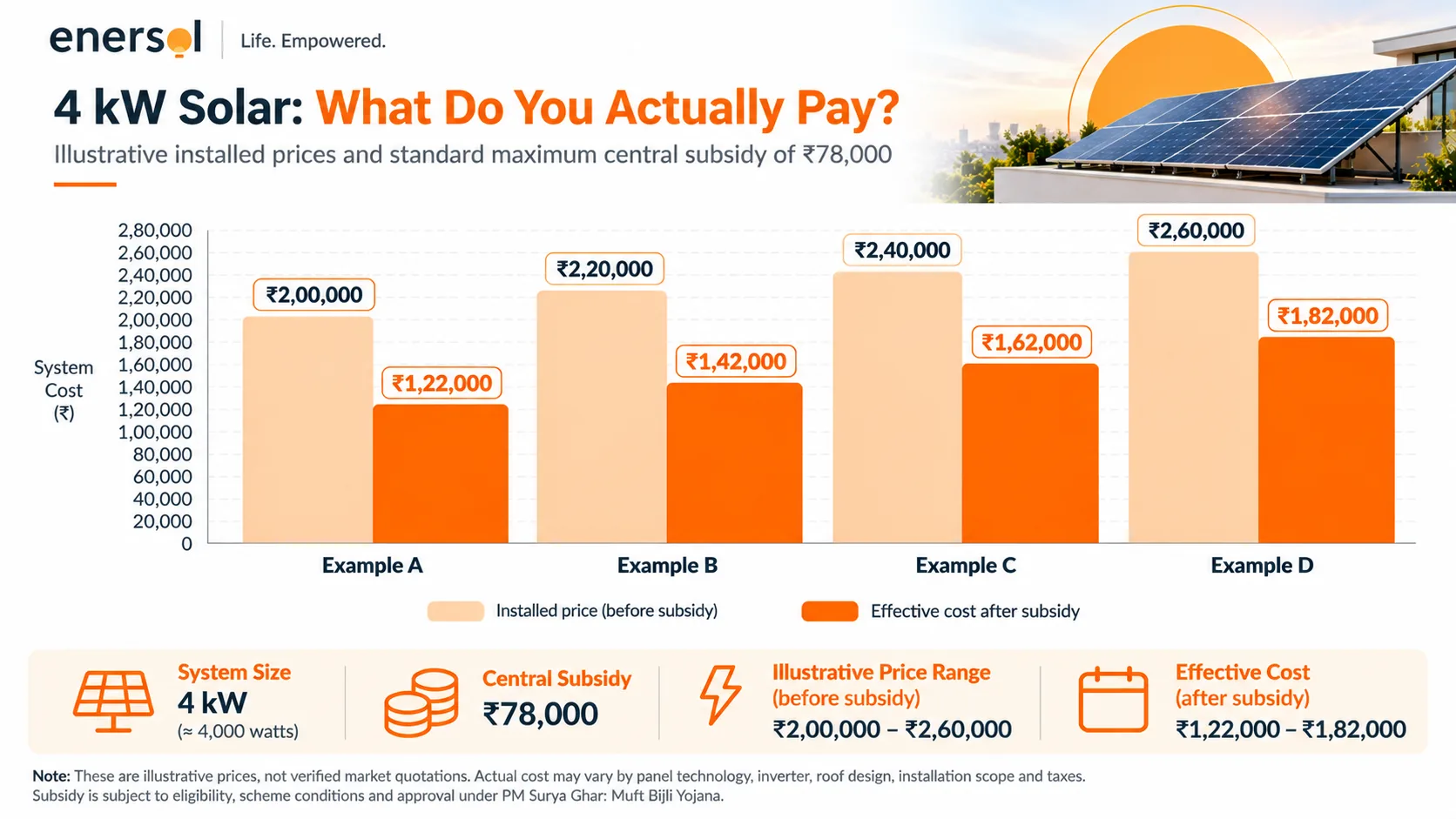
These are illustrative pricing scenarios, not independently verified November 2026 dealer rates or Enersol quotations.
Why can the difference be ₹60,000?
Because the total solar panels for home cost includes much more than the modules themselves.
A quotation may vary according to panel technology, inverter brand, mounting structure, roof height, electrical protection, warranty coverage and installation complexity.
Price Per Watt Matters, but It Isn't Everything
Suppose Installer A quotes ₹50 per watt and Installer B quotes ₹55 per watt.
Installer A looks cheaper.
But if Installer A excludes additional mounting work, earthing or certain approval-related expenses, the final cost may be closer than it first appears.
Compare complete, itemised quotations not just the headline price per watt.
Is 4 kW the Right Size for Your Home?
Get a site-specific assessment and a detailed quotation before choosing your system.
3. Government Subsidy for a 4 kW Solar System in 2026
The central government provides residential rooftop solar subsidies under PM Surya Ghar: Muft Bijli Yojana.
For eligible standard residential installations, the subsidy calculation is:
- First 2 kW: ₹30,000 per kW
- Additional capacity between 2 kW and 3 kW: ₹18,000
- Capacity beyond 3 kW: No further standard central subsidy
This means a 4 kW system receives the same standard maximum central subsidy as an eligible 3 kW system.
4 kW Solar Panel Price With Subsidy
| Example Installed Price | Central Subsidy | Effective Cost |
|---|---|---|
| ₹2,00,000 | ₹78,000 | ₹1,22,000 |
| ₹2,20,000 | ₹78,000 | ₹1,42,000 |
| ₹2,40,000 | ₹78,000 | ₹1,62,000 |
| ₹2,60,000 | ₹78,000 | ₹1,82,000 |
These are calculations using hypothetical installed prices and the standard maximum central subsidy.
Who Is Eligible?
Applicants must meet the scheme's residential consumer requirements.
The installation must also satisfy applicable equipment, vendor, documentation and commissioning conditions.
For subsidy-supported systems, DCR-compliant solar modules are required.
Homeowners can apply through the official portal:
Important: Don't assume every installation automatically qualifies for ₹78,000. Confirm eligibility before finalising the equipment and vendor.
4. How Much Electricity Can a 4 kW Solar System Generate?
This is where the investment becomes interesting.
A 4 kW solar system's generation depends on sunlight, roof orientation, panel tilt, shading, temperature and system losses.
For an illustrative Gujarat planning range of 3.5–4.5 units per installed kWp per day:
4 × 3.5 = 14 units per day.
4 × 4.5 = 18 units per day.
That gives an estimated range of approximately 420–540 units over a 30-day month.
| Period | Illustrative Generation |
|---|---|
| Daily | 14–18 units |
| Monthly (30 days) | 420–540 units |
| Annual (365 days) | 5,110–6,570 units |
These are planning estimates, not guaranteed generation figures.
Actual output changes seasonally. Monsoon cloud cover, summer heat and rooftop shading can all influence results.
Will Your Electricity Bill Become Zero?
Not necessarily.
Your final bill depends on electricity consumption, solar generation, self-consumption, export credits, fixed charges and applicable tariffs.
A grid-connected solar system also does not provide backup during a power cut unless it has a suitable backup arrangement.
5. Is a 4 kW Solar System Right for Your Home?
A 4 kW system may be worth evaluating if your household uses roughly 400–550 units of electricity per month.
However, monthly consumption alone isn't enough to determine the ideal capacity.
You also need to consider seasonal usage, the timing of electricity consumption, available rooftop space and local export-credit rules.
Appliances in a Typical Household
A family might use:
- Two air conditioners
- Refrigerator
- Washing machine
- Fans and lighting
- Television
- Water pump
- Kitchen appliances
But appliance ownership doesn't tell the whole story.
Two families with identical appliances can have very different electricity bills because their usage hours differ.
That's why an installer should review at least 12 months of electricity bills before recommending a home solar power system.
6. 3 kW vs 4 kW vs 5 kW: Which Is Better?
One common question is whether the extra capacity of a 4 kW system justifies the higher investment over 3 kW.
Here's a simple comparison.
| Feature | 3 kW | 4 kW | 5 kW |
|---|---|---|---|
| Illustrative monthly generation | 315–405 units | 420–540 units | 525–675 units |
| Standard maximum central subsidy | ₹78,000 | ₹78,000 | ₹78,000 |
| Rooftop space requirement | Lower | Moderate | Higher |
| Initial investment | Lower | Moderate | Higher |
Generation assumes 3.5–4.5 units per kWp per day over 30 days.
The 4 kW system may generate approximately one-third more electricity than a 3 kW system under comparable conditions.
But it won't receive an additional ₹30,000 subsidy for the fourth kilowatt.
So Is 4 kW Worth It?
It can be, if your household has enough electricity consumption to make use of the additional generation and the economics of exporting surplus energy are favourable.
If your electricity consumption is much lower, a smaller system may provide better financial value.
If you plan to add another air conditioner or an electric vehicle, your future consumption may also influence the decision.
7. What Affects the Cost of Installing 4 kW Solar Panels?
The house solar panel price depends on several components.
Solar Panel Technology
Modern technologies such as n-type TOPCon may offer higher efficiency or different degradation characteristics compared with some older products.
The price difference depends on the exact module model.
Inverter Selection
The inverter must be suitable for the system's electrical configuration.
Monitoring, protection features, warranty and service support can affect pricing.
Mounting Structure
A standard roof-mounted system may need less structural material than a high-rise elevated installation.
Roof condition, wind loading and waterproofing also matter.
Electrical Safety
Appropriate cables, earthing, isolators and protective devices are essential parts of a reliable installation.
Installation Quality
An experienced team should assess the roof, design the system, install the equipment and complete the required tests.
The cheapest quotation isn't automatically the best long-term investment.
8. Can You Install a 4 kW Solar System on EMI?
Yes. Some banks and financial institutions offer residential rooftop solar loans.
However, financing terms for a 4 kW system may differ from those available under specialised loan products for systems up to 3 kW.
Check the lender's applicable product, borrowing limit, interest rate and collateral requirements.
Example: Solar System on EMI
Suppose you finance ₹1,20,000 through a residential solar loan.
| Loan Detail | Illustrative Amount |
|---|---|
| Loan principal | ₹1,20,000 |
| Annual interest | 8% |
| Repayment period | 5 years |
| Approximate monthly EMI | ₹2,433 |
| Approximate total repayment | ₹1.46 lakh |
This is an illustrative reducing-balance EMI calculation, excluding processing fees, insurance and other charges.
The EMI is not the same as your electricity savings.
For example, if your solar installation reduces electricity purchases by ₹2,000 per month but your EMI is ₹2,433, your immediate monthly cash flow will differ from your long-term savings.
Also, the government subsidy may be credited after installation and verification. Its effect on the loan balance depends on the lender's process.
Before signing, compare the total repayment amount, not just the advertised EMI.
9. Ahmedabad Example: Should a Family Upgrade From 3 kW to 4 kW?
Consider a hypothetical family in Shela, Ahmedabad.
Their electricity consumption ranges from 350 units in cooler months to 550 units during summer.
They initially considered a 3 kW system.
But after reviewing their annual consumption and future appliance requirements, they ask whether 4 kW would make more sense.
The installer compares expected annual generation, usable rooftop area and projected electricity credits.
A 4 kW system offers additional generation capacity, but the family must pay for that extra kilowatt without receiving additional standard central subsidy.
The right decision depends on how much of that electricity the family can use or receive value for under the applicable billing rules.
The lesson?
Don't size your solar system using only your highest summer bill. Review your full year's electricity consumption.
For homeowners looking for a solar panel for home in Ahmedabad, a site assessment and realistic generation estimate are more useful than a generic price chart.
11. Final Recommendation: Choose the Capacity That Matches Your Consumption
A 4 kW solar system can be a practical option for households that need more generation than a typical 3 kW installation but don't require a full 5 kW system.
The standard central subsidy can reduce the effective investment by up to ₹78,000 for eligible residential consumers.
But the final decision should be based on more than the subsidy.
Consider your annual electricity consumption, rooftop conditions, equipment quality, installation cost and financing terms.
At Enersol Solutions, residential solar planning begins with understanding your electricity requirements and available rooftop space.
Planning a 4 kW rooftop solar installation in Ahmedabad or elsewhere in Gujarat?
Get a site-specific assessment and a detailed quotation before choosing your system.
Explore Residential Solar: https://www.enersol.co.in/solutions/rooftop-solar/residential-solar