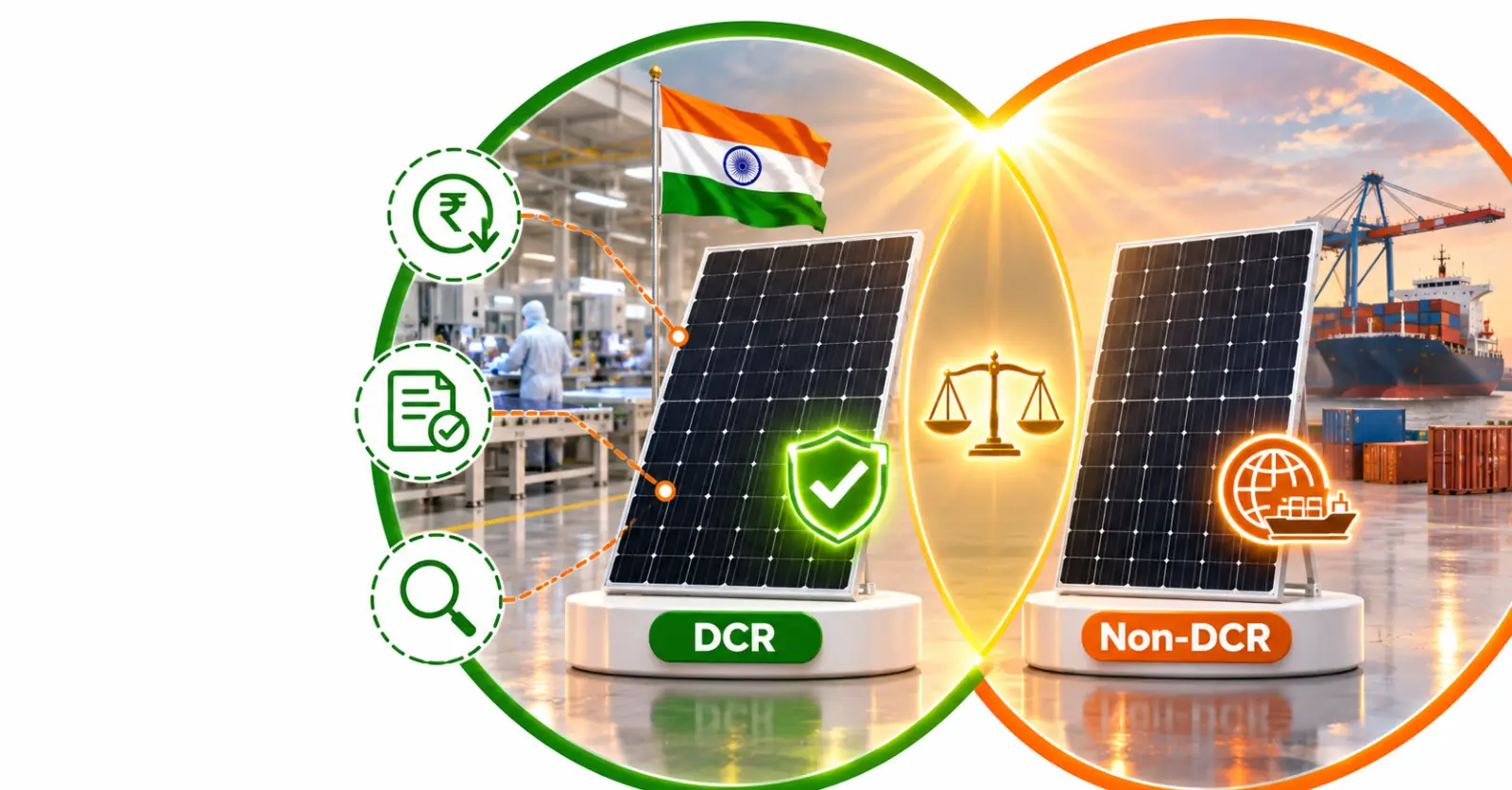
DCR or non-DCR solar panels? Compare prices, PM Surya Ghar subsidy eligibility, panel quality and what Ahmedabad homeowners should verify before buying.
Quick Summary: The Difference Could Affect Your ₹78,000 Subsidy
Imagine two homeowners in Ahmedabad installing a 3 kW rooftop solar system.
Both choose good-quality panels. Both expect to generate electricity for years.
But one homeowner selects DCR solar panels, while the other selects non-DCR panels.
The difference may not be obvious when looking at their rooftops.
Yet it can determine whether their installation qualifies for the central government subsidy.
Under PM Surya Ghar: Muft Bijli Yojana, eligible residential installations must use DCR-compliant solar modules to receive Central Financial Assistance (CFA).
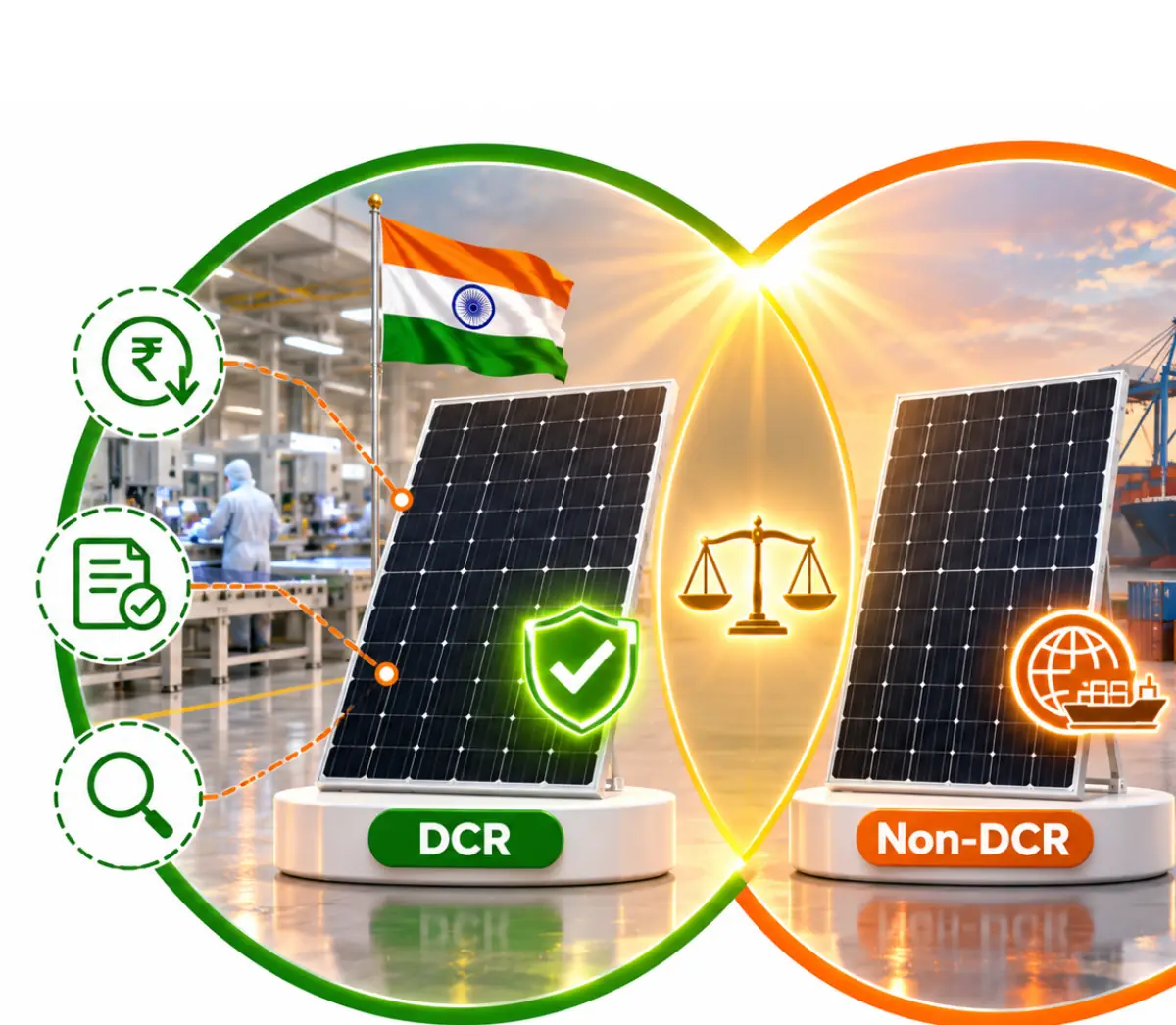
DCR means Domestic Content Requirement: both the solar cells and the finished solar modules must be manufactured in India.
Non-DCR panels do not meet that specific requirement.
Here's the basic comparison.
| Feature | DCR Solar Panels | Non-DCR Solar Panels |
|---|---|---|
| Full form | Domestic Content Requirement | Non-Domestic Content Requirement |
| Solar cell origin | Manufactured in India | May contain imported cells |
| Module manufacturing | Manufactured in India | May be manufactured in India or abroad |
| PM Surya Ghar subsidy | Can qualify when all scheme conditions are met | Not eligible for CFA under the scheme |
| Typical pricing | Often higher for comparable specifications | Often lower for comparable specifications |
| Technology | Can use modern cell technologies | Can also use modern cell technologies |
| Quality | Depends on manufacturer and product | Depends on manufacturer and product |
| Common applications | Subsidised residential rooftop systems | Eligible non-subsidised installations |
The most important point: DCR is a manufacturing-compliance category, not a solar panel efficiency rating.
1. What Are DCR Solar Panels?
A solar panel contains many photovoltaic cells connected together.
These cells convert sunlight into electricity.
The cells are then assembled into a finished module with glass, encapsulation materials, electrical connections and a protective structure.
For a panel to meet India's Domestic Content Requirement under applicable government-supported programmes, both the cells and the module must be manufactured domestically.
Why Does India Have a DCR Requirement?
India wants to expand its domestic solar manufacturing ecosystem.
Manufacturing finished panels is one part of that process.
Manufacturing solar cells is another.
The DCR requirement encourages investment across both stages rather than relying entirely on imported cells.
For homeowners, the practical significance is subsidy eligibility.
If you're applying for PM Surya Ghar assistance, you need to ensure the proposed modules meet the applicable DCR conditions.
2. What Are Non-DCR Solar Panels?
Non-DCR solar panels are modules that don't satisfy the required domestic-content conditions.
For example, a company may manufacture a solar module in India using imported solar cells.
The finished product may be labelled Made in India because the module assembly takes place domestically.
But it would not satisfy the DCR condition requiring Indian-manufactured cells.
This is where confusion begins.
Made in India does not automatically mean DCR-compliant.
Non-DCR panels can still be technically capable, efficient and suitable for applications where DCR is not required.
Their use depends on the project's applicable regulations and subsidy conditions.
DCR or Non-DCR for Your Home?
Get a quotation that clearly states the panel type and your subsidy eligibility.
3. DCR vs Non-DCR Solar Panels: What's the Real Difference?
Let's consider a simple example.
Two manufacturers offer 550 W solar panels.
Both have similar efficiency, warranty terms and physical dimensions.
One uses Indian-manufactured cells and is DCR-verified.
The other uses imported cells.
The panels may perform similarly under comparable conditions.
But their eligibility for a subsidised residential installation is different.
The Difference Is About Compliance, Not Automatically Performance
| Buying Question | What You Should Know |
|---|---|
| Does DCR mean higher efficiency? | No |
| Does non-DCR mean lower quality? | No |
| Can both types have long performance warranties? | Yes |
| Can both use advanced solar cell technologies? | Yes |
| Is DCR necessary for PM Surya Ghar CFA? | Yes |
| Is DCR verification important? | Yes |
| Does every solar project require DCR panels? | No; requirements depend on the project |
This distinction matters when comparing a solar panel manufacturer or installation company.
Don't accept a statement such as “DCR panels are always better” without asking about the actual panel model and its technical specifications.
4. Which Solar Panels Qualify for PM Surya Ghar Subsidy?
Under PM Surya Ghar, the central subsidy is available to eligible residential consumers installing rooftop solar systems that meet the scheme's conditions.
DCR compliance is mandatory for installations claiming CFA.
The standard central subsidy structure is:
| Residential Solar Capacity | Central Subsidy |
|---|---|
| 1 kW | ₹30,000 |
| 2 kW | ₹60,000 |
| 3 kW | ₹78,000 |
| 5 kW | ₹78,000 |
| 7 kW | ₹78,000 |
The subsidy reaches its standard maximum at 3 kW.
Installing a larger system does not automatically increase the central subsidy beyond ₹78,000.
What Happens if You Install Non-DCR Panels?
Under the scheme's operational guidelines, using non-DCR modules in an installation claiming CFA makes that installation ineligible for the central subsidy.
That is why panel selection must be confirmed before installation, not after the system is commissioned.
Also, DCR compliance alone doesn't guarantee payment.
The consumer, vendor, installation and documentation must satisfy the scheme's other requirements.
5. DCR Solar Panel Price With Subsidy: How Much Is the Difference?
DCR modules have generally been more expensive than comparable modules manufactured using imported cells.
However, there is no universal DCR price premium.
The difference depends on panel technology, manufacturer, supply conditions, production scale and market prices.
For homeowners comparing solar panel price in Ahmedabad, the most useful approach is to compare the complete installed system cost.
Illustrative 3 kW Price Comparison
Consider these hypothetical quotations.
| Cost Detail | DCR System | Non-DCR System |
|---|---|---|
| Complete installed price | ₹1,80,000 | ₹1,60,000 |
| Difference before subsidy | ₹20,000 higher | ₹20,000 lower |
| PM Surya Ghar CFA | ₹78,000, if eligible | ₹0 |
| Effective cost | ₹1,02,000 | ₹1,60,000 |
Illustrative figures only not verified November 2026 Ahmedabad market quotations or Enersol prices.
At first, the non-DCR system appears ₹20,000 cheaper.
But if the homeowner qualifies for the full ₹78,000 subsidy on the DCR installation, the effective comparison changes.
In this example:
₹1,60,000 − ₹1,02,000 = ₹58,000
The eligible DCR system has a ₹58,000 lower effective cost.
This doesn't mean DCR systems are always cheaper after subsidy.
It means homeowners should compare the final eligible investment rather than just the initial quotation.
Don't Confuse Panel Price With Installed System Price
A solar panel price may exclude the inverter, mounting structure, cables, electrical protection, installation labour and approval-related costs.
When comparing quotations, ask for the complete project price before subsidy and the expected effective cost after subsidy as separate figures.
6. Are DCR Solar Panels Better Than Non-DCR Panels?
Not necessarily.
A panel's performance depends on its actual design, manufacturing quality, electrical characteristics and operating conditions.
For example, two panels may differ in:
- Module efficiency
- Temperature coefficient
- Product warranty
- Performance degradation guarantee
- Mechanical-load rating
- Manufacturer service support
These characteristics deserve attention regardless of whether the module is DCR or non-DCR.
What Matters for Gujarat Homes?
Ahmedabad homeowners should pay particular attention to temperature performance, rooftop shading, installation design and warranty support.
Gujarat's hot summers can affect panel operating temperatures.
But selecting DCR-compliant modules does not automatically solve temperature-related performance losses.
The right decision is to select a suitable, verified DCR product when subsidy eligibility matters—and then compare its technical quality against other eligible options.
7. How Can You Verify Whether a Solar Panel Is Genuine DCR?
This is one of the most important checks before installing rooftop solar panels for home use.
The Ministry of New and Renewable Energy has established a DCR verification system through the National Institute of Solar Energy (NISE).
The system supports traceability of domestically manufactured cells and modules.
What Should Homeowners Ask Their Installer?
1. Exact panel manufacturer and model
Ask for the full product details rather than a generic brand name.
2. Applicable ALMM listing
Check whether the proposed module and relevant cell manufacturing arrangements satisfy the applicable government requirements.
3. DCR verification details
Ask for the relevant certificate and module serial-number information.
4. Written confirmation of subsidy compliance
The installer should identify the scheme requirements the proposed equipment satisfies.
5. Final installation documentation
Keep the invoice, module details, warranty documents and commissioning records.
A useful step is to verify the certificate through the official NISE DCR Verification Portal.
For an Ahmedabad solar panel manufacturer or installation supplier, documentation should be as important as the product brochure.
8. Ahmedabad Example: A Homeowner Almost Chooses the Wrong Panels
Consider a hypothetical homeowner in Bopal, Ahmedabad.
Their monthly electricity consumption averages around 300 units.
After reviewing their bills, they decide to install a 3 kW rooftop solar system.
They receive two quotations.
The first installer offers a lower upfront price and describes the panels as Indian-made.
The second installer provides the panel model, DCR verification details and a clear explanation of PM Surya Ghar eligibility.
The homeowner asks the first installer whether the solar cells are manufactured in India.
The answer is that the modules are assembled in India using imported cells.
That distinction changes the decision.
If the homeowner wants the central subsidy, the first proposal cannot be treated as equivalent to a DCR-compliant installation.
The lesson is simple:
Don't rely on the words “Made in India” alone. Verify the actual DCR status.
9. Which Solar Panels Should You Choose?
The answer depends on how the system will be financed and which regulations apply.
For a Homeowner Claiming PM Surya Ghar Subsidy
Choose DCR-compliant modules that meet the applicable scheme requirements.
Then compare eligible panel options based on quality, warranty, efficiency and overall installed cost.
For a Homeowner Not Claiming Subsidy
Non-DCR modules may be an option, subject to applicable grid-connection, ALMM and other regulatory requirements.
The installer should verify these conditions before recommending equipment.
For Commercial or Industrial Solar Projects
Requirements depend on the project structure, procurement arrangements, commissioning timeline and applicable regulations.
Do not assume every commercial solar installation has the same DCR rules as a subsidised residential project.
A Practical Buying Checklist
| Before You Sign | What to Confirm |
|---|---|
| Subsidy | Is the installation eligible for PM Surya Ghar? |
| DCR status | Are the proposed modules verified as compliant? |
| Manufacturer | What are the exact brand and model? |
| ALMM requirements | Are the applicable approvals satisfied? |
| Price | What is the total installed cost before subsidy? |
| Warranty | What do the product and performance warranties cover? |
| Service | Who handles repairs and warranty claims? |
11. Final Recommendation: Don't Let a Lower Quote Cost You the Subsidy
DCR and non-DCR panels can look almost identical on a rooftop.
They can also offer similar technical performance.
But for a homeowner applying under PM Surya Ghar, the difference can affect subsidy eligibility.
Before choosing a solar panel manufacturer or installer, confirm the origin and compliance of the proposed modules.
Then compare panel quality, system design, total installed price and after-sales support.
At Enersol Solutions, residential rooftop solar planning includes understanding household electricity needs, recommending suitable equipment and assisting with applicable approval and subsidy processes.
Planning rooftop solar in Ahmedabad or elsewhere in Gujarat?
Ask for a complete quotation that clearly identifies the panel model, DCR compliance and expected subsidy eligibility.
Residential Solar: https://www.enersol.co.in/solutions/rooftop-solar/residential-solar