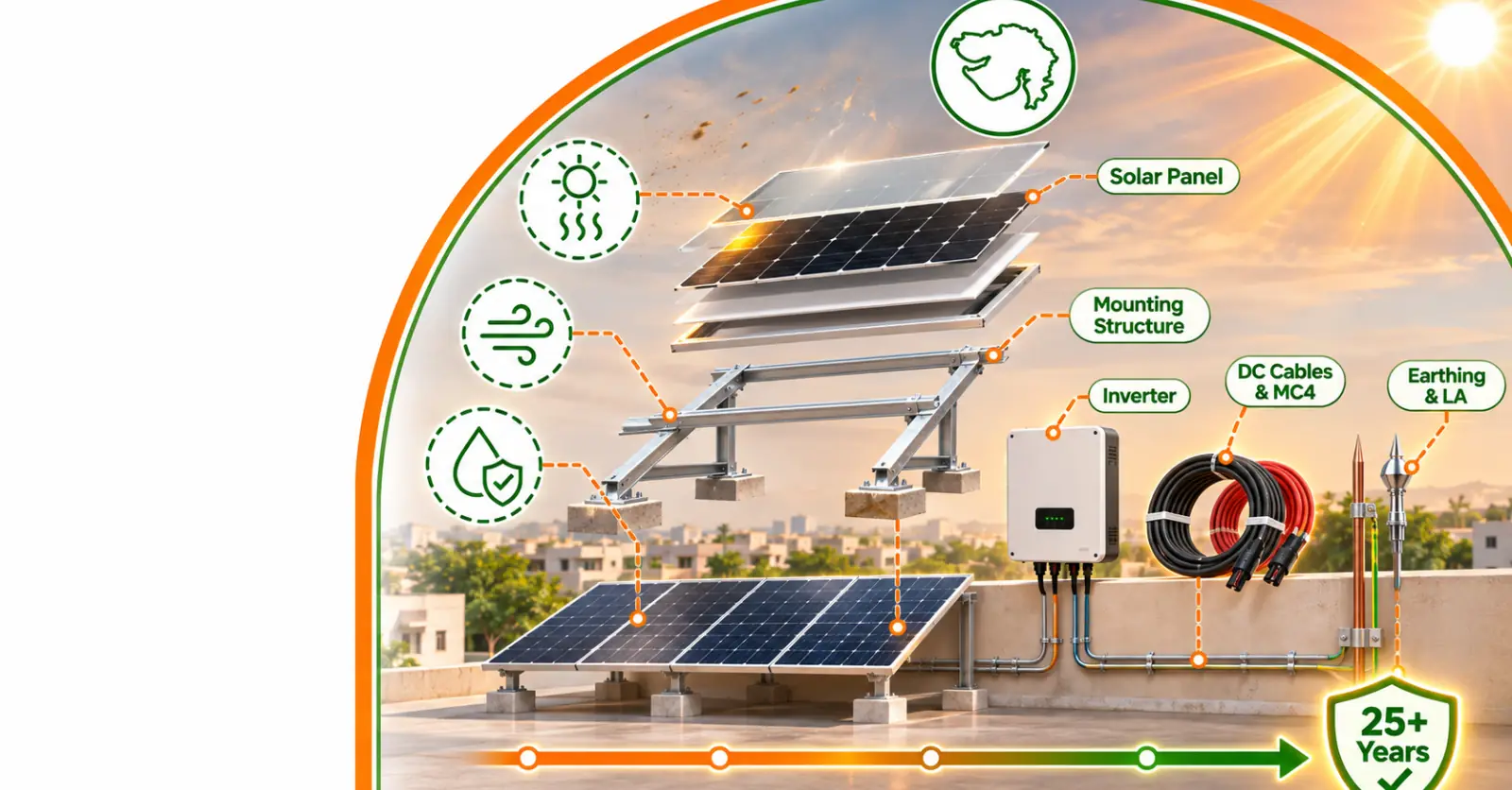
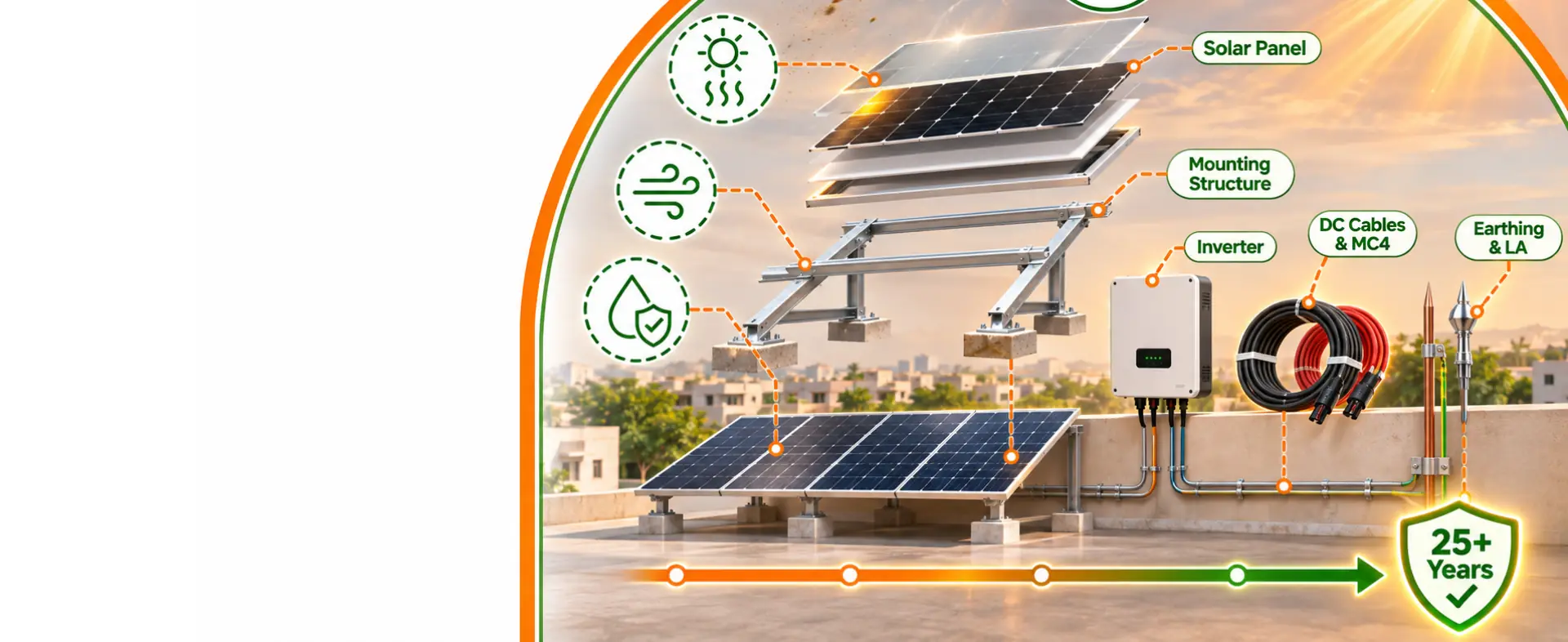
A 25-year solar panel warranty doesn't protect every component. See what Gujarat homeowners should check in panels, inverters, mounting, wiring and service.
Quick Summary: A 25-Year Solar Panel Warranty Doesn't Mean Every Component Will Last 25 Years
When homeowners invest in rooftop solar, they often hear one reassuring statement:
"Solar panels last 25 years or more."
That's encouraging, but there's an important detail.
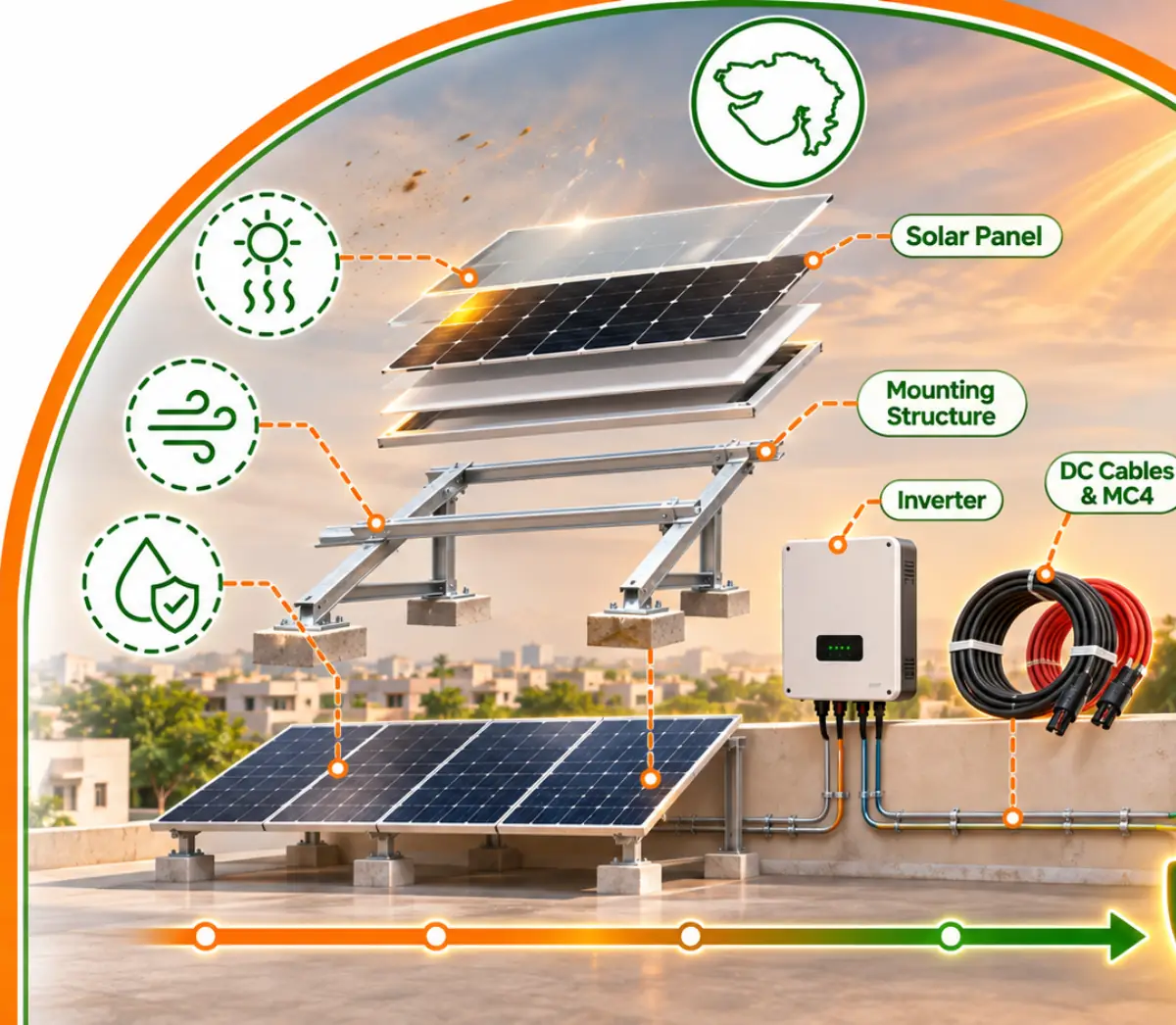
Your solar installation includes much more than panels. It also has an inverter, mounting structure, cables, connectors, earthing and electrical protection equipment.
These components don't necessarily have the same lifespan.
In Gujarat, where rooftop systems face intense summer heat, dust, monsoon rain and varying wind exposure, component quality and installation workmanship become especially important.
| Solar Component | What Matters for Durability | What to Check |
|---|---|---|
| Solar panels | Low degradation, weather resistance | Product and performance warranties |
| Solar inverter | Heat management, electrical reliability | Warranty, ventilation, service availability |
| Mounting structure | Corrosion resistance, structural strength | Material, coating, wind-load design |
| DC cables and connectors | UV and moisture resistance | Certification, compatibility, routing |
| Earthing and protection | Electrical safety | Proper design, testing and inspection |
| Monitoring system | Early fault detection | Alerts, data access and support |
The takeaway: For a solar system to remain useful for 25+ years, every component needs appropriate selection, installation and maintenance.
1. Why Gujarat's Climate Matters for Rooftop Solar
Imagine a homeowner in Ahmedabad installing a 3 kW rooftop solar system.
During the first year, everything works well.
The panels generate electricity, the inverter displays normal readings and the family starts seeing lower electricity purchases.
But what happens after ten summers and ten monsoons?
Will the panel mounting bolts remain secure?
Will the inverter continue operating reliably in a hot utility area?
Will cables and connectors withstand years of sunlight and weather exposure?
These are the questions that matter when evaluating a long-term solar investment.
Gujarat's conditions vary considerably by location.
Ahmedabad experiences very hot summers and seasonal dust. Coastal locations such as parts of Surat, Bharuch and Kutch can also expose outdoor equipment to more corrosive conditions, depending on proximity to the sea.
That doesn't mean solar is unsuitable for Gujarat.
It means the system should be engineered for the specific property rather than installed as a one-size-fits-all package.
2. Which Are the Best Solar Panels for Home Durability?
When comparing the best solar panels for home use, don't judge quality only by wattage.
A 600 W panel isn't automatically more durable than a 550 W panel.
Wattage tells you the panel's rated power under standard test conditions. Durability depends on additional factors.
Check the Panel's Degradation Rate
Solar panels gradually lose some generating capacity as they age.
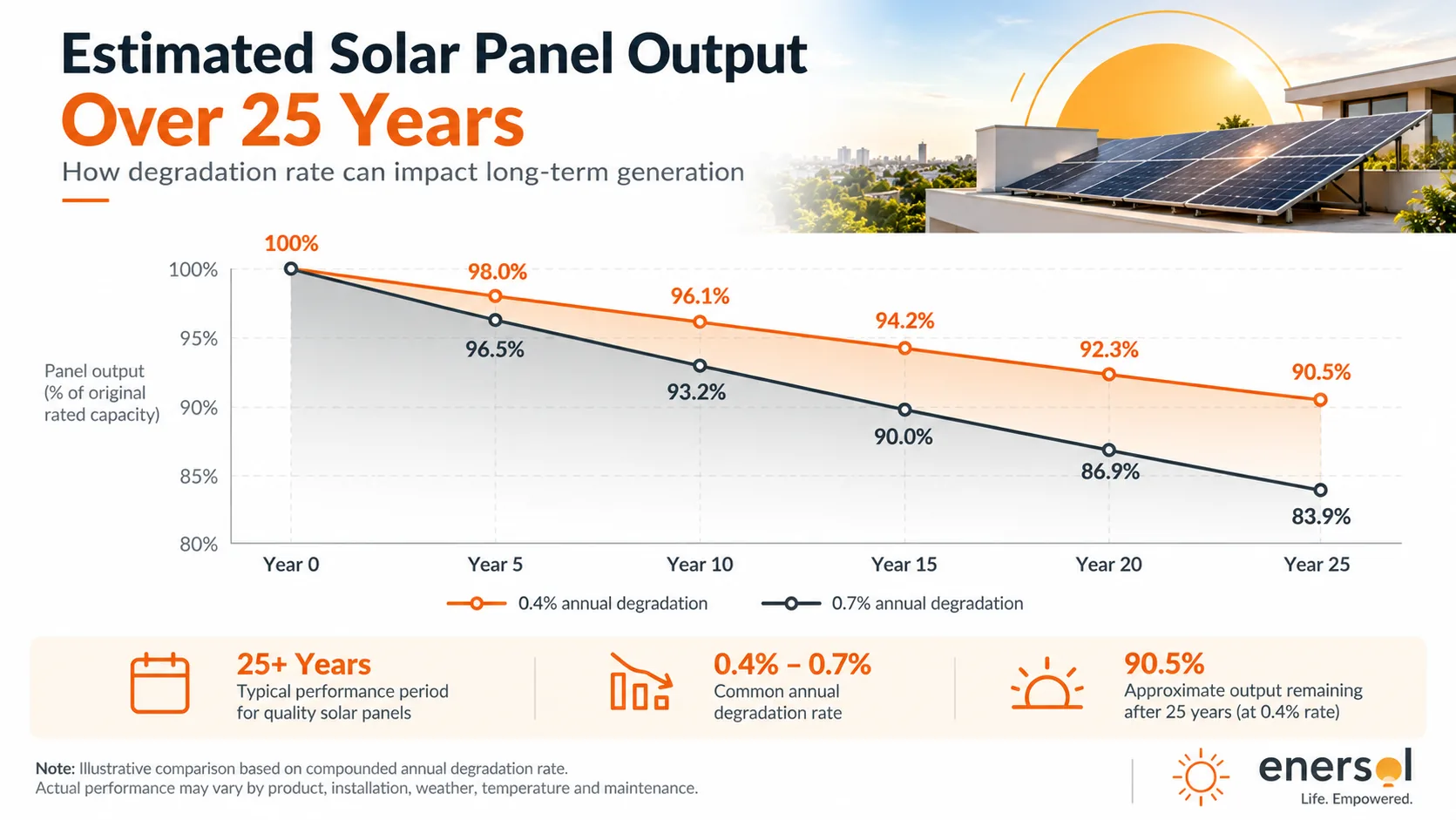
Research from the US National Renewable Energy Laboratory and related long-term studies has commonly found degradation rates around 0.5% per year, although actual performance varies by module design and operating conditions.
Consider two hypothetical solar panels.
Panel A degrades by 0.4% annually.
Panel B degrades by 0.7% annually.
Both start at 100% of their rated output.
After 25 years, assuming a constant compounded degradation rate, their remaining rated capacity would be approximately:
| Year | Panel A: 0.4% Annual Degradation | Panel B: 0.7% Annual Degradation |
|---|---|---|
| 1 | 99.6% | 99.3% |
| 5 | 98.0% | 96.5% |
| 10 | 96.1% | 93.2% |
| 15 | 94.2% | 90.0% |
| 20 | 92.3% | 86.9% |
| 25 | 90.5% | 83.9% |
Illustrative mathematical comparison, not the measured performance of any particular brand or a guarantee of future generation.
The difference becomes more meaningful over a long operating period.
However, the lowest advertised degradation figure shouldn't be your only selection criterion. Product reliability, testing, warranty terms and manufacturer support also matter.
Check Certification and Manufacturing Quality
Ask your installer for the module's exact manufacturer and model number.
Verify applicable BIS certification and any relevant ALMM and domestic-content requirements for your installation and subsidy scheme.
Also compare the module's temperature coefficient, mechanical-load rating and performance warranty.
In Gujarat's summer conditions, temperature performance deserves attention because solar panels generally produce less power as cell temperature rises.
Want Solar That Performs for 25+ Years?
Get a complete system proposal covering panels, inverter, structure, wiring and service.
3. What Does a 25-Year Solar Panel Warranty Actually Cover?
This is where many homeowners misunderstand solar warranties.
A panel can have more than one warranty.
Product Warranty
This covers specified defects in manufacturing, materials or workmanship.
The duration varies by manufacturer and model.
Performance Warranty
This promises that the panel will retain at least a specified level of rated power over time, subject to the manufacturer's testing conditions and exclusions.
For example, a 25-year performance warranty might guarantee a defined minimum percentage of the original rated output at year 25.
It does not mean the manufacturer guarantees identical electricity generation every year.
Installation or Workmanship Warranty
This is a separate commitment from the installer.
It can cover specified installation defects, subject to the contract.
Under PM Surya Ghar, eligible installations have defined vendor maintenance and workmanship obligations.
Before purchasing residential solar panels, ask for all warranty documents separately.
A long performance warranty is useful, but it doesn't replace a clear product warranty or a reliable local service arrangement.
4. How Long Does a Household Solar Inverter Last?
Solar panels produce direct-current electricity.
A solar inverter for home use converts that electricity into alternating current suitable for household loads and grid connection.
It is one of the most important electrical components in the system.
Unlike solar panels, inverters contain electronic components that are more sensitive to operating temperature and electrical stress.
An inverter may need repair or replacement during the lifetime of the solar panels.
Why Installation Location Matters
Consider two identical inverters.
One is installed in a shaded, ventilated area according to the manufacturer's instructions.
The other is exposed to direct afternoon sunlight in a poorly ventilated enclosure.
The second inverter may experience higher operating temperatures, which can affect reliability.
For Ahmedabad homes, inverter placement deserves particular attention during summer.
What Should You Compare?
| Inverter Feature | Why It Matters |
|---|---|
| Manufacturer warranty | Defines covered defects and duration |
| Temperature operating range | Helps assess suitability for site conditions |
| Cooling and ventilation | Supports reliable operation |
| Ingress protection rating | Indicates resistance to specified dust and water exposure |
| Monitoring and fault alerts | Helps identify problems earlier |
| Local service support | Matters if repair or replacement is needed |
A household solar inverter should be selected for system compatibility and reliability, not just its advertised conversion efficiency.
Ask the installer what replacement and service options would be available if the inverter fails after the initial warranty period.
5. Why Mounting Structures Deserve More Attention
The mounting structure holds your solar panels in position.
It may not be the most exciting part of a solar quotation, but it is essential to long-term safety.
A good structure should be designed for the roof, panel arrangement, local wind conditions and expected environmental exposure.
Aluminium or Galvanised Steel?
Both can be suitable when properly engineered.
| Material | Advantages | Important Considerations |
|---|---|---|
| Aluminium | Lightweight and naturally corrosion-resistant | Requires appropriate structural design and compatible fasteners |
| Hot-dip galvanised steel | Strong and widely used for solar structures | Coating quality and corrosion protection matter |
| Stainless-steel fasteners | Can provide strong corrosion resistance | Grade selection and compatibility with surrounding metals matter |
For coastal installations, corrosion exposure may require additional attention to material grades, protective coatings and fastener selection.
The mounting structure must also be designed for wind loads in accordance with applicable engineering standards.
Ask your installer: What material and coating are specified, and how has the structure been designed for my roof?
6. Cables, Connectors and Electrical Protection: The Small Components That Matter
A solar system can use excellent panels and a reliable inverter but still develop problems if the electrical installation is poor.
Cables exposed to sunlight need suitable UV resistance.
Connectors must be compatible and correctly installed.
Electrical protection devices need to be selected for the system's voltage, current and installation conditions.
Earthing and lightning protection should be designed and installed according to applicable requirements.
Avoid choosing a quotation that leaves these items unspecified.
They may represent a smaller share of the total cost, but they contribute directly to safety and reliability.
For a long-term installation, insist on proper cable routing, mechanical protection, identification labels and commissioning tests.
7. Ahmedabad Example: Why the Cheapest Solar Quotation Isn't Always the Best
Consider a hypothetical homeowner in Thaltej, Ahmedabad.
They receive two quotations for a 3 kW rooftop solar system.
The first quotation is ₹1.55 lakh.
The second is ₹1.75 lakh.
Both use panels with 25-year performance warranties.
At first glance, the first option seems better.
But the homeowner compares the full technical specifications.
The second proposal provides a detailed mounting-structure specification, inverter warranty, electrical protection schedule, cable-routing plan and written maintenance responsibilities.
The first proposal leaves several of these details unclear.
Does that automatically make the second system better?
No.
The homeowner should ask the first installer to clarify its scope and then compare both quotations on equal terms.
The real value lies in knowing what you're buying.
A ₹20,000 difference in initial cost may matter less over 25 years if one installation avoids repeated repair costs or prolonged downtime.
But that benefit must be supported by actual equipment specifications and service commitments not sales promises.
8. Solar Panel With 25-Year Warranty Price in Gujarat: What Should You Compare?
When searching for a solar panel with a 25 year warranty price Gujarat, it's important to distinguish between the price of individual panels and the price of a complete rooftop solar system.
A panel price does not include the inverter, mounting structure, wiring, protection equipment, installation labour or approvals.
For example, two complete 3 kW systems may use panels with similar performance warranties but have different total costs because of their inverter selection, mounting design and service scope.
Instead of relying on a generic price per panel, request an itemised quotation.
| Cost Component | What to Verify |
|---|---|
| Solar modules | Brand, model, capacity, product warranty, performance warranty |
| Inverter | Brand, model, rating, warranty |
| Mounting structure | Material, coating, engineering and roof fixing |
| Electrical installation | Cable specifications, connectors, earthing and protection |
| Installation | Labour, testing, commissioning and roof work |
| Documentation | Subsidy and DISCOM approval assistance |
| Service | Maintenance scope, exclusions and response process |
For home solar installation in Gujarat, an accurate quotation should follow a roof survey and electricity-consumption review.
9. Maintenance Checklist for Long-Term Solar Performance
Solar systems generally require less routine maintenance than many mechanical systems, but they should not be ignored.
Here's a practical schedule to discuss with your installer.
| When | What to Check |
|---|---|
| Regularly | Review generation monitoring and fault alerts |
| As needed | Clean panels safely when dust or deposits affect performance |
| Before monsoon | Arrange checks of drainage, exposed cables and mounting condition |
| After severe weather | Request inspection if damage or abnormal operation is suspected |
| Annually | Professional electrical and mechanical inspection |
| When output falls unexpectedly | Compare generation against expected seasonal performance |
This is an illustrative maintenance checklist. Follow the manufacturer's instructions and your installer's documented maintenance plan.
Do not open inverter enclosures, disconnect DC connectors or attempt rooftop electrical repairs yourself.
Use qualified technicians for electrical testing and repairs.
11. Final Recommendation: Invest in a Complete Solar System, Not Just Long-Warranty Panels
A 25-year performance warranty is an important part of a solar investment.
But the long-term reliability of your rooftop system also depends on the inverter, mounting structure, cables, electrical protection and installation workmanship.
For Gujarat homeowners, climate suitability and dependable local service deserve particular attention.
At Enersol Solutions, residential solar planning includes system design, installation, approval assistance and after-sales support.
Before choosing a solar system, ask for a complete equipment list, written warranty terms, site-specific design and maintenance plan.
Planning rooftop solar in Ahmedabad or elsewhere in Gujarat?
Get your roof and electricity consumption assessed before comparing quotations.
Residential Solar: https://www.enersol.co.in/solutions/rooftop-solar/residential-solar