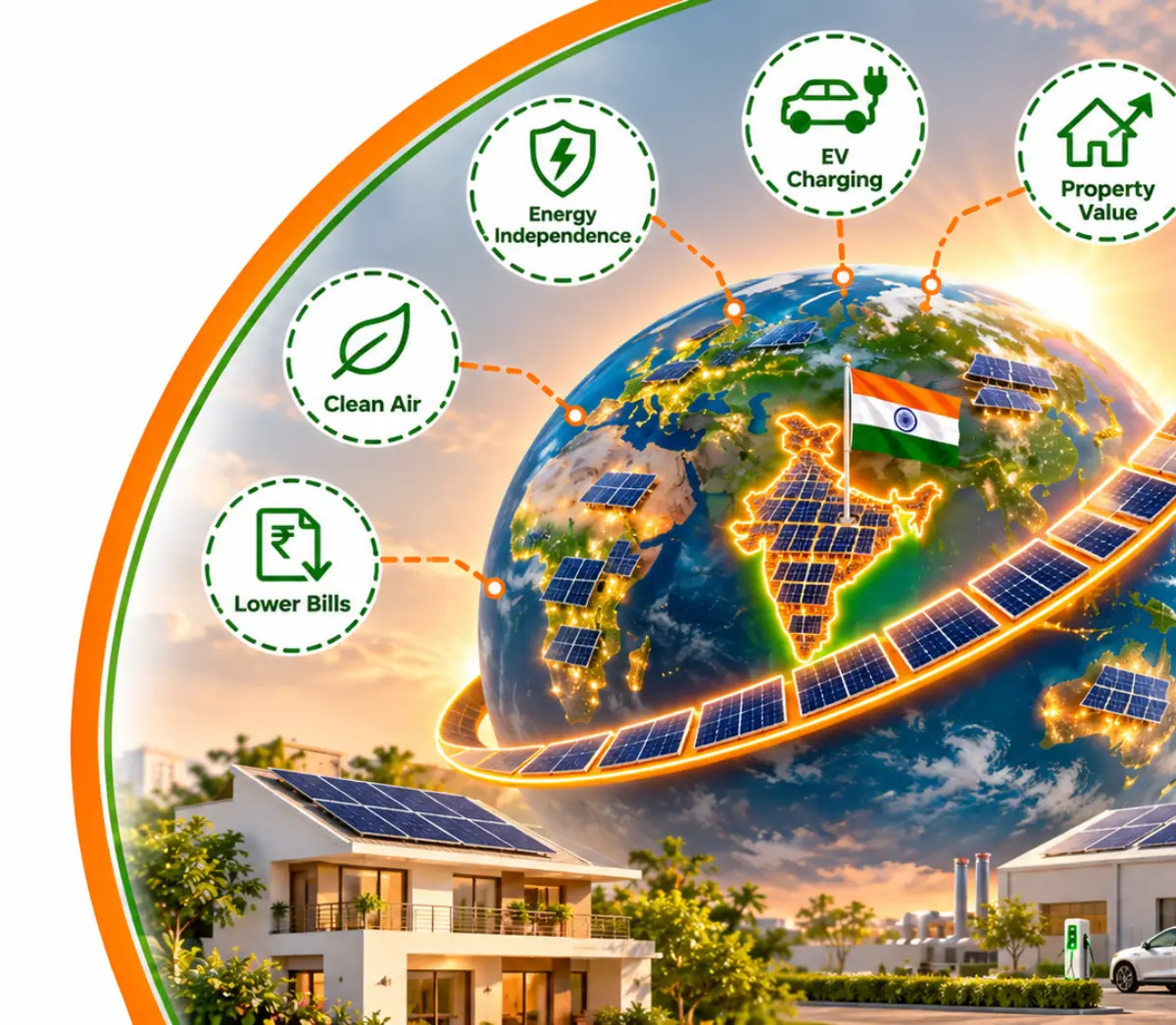
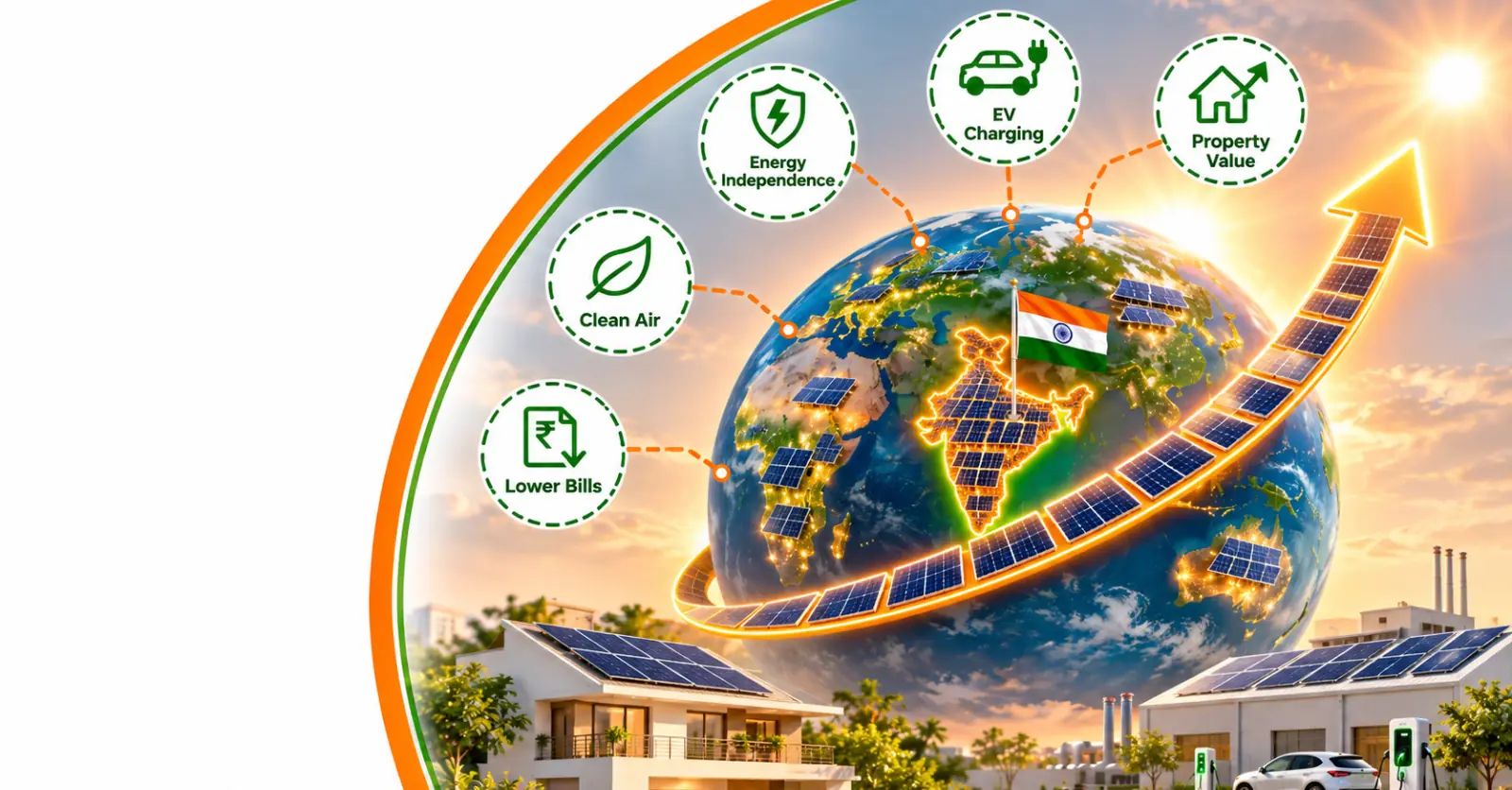

India's solar capacity has crossed 164 GW. Here's why homeowners and businesses are choosing solar for more than lower bills and what 29% efficiency could change.
Quick Summary: Solar Is Becoming More Than a Way to Save Electricity
A few years ago, most homeowners considered solar panels for one reason: reducing electricity bills.
That reason still matters. But the solar industry is changing.
India is building more solar power plants, manufacturers are investing in advanced panels, and homeowners are beginning to see rooftop solar as a long-term energy investment.
India's installed solar capacity reached 164.59 GW by July 31, 2026, compared with just 2.8 GW in 2014, according to the Government of India.
Globally, the International Energy Agency expects solar PV to account for nearly 80% of renewable electricity capacity expansion between 2025 and 2030.
So what's driving this growth?
| Reason Behind Solar Demand | Why It Matters |
|---|---|
| Rising electricity consumption | Homes and businesses need more power |
| Energy security | Countries want more diverse domestic energy sources |
| Better solar technology | More electricity can be generated from limited space |
| Government support | Subsidies can reduce eligible homeowners' initial costs |
| Industrial competitiveness | Businesses want greater control over energy expenses |
| Environmental concerns | Solar reduces reliance on fossil-fuel electricity |
Solar is no longer only about today's electricity bill. It is increasingly about how electricity will be produced and managed over the coming decades.
1. Why Is Solar Panel Demand Increasing So Quickly in India?
Think about how electricity consumption has changed in an average Indian home.
Ten years ago, a family might have used one air conditioner, a refrigerator, fans and a television.
Today, the same home may have multiple air conditioners, larger appliances, work-from-home equipment and plans for an electric vehicle.
As lifestyles change, electricity demand grows.
For homeowners, solar offers an opportunity to generate part of that electricity on their own rooftops.
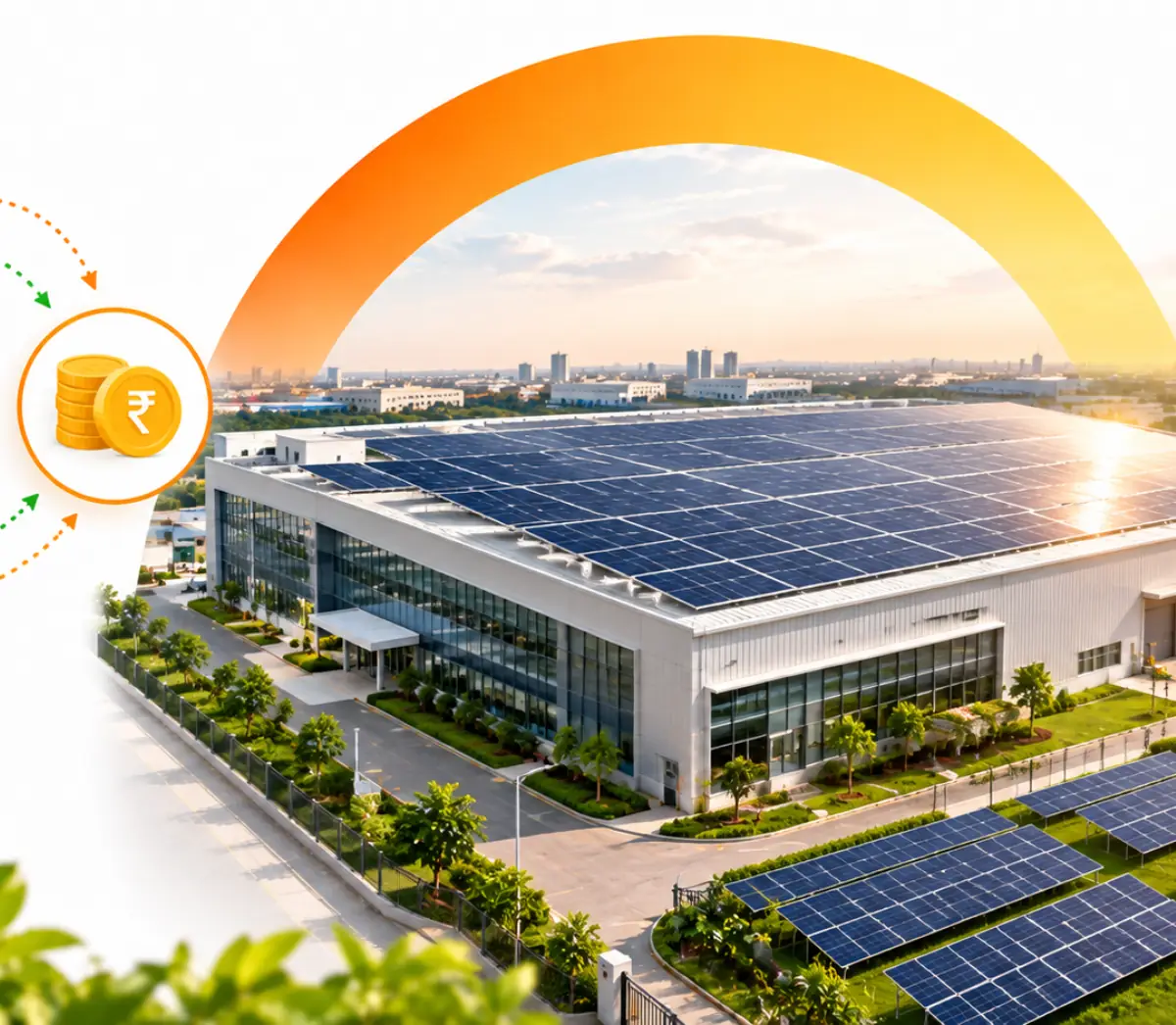
For businesses, it can help reduce dependence on purchased electricity during solar-generation hours.
But there's a larger national reason.
India needs substantial new electricity generation capacity to support economic growth. Expanding domestic solar generation helps diversify the country's energy supply.
According to the Government of India, solar capacity increased from 2.8 GW in 2014 to 164.59 GW by July 2026.
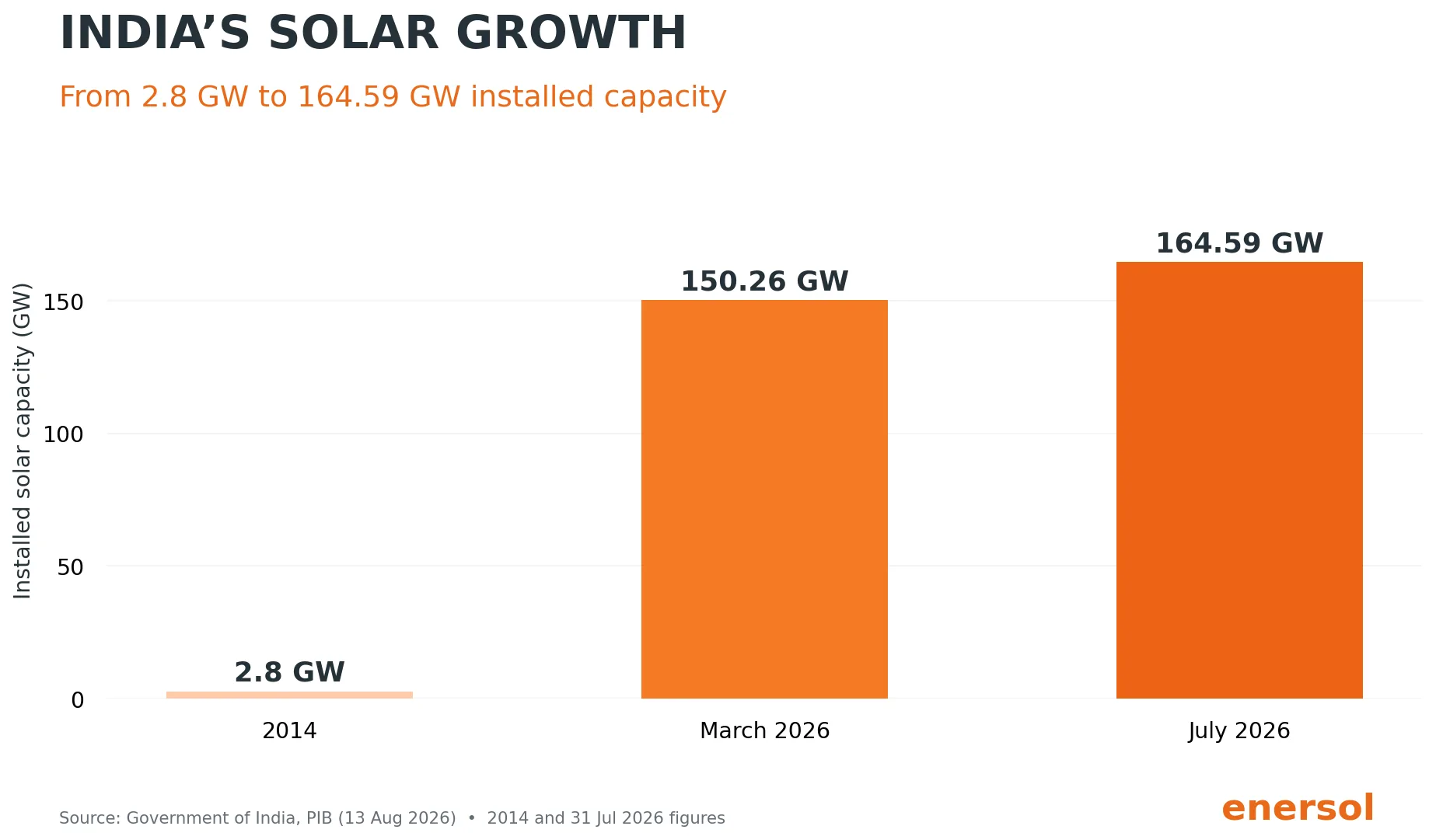
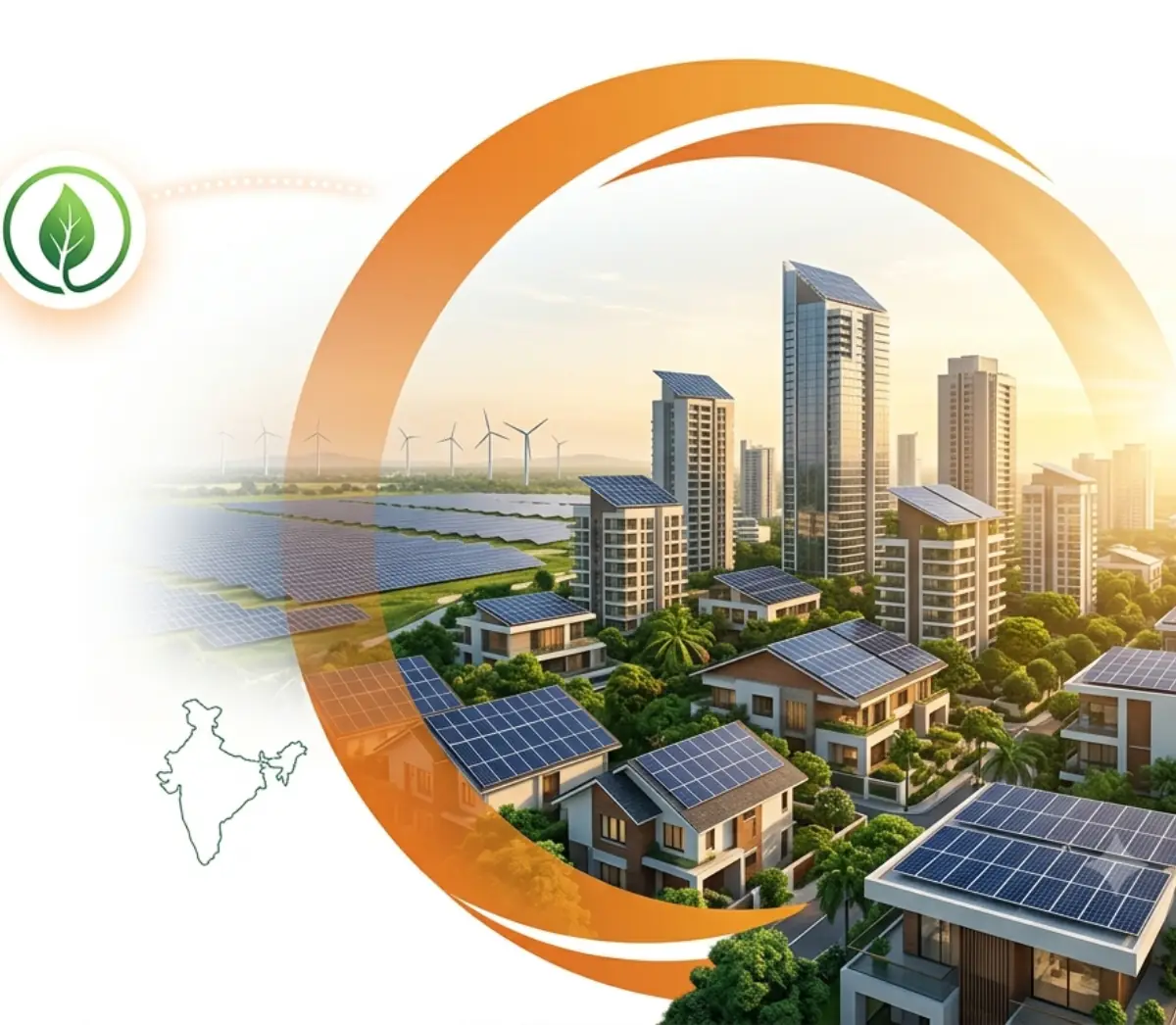
This is not just an increase in the number of rooftop panels. It includes utility-scale solar farms, industrial projects, distributed solar installations and residential systems.
2. Solar Demand Is Rising Worldwide, Not Just in India
India is part of a much larger shift.
The International Energy Agency's Renewables 2025 report projects that global renewable power capacity will increase by approximately 4,600 GW between 2025 and 2030.
Solar photovoltaic systems are expected to account for nearly 80% of that expansion.
Why is solar attracting so much investment?
One reason is that solar projects can be developed at different scales.
A homeowner can install a few kilowatts on a terrace.
A factory can install hundreds of kilowatts or several megawatts.
A utility company can develop a large solar farm supplying electricity to the grid.
This flexibility makes photovoltaic solar energy useful for different electricity requirements.
However, solar growth also creates challenges. Electricity networks need to manage changing generation throughout the day, and energy storage and grid upgrades are becoming increasingly important.
Solar panels alone cannot solve every electricity problem, but they are becoming a major part of the solution.
Thinking About Rooftop Solar Now?
Get a site-specific assessment based on the technology available today.
3. Why Homeowners Want Solar Energy for More Than Lower Bills
Consider a hypothetical family living in Shela, Ahmedabad.
Their electricity bills increase during summer because of regular air-conditioner usage.
Initially, they considered installing solar electricity for home use to reduce monthly expenses.
But while planning, they discover other reasons to consider rooftop solar.
Better Planning for Future Electricity Needs
The family expects to buy an electric vehicle within a few years.
That could increase household electricity consumption.
A solar installation designed around present and reasonable future demand may help manage part of that additional usage.
Using Existing Rooftop Space
A terrace is already part of the property.
If it is structurally suitable, receives sufficient sunlight and has enough usable space, it can support electricity generation without requiring a separate plot of land.
Reducing Fossil-Fuel Electricity Dependence
Solar generates electricity without burning fuel at the point of generation.
Although manufacturing and installing panels have environmental impacts, solar electricity generally has much lower lifecycle greenhouse-gas emissions than fossil-fuel generation.
Greater Awareness of Electricity Consumption
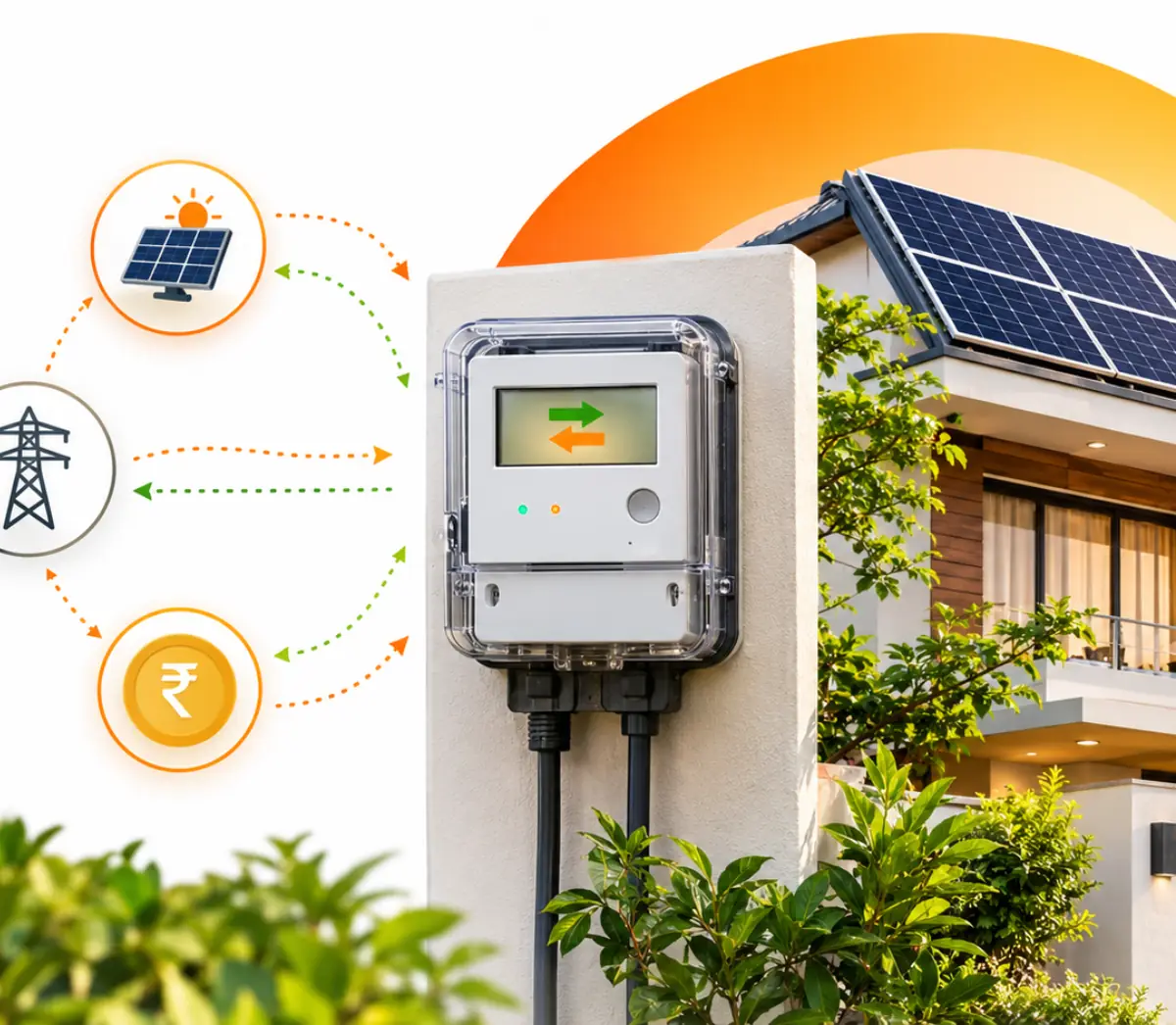
Solar monitoring systems can show how much electricity a rooftop plant produces.
When combined with electricity bills and consumption information, this helps homeowners understand when electricity is generated and how their usage changes over time.
One important clarification: a conventional on-grid solar system does not provide backup electricity during a grid outage. That requires a suitable hybrid or battery-backed arrangement.
4. The Latest Technology in Solar Panels Is Changing What's Possible
Solar technology is improving in ways that matter to ordinary homeowners.
A solar panel converts sunlight into electricity through photovoltaic cells.
Panel efficiency describes how much incoming sunlight is converted into electrical power under standard test conditions.
For example, consider two panels of the same physical area receiving identical sunlight.
One has 20% efficiency.
The other has 25% efficiency.
Under the same test conditions, the second panel can produce approximately 25% more rated power from that area.
This is particularly relevant for homes with limited rooftop space.
What Is Changing in Solar Technology?
| Technology | What It Does | Why Homeowners Should Care |
|---|---|---|
| Mono PERC | Improves conventional crystalline-silicon cell performance | Established technology used in many installations |
| N-type TOPCon | Uses advanced cell passivation to reduce electrical losses | Can offer higher efficiency and improved performance characteristics |
| Heterojunction (HJT) | Combines crystalline silicon with thin semiconductor layers | Offers another high-efficiency module option |
| Perovskite-silicon tandem | Uses complementary light-absorbing layers | Could deliver higher efficiency from similar panel area |
| Solar monitoring | Tracks generation and system performance | Helps identify unusual drops in output |
These technologies differ in commercial maturity, cost, warranty support and field experience.
The newest option is not automatically the best choice for every home.
5. The 29% Efficiency Target: Why the INA Solar–Caelux Partnership Matters
On October 26, 2026, pv magazine India reported a partnership between Indian manufacturer INA Solar and US-based Caelux.
The companies announced a five-year collaboration aimed at commercialising 3 GW of hybrid-tandem solar modules.
Their stated goal is to reach module efficiencies of up to 29% by 2028.
The technology combines INA Solar's n-type TOPCon platform with Caelux's perovskite-based energy-producing glass.
Why Is This Interesting?
Traditional silicon solar cells cannot convert every part of the sunlight spectrum into electricity equally efficiently.
Tandem technology uses different light-absorbing materials together, potentially capturing more energy from incoming sunlight.
For a homeowner, higher efficiency could eventually mean more installed capacity within the same usable rooftop area.
A Simple Rooftop Example
Suppose two future solar module designs have the same total area and receive identical sunlight.
One operates at 22% module efficiency.
The other operates at 29%.
Under standard test conditions, the second design could offer approximately 32% more rated power from that area.
That is a comparison of efficiency, not a guarantee of 32% higher annual electricity generation.
Actual output also depends on temperature, shading, inverter losses, module degradation and installation design.
Important: The 29% figure is a future commercialisation target. It should not be presented as the efficiency of a currently available Enersol residential panel.
Before such technology becomes a mainstream rooftop option, manufacturers must demonstrate reliability, durability, certification and commercially competitive pricing.
6. Why Gujarat and Ahmedabad Are Important to India's Solar Growth
Gujarat has a strong industrial base, substantial solar development activity and growing interest in distributed renewable energy.
For Ahmedabad homeowners, the decision is increasingly practical.
A family in Satellite may want solar to reduce electricity purchases.
A bungalow owner in South Bopal may want to use available rooftop space.
A business owner in Sanand may evaluate solar as part of a wider electricity cost strategy.
These are different applications, but they share the same basic requirement: the solar system must match actual electricity consumption and site conditions.
When comparing solar energy companies in Ahmedabad, homeowners should ask for a rooftop survey, realistic generation estimate, equipment specifications and written after-sales commitments.
Gujarat's solar potential does not mean every rooftop will perform identically. Shade, orientation, dust, temperature and mounting design still matter.
7. Should You Buy Rooftop Solar Panels for Home Now or Wait for Better Technology?
This is a reasonable question, especially when new solar efficiency records appear in the news.
Technology will continue improving.
But waiting for the next generation of panels also means postponing the electricity generation and potential savings available from a suitable system today.
Consider two situations.
Homeowner A: Has a suitable, unshaded rooftop, consistent electricity consumption and an affordable installation proposal.
For this household, an established, properly designed solar system may already make financial sense.
Homeowner B: Has a roof that needs structural repairs or expects major changes in electricity demand.
For this household, addressing those issues before installation may be more important than choosing the newest panel technology.
The decision should depend on current system economics, available equipment, roof readiness and future electricity requirements.
Don't buy solar simply because a new technology sounds exciting.
And don't delay a suitable installation indefinitely because a more efficient panel may arrive later.
8. What to Check Before Buying Solar Panels for Your Home
Before choosing a home solar system, compare the following:
| Check | Why It Matters |
|---|---|
| Last 12 months of electricity bills | Helps estimate annual consumption |
| Roof strength and usable area | Determines safe installation possibilities |
| Shading and panel orientation | Influences electricity generation |
| Module technology and warranty | Affects equipment selection and long-term expectations |
| Inverter and electrical safety | Supports reliable, safe operation |
| Subsidy eligibility | Affects the effective investment |
| Monitoring and maintenance | Helps track and protect system performance |
A good solar proposal should explain the expected annual generation, not just the number of panels being installed.
For Ahmedabad homeowners, Enersol Solutions offers residential rooftop solar services covering system design, installation, approval assistance and after-sales support.
10. Final Takeaway: Solar Demand Is Growing Because Its Role Is Growing
Solar started as a practical way for many households to reduce electricity expenses.
Today, it is also part of a much bigger conversation about energy security, manufacturing, technology and long-term electricity planning.
India's growing solar capacity shows how quickly the sector is expanding.
Partnerships such as INA Solar and Caelux show where future technology could take it.
But for homeowners, the most important question remains simple:
Will this solar system work well for my home, my electricity usage and my budget?
At Enersol Solutions, the focus is on helping homeowners make that decision through appropriate system design, quality installation and ongoing support.
Planning rooftop solar in Ahmedabad or elsewhere in Gujarat?
Start with your electricity bills, assess your rooftop and compare realistic generation estimates before investing.
Residential Solar: https://www.enersol.co.in/solutions/rooftop-solar/residential-solar